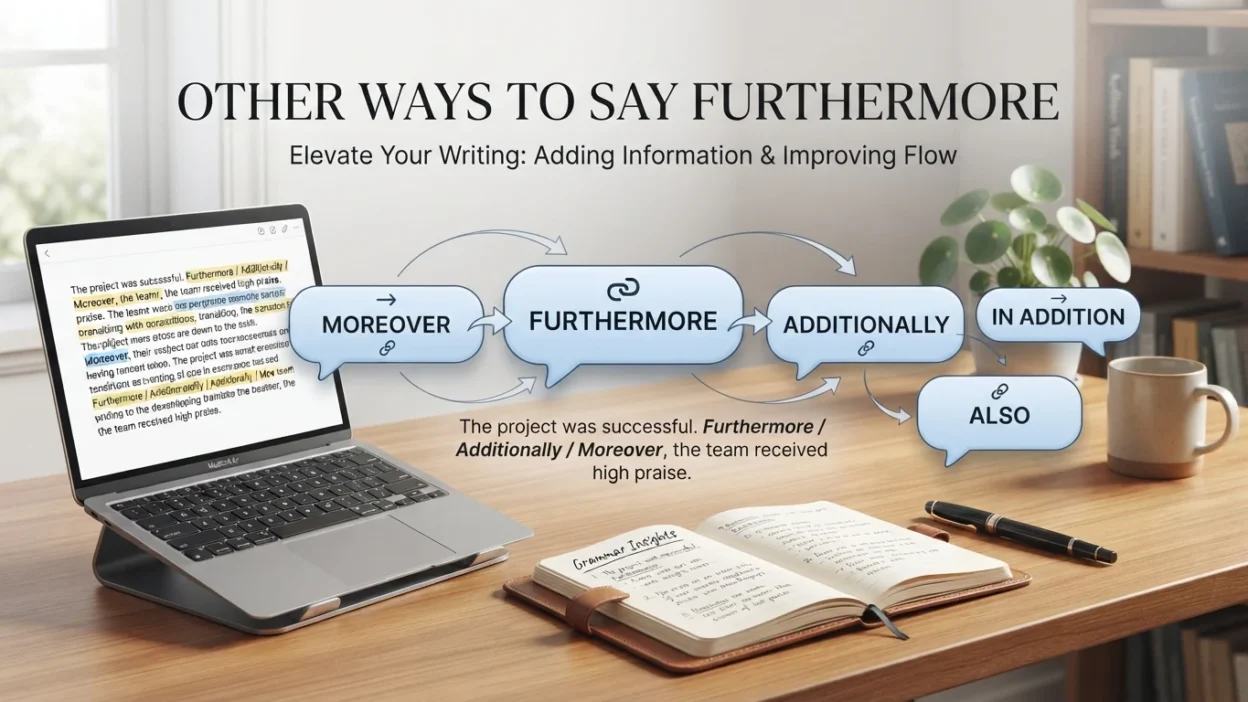
Learning other ways to say furthermore helps make formal writing more natural, while alternatives let you adapt your tone for many situations. Whether you are writing a business email, preparing a report, or sharing a thoughtful message with a friend, selecting the right transition can make your communication warmer, clearer, and more engaging. Moreover can bring confidence and structure to a professional report, while Also can make a casual message feel friendly and approachable. Good clarity comes from varying your transitions instead of repeating the same phrase. In my experience, readers respond better when ideas flow smoothly and the language feels human, rather than mechanical or distant. Using multiple alternatives helps maintain the logical flow of your ideas while keeping your tone flexible and expressive, making your writing more persuasive and enjoyable to read. This helps readers connect with your messages and strengthens your arguments by showing thoughtfulness and care for the reader’s experience. When adding information, explaining a point, or connecting related ideas, choosing varied transitions keeps your message confident without becoming repetitive.
Quick Answer
Common alternatives to “furthermore” include moreover, additionally, in addition, also, besides, what’s more, as well as, and on top of that. Choose the phrase based on your sentence structure, level of formality, and relationship between ideas.
Formal and Professional Alternatives
1. Moreover
Definition: “Moreover” adds another important point that supports or develops the previous idea.
Usage rule: Place it at the beginning of a sentence or clause, usually followed by a comma.
Practical examples: The proposal is affordable. Moreover, it can be implemented quickly.
Tips: Use “moreover” in professional reports, academic writing, and formal presentations.
2. Additionally
Definition: “Additionally” introduces extra information related to the previous statement.
Usage rule: It commonly appears at the beginning of a sentence followed by a comma.
Practical examples: Additionally, the company offers free training to new employees.
Tips: This is a clear and professional replacement for “furthermore.”
3. In Addition
Definition: “In addition” means that another fact or point should be added.
Usage rule: Use it at the beginning or middle of a sentence, depending on the structure.
Practical examples: In addition, the course includes practical exercises.
Tips: It is useful in reports, essays, emails, and presentations.
4. Furthermore
Definition: “Furthermore” adds another supporting point, usually in formal writing.
Usage rule: Use it to connect an additional idea with information already presented.
Practical examples: The software is easy to use. Furthermore, it requires little maintenance.
Tips: Keep it when a formal tone is appropriate, but vary transitions when possible.
5. In Addition To This
Definition: “In addition to this” adds information while directly referring to a previously mentioned point.
Usage rule: Use it when “this” clearly refers to the preceding idea or situation.
Practical examples: The service is affordable. In addition to this, customers receive technical support.
Tips: Avoid overusing it when a shorter transition would work.
6. Not Only That
Definition: “Not only that” adds another point, often one that makes the previous statement stronger.
Usage rule: Use it as a transition before an additional statement.
Practical examples: The hotel is affordable. Not only that, it is close to the city center.
Tips: This phrase works well in persuasive and conversational writing.
7. Beyond That
Definition: “Beyond that” introduces information that goes further than the point already discussed.
Usage rule: Use it when adding a related idea or consideration.
Practical examples: The course teaches grammar. Beyond that, it helps students improve confidence.
Tips: It sounds natural in professional explanations and discussions.
Academic and Essay Writing Alternatives
8. In Addition
Definition: “In addition” adds another supporting idea to an argument.
Usage rule: Use it before a new sentence or clause when the added point is connected.
Practical examples: In addition, the research provides useful information about consumer behavior.
Tips: It is one of the safest choices for essays and academic assignments.
9. Moreover
Definition: “Moreover” introduces another point that gives additional support to an argument.
Usage rule: Place it before the additional statement, generally with a comma.
Practical examples: Moreover, the findings support the original hypothesis.
Tips: Use it when the second point is important rather than merely extra.
10. Additionally
Definition: “Additionally” provides another fact, reason, or supporting detail.
Usage rule: Usually place it at the beginning of a sentence.
Practical examples: Additionally, the study examined several different age groups.
Tips: It works well when you need a neutral academic transition.
11. What’s More
Definition: “What’s more” adds information that further supports or strengthens a statement.
Usage rule: Use it to introduce an additional point, usually at the start of a sentence.
Practical examples: The method is simple. What’s more, it is inexpensive.
Tips: It is slightly less formal than “moreover.”
12. Equally Important
Definition: “Equally important” signals that the next point deserves similar attention.
Usage rule: Use it before presenting another significant idea.
Practical examples: The results are accurate. Equally important, they can be reproduced by other researchers.
Tips: Use this phrase when you want to emphasize the importance of the added point.
13. Another Point Is
Definition: “Another point is” introduces an additional argument, fact, or consideration.
Usage rule: Use it when moving to another clearly defined idea.
Practical examples: Another point is that the policy could reduce unnecessary costs.
Tips: This phrase is straightforward and easy to understand.
14. Along With This
Definition: “Along with this” adds information connected to something already discussed.
Usage rule: Use it when the new point is closely related to the previous information.
Practical examples: Along with this, the program provides regular progress reports.
Tips: Use it naturally rather than forcing it into highly formal academic sentences.
Business and Workplace Alternatives
15. Also
Definition: “Also” adds another fact, action, or piece of information.
Usage rule: It can appear before the main verb or at the beginning of a sentence.
Practical examples: The team completed the report and also prepared the presentation.
Tips: “Also” is simple, natural, and suitable for many workplace messages.
16. Besides
Definition: “Besides” introduces an additional reason, fact, or consideration.
Usage rule: Use it to add another point that supports or expands the discussion.
Practical examples: Besides saving time, the new system reduces errors.
Tips: It can sound conversational, so consider “in addition” for highly formal writing.
17. As Well
Definition: “As well” adds another related item or fact.
Usage rule: It is commonly placed at the end of a sentence.
Practical examples: The manager reviewed the report and checked the budget as well.
Tips: It sounds natural in the workplace and everyday communication.
18. As Well As
Definition: “As well as” connects two related things or actions.
Usage rule: Follow it with a noun, pronoun, gerund, or matching grammatical structure.
Practical examples: The course covers grammar as well as professional vocabulary.
Tips: Keep the grammatical structures on both sides balanced.
19. Alongside This
Definition: “Alongside this” introduces an additional idea that exists together with the previous one.
Usage rule: Use it as a transition when two related aspects should be considered together.
Practical examples: Alongside this, the company introduced a new training program.
Tips: It works particularly well in professional and analytical writing.
20. On Top of This
Definition: “On top of this” adds another point, often emphasizing that the new information is significant.
Usage rule: Use it before an additional statement or consideration.
Practical examples: The project is already behind schedule. On top of this, the budget has been reduced.
Tips: It is more conversational than “furthermore” and works well when emphasizing an added difficulty.
21. In the Same Way
Definition: “In the same way” connects an additional idea that follows a similar pattern or principle.
Usage rule: Use it when the next point relates closely to the previous idea.
Practical examples: The first method saves time. In the same way, the second method reduces costs.
Tips: Use it for connected ideas rather than simple addition.
Conversational and Natural Alternatives
22. What’s More
Definition: “What’s more” introduces another interesting or useful point.
Usage rule: Place it before the additional statement, usually at the beginning of a sentence.
Practical examples: The restaurant is affordable. What’s more, the food is excellent.
Tips: It sounds friendly and natural in everyday communication.
23. Plus
Definition: “Plus” adds another reason, benefit, or fact.
Usage rule: Use it mainly in casual speech and informal writing.
Practical examples: The apartment is affordable. Plus, it is close to public transportation.
Tips: Avoid “plus” in highly formal reports unless the style allows conversational language.
24. On Top of That
Definition: “On top of that” adds another point, often with emphasis.
Usage rule: Use it to introduce additional information after making a previous statement.
Practical examples: The trip was long. On top of that, we had to wait for the train.
Tips: It is useful for casual storytelling and everyday conversation.
25. Another Thing
Definition: “Another thing” introduces an additional thought or consideration.
Usage rule: Use it when moving naturally from one point to another.
Practical examples: Another thing to consider is the cost of maintenance.
Tips: It is simple and conversational but less formal than “moreover.”
26. And
Definition: “And” is the simplest way to connect an additional idea or piece of information.
Usage rule: Use “and” to join words, phrases, or clauses that are logically connected.
Practical examples: The course is affordable, and it is easy to follow.
Tips: Although simple, “and” can make writing feel direct and natural.
27. Plus, There’s More
Definition: “Plus, there’s more” signals that additional information is coming.
Usage rule: Use it mainly in casual or promotional communication.
Practical examples: The membership includes free lessons. Plus, there’s more: members receive monthly resources.
Tips: Keep this expression away from highly formal academic writing.
28. Not to Mention
Definition: “Not to mention” adds another relevant point that the writer believes is worth considering.
Usage rule: It is often followed by a noun phrase or another supporting detail.
Practical examples: The course is affordable, not to mention highly practical.
Tips: Use it when the additional point is an especially noticeable benefit or detail.
Persuasive and Emphatic Alternatives
29. More Importantly
Definition: “More importantly” introduces a point that the writer considers especially significant.
Usage rule: Use it before a statement that deserves greater emphasis.
Practical examples: The plan is affordable. More importantly, it is sustainable.
Tips: Use it when the next idea has greater importance than the previous one.
30. More Significantly
Definition: “More significantly” highlights an additional point with greater significance.
Usage rule: Place it before a statement that deserves stronger emphasis.
Practical examples: The change reduced costs. More significantly, it improved customer satisfaction.
Tips: This phrase is suitable for analytical and professional writing.
31. Of Equal Importance
Definition: “Of equal importance” introduces a point that deserves the same level of attention as the previous one.
Usage rule: Use it when emphasizing two ideas as similarly important.
Practical examples: The project must stay within budget. Of equal importance, it must meet quality standards.
Tips: This phrase is formal and useful in reports and structured arguments.
32. Furthermore, It Is Worth Noting
Definition: This expression adds a point while drawing attention to information that deserves consideration.
Usage rule: Use it before a relevant fact or observation.
Practical examples: Furthermore, it is worth noting that the results were consistent across all groups.
Tips: Use it selectively because it can sound repetitive if overused.
33. It Is Also Important to Note
Definition: This phrase introduces additional information that the writer considers important.
Usage rule: Use it before a fact, observation, or supporting argument.
Practical examples: It is also important to note that the process requires regular review.
Tips: It works well in reports, research writing, and detailed explanations.
34. In Addition to This
Definition: “In addition to this” adds another related point while referring back to the previous information.
Usage rule: Use it when the preceding idea is clearly understood.
Practical examples: The service is fast. In addition to this, it offers flexible payment options.
Tips: Use a shorter transition when the reference to “this” is unnecessary.
35. More Than That
Definition: “More than that” suggests that the situation involves something beyond the point already mentioned.
Usage rule: Use it when emphasizing that an additional idea goes beyond the previous statement.
Practical examples: The course improves vocabulary. More than that, it helps learners communicate with confidence.
Tips: This phrase is natural in explanatory and persuasive writing.
Placement & Grammar Rules Table
| Synonym or phrase | Sentence position / placement | Tone / formality | Example sentence |
| Moreover | Beginning or middle | Formal | Moreover, the results were consistent. |
| Additionally | Usually beginning | Formal/neutral | Additionally, the team reviewed the data. |
| In addition | Beginning or middle | Formal/neutral | In addition, the course includes exercises. |
| Also | Before main verb or beginning | Neutral/casual | She also completed the report. |
| Besides | Beginning or middle | Neutral/casual | Besides saving time, it reduces costs. |
| As well | Usually end | Neutral | The manager attended as well. |
| As well as | Within a sentence | Neutral/formal | The program teaches writing as well as grammar. |
| What’s more | Beginning | Neutral | What’s more, it is affordable. |
| Plus | Beginning or middle | Casual | Plus, it is easy to use. |
| Nevertheless | Beginning or middle | Formal | Nevertheless, the plan succeeded. |
| On top of that | Beginning | Casual | On top of that, the service is free. |
| More importantly | Beginning | Formal/neutral | More importantly, the results are reliable. |
| Alongside this | Beginning or middle | Formal/neutral | Alongside this, the company offers training. |
| Not to mention | Middle or end | Neutral/casual | It is affordable, not to mention convenient. |
Common Mistakes When Using “Furthermore”
1. Repeating “Furthermore” Too Often
Using “furthermore” at the beginning of every paragraph can make writing repetitive. Replace it with suitable transitions such as “moreover,” “additionally,” or “in addition.”
2. Using the Wrong Level of Formality
“Plus” and “on top of that” can sound too casual in academic writing. For formal work, consider “moreover,” “additionally,” or “in addition.”
3. Treating Every Alternative as Identical
Many transition words have related but slightly different purposes. “More importantly,” for example, emphasizes importance, while “also” simply adds information.
4. Incorrect Punctuation
Words such as “moreover,” “however,” and “additionally” often need commas when used as introductory transitions. Always check the complete sentence structure.
5. Using “As Well As” Incorrectly
“As well as” connects related grammatical elements, but the structures should remain clear and logically balanced.
6. Using “Furthermore” When There Is No Addition
“Furthermore” should introduce additional information. If the second sentence contrasts with the first, a contrast transition such as “however” may be more appropriate.
Practical Examples
Professional Email
The updated proposal includes a clearer project timeline. Additionally, it provides a detailed breakdown of expected costs. Moreover, the revised plan explains how the team will monitor progress. In addition, clients will receive regular updates throughout the project.
Academic Essay
Regular reading can improve vocabulary and comprehension. Furthermore, it exposes learners to different sentence structures and writing styles. Additionally, frequent reading can help students recognize how ideas are connected. More importantly, it can support clearer and more confident communication.
Business Report
The new system has reduced manual work across several departments. In addition, employees can complete routine tasks more efficiently. Moreover, the system provides better access to important information. Equally important, it creates a more consistent process for future projects.
Casual Conversation
The new café has great food. What’s more, the prices are reasonable. Plus, the staff are friendly. On top of that, it is only a few minutes from my office.
FAQs
What is another word for “furthermore”?
Common alternatives include “moreover,” “additionally,” “in addition,” “also,” and “besides.” The right choice depends on the context and tone.
Is “moreover” the same as “furthermore”?
“Moreover” and “furthermore” are very similar because both add supporting information. They are often interchangeable in formal writing.
What is the best formal alternative to “furthermore”?
“Moreover,” “additionally,” and “in addition” are widely useful formal alternatives, depending on the sentence structure.
What can I use instead of “furthermore” in an essay?
For an essay, you can use “moreover,” “additionally,” “in addition,” “what’s more,” or “equally important,” depending on the intended emphasis.
What are casual alternatives to “furthermore”?
Casual options include “also,” “plus,” “what’s more,” “on top of that,” and “another thing.”
Can I use “also” instead of “furthermore”?
Yes. “Also” can add information, but it is usually simpler and less formal than “furthermore.”
Can “besides” replace “furthermore”?
Sometimes. “Besides” can introduce an additional point, but it may sound more conversational and can also have other meanings depending on context.
Is “in addition” formal?
Yes. “In addition” is a neutral-to-formal transition that works well in essays, reports, emails, and professional communication.
What is the difference between “moreover” and “furthermore”?
Both generally introduce additional information. In most contexts, the difference is small, and either can work when the grammar and meaning fit.
Final Thoughts
Knowing other ways to say furthermore helps you avoid repetition and create smoother, more purposeful writing. Formal options such as “moreover,” “additionally,” and “in addition” are useful for academic and professional communication, while “also,” “plus,” and “on top of that” work naturally in casual situations.
The most effective transition is the one that matches your meaning, sentence structure, and audience. By varying your transition words thoughtfully, you can make your writing clearer, more engaging, and easier for readers to follow.