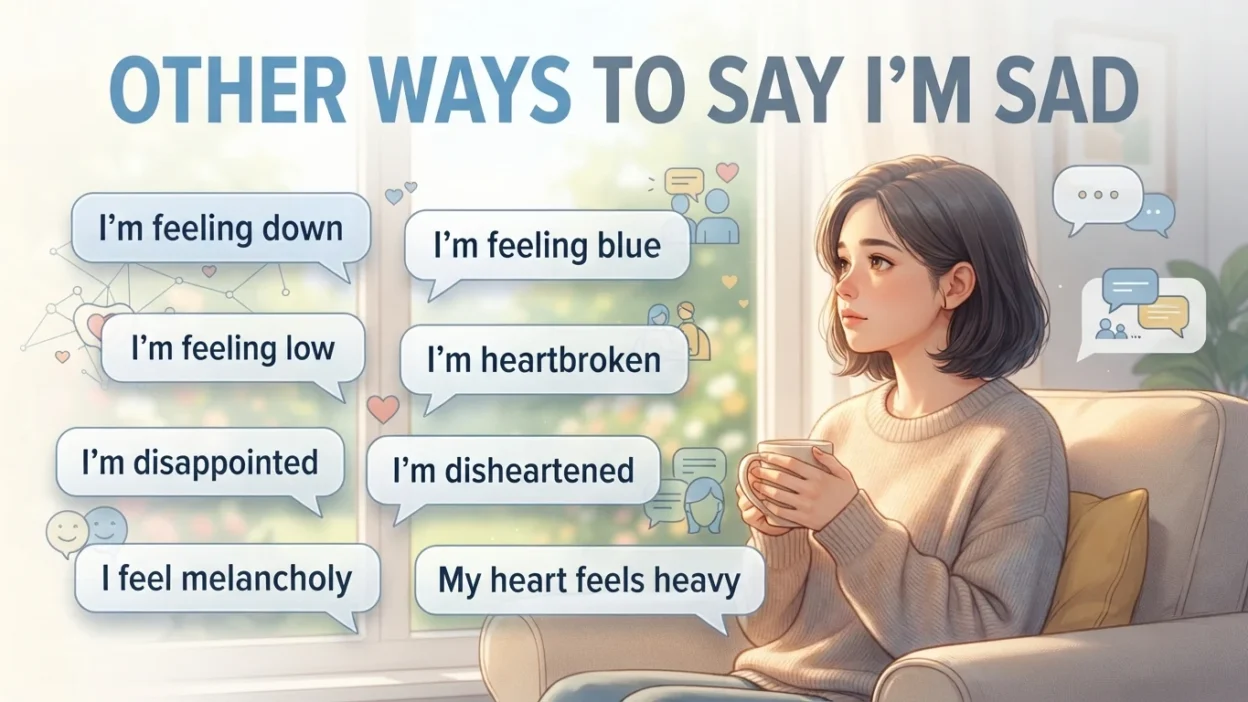
Using other ways to say I’m sad can help you describe your emotional state with more clarity when you feel unhappy, heartbroken, or low today. The phrase I’m sad has full nuance because emotions may come from personal loss, a disappointing day, or a temporarily low mood. When you use alternative ways to say I’m sad, you can make your communication more personal and meaningful while showing intensity, depth, and an accurate sense of what you are experiencing. In my experience, choosing words carefully helps you express vulnerability without feeling exposed and gives the listener a clearer way to respond with care, empathy, and understanding. Words such as blue, low-spirited, and downhearted may describe a milder temporary emotion, while disheartened, forlorn, and melancholy can express something more deep or significant. These subtle distinctions help people connect in a genuine and supportive way, while tone, context, and relationship guide which personal expressions fit best with close friends, family, or colleagues in professional and reflective settings. This is an important aspect of expressing sadness with appropriate words, because exploring alternatives can help you acknowledge feelings fully instead of minimizing or hiding them. Multiple emotions, including sadness, disappointment, frustration, and loneliness, can appear together, so varied vocabulary helps you accurately describe your emotional experience. This is crucial for emotional well-being and personal growth, while expressing feelings thoughtfully can encourage others to open up and create a safe space for honest conversations where people can communicate openly and strengthen relationships.
Quick Answer
Some natural alternatives to “I’m sad” include I’m feeling down, I’m feeling blue, I’m heartbroken, I’m disappointed, I’m feeling low, I’m disheartened, and I’m going through a difficult time. Choose the phrase according to the intensity, context, and relationship.
1. Casual Ways to Say I’m Sad
1. I’m Feeling Down
Definition: A common, gentle way to say you are feeling unhappy or less positive than usual.
Usage rule: Use it for everyday conversations when your sadness is noticeable but not necessarily severe.
Practical examples: “I’m feeling down today because things did not go as planned.”
Tips: This phrase sounds natural with friends, family, and people you know well.
2. I’m Feeling Blue
Definition: A familiar expression meaning that you feel sad or emotionally low.
Usage rule: Use it when you want a softer or more conversational expression.
Practical examples: “I’ve been feeling blue since my friend moved away.”
Tips: It is casual and works better in relaxed conversations than formal writing.
3. I’m Feeling Low
Definition: A simple expression for feeling unhappy, discouraged, or emotionally tired.
Usage rule: Use it when you want to describe a general low mood.
Practical examples: “I’m feeling low after a difficult week at work.”
Tips: Add a reason when you want the listener to understand your feelings better.
4. I’m Not Feeling Great
Definition: A mild way to communicate that you are not emotionally well.
Usage rule: Use it when you do not want to describe your sadness directly.
Practical examples: “I’m not feeling great today, so I might stay home.”
Tips: It can refer to physical or emotional discomfort, so context is useful.
5. I’m Having a Rough Day
Definition: An informal phrase suggesting that the day has been difficult or emotionally challenging.
Usage rule: Use it when your sadness is connected to recent events.
Practical examples: “I’m having a rough day after hearing the news.”
Tips: This phrase sounds natural in friendly conversations.
6. I’m Having a Hard Time
Definition: A broad expression indicating that you are struggling emotionally or personally.
Usage rule: Use it when sadness is part of a larger difficulty.
Practical examples: “I’m having a hard time adjusting to everything.”
Tips: This phrase can sound more serious than “I’m feeling down.”
7. I’m a Little Upset
Definition: A mild expression showing sadness, disappointment, or emotional disturbance.
Usage rule: Use it when you want to communicate moderate emotional discomfort.
Practical examples: “I’m a little upset about what happened yesterday.”
Tips: “A little” softens the emotional statement.
2. Deeper Ways to Express Sadness
1. I’m Heartbroken
Definition: A strong expression describing intense emotional pain.
Usage rule: Use it for serious sadness, especially after loss, rejection, or a painful personal event.
Practical examples: “I’m heartbroken that our plans fell apart.”
Tips: Avoid using it for minor disappointments because it suggests significant emotional pain.
2. I’m Heavy-Hearted
Definition: A thoughtful expression describing deep sadness or emotional heaviness.
Usage rule: Use it when discussing serious or meaningful emotional situations.
Practical examples: “I’m heavy-hearted after saying goodbye to my family.”
Tips: This expression works especially well in reflective writing.
3. I’m Deeply Hurt
Definition: A direct way to explain that something has caused significant emotional pain.
Usage rule: Use it when another person’s actions or a difficult event has affected you strongly.
Practical examples: “I’m deeply hurt by what happened.”
Tips: It is more specific than simply saying “I’m sad.”
4. I’m Devastated
Definition: A very strong expression for overwhelming sadness or emotional shock.
Usage rule: Reserve it for extremely serious situations.
Practical examples: “I’m devastated by the loss.”
Tips: Because it is intense, do not use it for ordinary disappointments.
5. I’m Crushed
Definition: An informal expression meaning that something has caused severe disappointment or sadness.
Usage rule: Use it mainly in casual conversations.
Practical examples: “I’m crushed that I missed such an important opportunity.”
Tips: It is emotional and conversational rather than formal.
6. I’m Brokenhearted
Definition: A variation of “heartbroken” that expresses deep emotional sadness.
Usage rule: Use it when the emotional pain is particularly strong.
Practical examples: “She was brokenhearted after the relationship ended.”
Tips: It is especially common when discussing relationships or personal loss.
7. I’m Grieving
Definition: A phrase describing deep sadness connected to a significant loss, especially the death of someone.
Usage rule: Use it when sadness is part of a genuine grieving process.
Practical examples: “I’m grieving the loss of someone very close to me.”
Tips: This is a serious expression and should be used with care.
3. Professional Ways to Say I’m Sad
1. I’m Feeling Discouraged
Definition: A professional-friendly way to describe sadness caused by setbacks or disappointing results.
Usage rule: Use it in workplace conversations when you want to remain composed.
Practical examples: “I’m feeling discouraged by the results, but I’m ready to improve.”
Tips: It focuses on the effect of a setback rather than intense personal sadness.
2. I’m Disappointed
Definition: A clear expression of sadness caused by an unmet expectation.
Usage rule: Use it when a result, decision, or event did not meet expectations.
Practical examples: “I’m disappointed that the project was delayed.”
Tips: This is one of the safest choices for professional communication.
3. I’m Feeling Disheartened
Definition: A somewhat formal phrase meaning that you have lost confidence or enthusiasm because of something discouraging.
Usage rule: Use it in reflective, professional, or formal communication.
Practical examples: “I’m feeling disheartened by the repeated setbacks.”
Tips: It sounds more polished than “I’m feeling down.”
4. I’m Struggling With This
Definition: A direct but professional way to explain that a situation is emotionally difficult.
Usage rule: Use it when you want to acknowledge difficulty without oversharing.
Practical examples: “I’m struggling with this change and may need some time.”
Tips: It can invite useful support without requiring detailed personal information.
5. This Has Been Difficult for Me
Definition: A calm expression that communicates emotional difficulty.
Usage rule: Use it when discussing a sensitive matter with colleagues, managers, or clients.
Practical examples: “This transition has been difficult for me.”
Tips: It is respectful and measured.
6. I’m Finding This Emotionally Difficult
Definition: A formal way to explain that something is affecting you emotionally.
Usage rule: Use it when a situation requires careful and professional wording.
Practical examples: “I’m finding this situation emotionally difficult.”
Tips: This expression is suitable for formal conversations where “I’m sad” may sound too casual.
7. I’m Not in the Best Frame of Mind
Definition: A polite expression indicating that you are not feeling emotionally positive or focused.
Usage rule: Use it when you need space without explaining your sadness in detail.
Practical examples: “I’m not in the best frame of mind for a long discussion today.”
Tips: It can be useful when setting a respectful boundary.
4. Gentle and Sensitive Alternatives
1. I’m Feeling a Little Low
Definition: A soft way to describe mild sadness.
Usage rule: Use it when you want to communicate sadness without sounding overly serious.
Practical examples: “I’m feeling a little low after that conversation.”
Tips: “A little” makes the statement gentler.
2. I’m Going Through a Difficult Time
Definition: A sensitive expression for experiencing ongoing emotional or personal challenges.
Usage rule: Use it when the reason for your sadness is larger than one specific event.
Practical examples: “I’m going through a difficult time at the moment.”
Tips: It allows you to share honestly without revealing private details.
3. I’m Feeling Emotionally Drained
Definition: A phrase describing emotional exhaustion that may include sadness.
Usage rule: Use it when repeated stress or difficult experiences have affected your emotions.
Practical examples: “I’m feeling emotionally drained after everything that happened.”
Tips: This phrase describes emotional exhaustion rather than sadness alone.
4. I’m Feeling Vulnerable
Definition: An expression showing that you feel emotionally exposed or sensitive.
Usage rule: Use it when sadness makes you feel especially sensitive.
Practical examples: “I’m feeling vulnerable after what happened.”
Tips: It does not directly mean “sad,” so use it when emotional openness is the main idea.
5. I’m Having a Difficult Moment
Definition: A gentle way to describe temporary emotional difficulty.
Usage rule: Use it when you want to emphasize that the feeling may pass.
Practical examples: “I’m having a difficult moment and could use some quiet time.”
Tips: This phrase works well when you want to avoid dramatic language.
6. I’m Feeling a Bit Downhearted
Definition: A gentle expression for feeling discouraged or sad.
Usage rule: Use it when you want a slightly more expressive alternative to “sad.”
Practical examples: “I’m feeling a bit downhearted after the news.”
Tips: It can work in both conversation and personal writing.
7. I Could Use Some Support Right Now
Definition: A practical way to communicate emotional difficulty without directly saying “I’m sad.”
Usage rule: Use it when your main goal is to let someone know that you need support.
Practical examples: “I could use some support right now if you have time.”
Tips: This is especially useful when you want to encourage a caring response.
5. Poetic and Expressive Ways to Say I’m Sad
1. I Feel Melancholy
Definition: “Melancholy” describes a thoughtful or gentle form of sadness.
Usage rule: Use it mainly in reflective, literary, or personal writing.
Practical examples: “I feel melancholy when I think about those old memories.”
Tips: It sounds more poetic than everyday expressions.
2. I Feel Forlorn
Definition: “Forlorn” describes deep sadness combined with loneliness or abandonment.
Usage rule: Use it when the emotional situation involves isolation or loss.
Practical examples: “I felt forlorn after everyone left.”
Tips: This is less common in everyday speech but useful in creative writing.
3. My Heart Feels Heavy
Definition: A figurative expression for emotional sadness or concern.
Usage rule: Use it when you want a warm, expressive way to describe your feelings.
Practical examples: “My heart feels heavy after hearing the news.”
Tips: It works particularly well in personal messages.
4. I’m Feeling Downhearted
Definition: An expressive way to describe sadness, discouragement, or loss of hope.
Usage rule: Use it when sadness is connected to disappointment or difficult circumstances.
Practical examples: “I’ve been feeling downhearted since the decision.”
Tips: It is more expressive than simply saying “I’m sad.”
5. I’m Carrying a Lot of Sadness
Definition: A figurative expression suggesting that sadness has remained with you for some time.
Usage rule: Use it for deeper personal or reflective communication.
Practical examples: “I’m carrying a lot of sadness after everything that happened.”
Tips: This phrase is more emotional and reflective than casual.
6. I’m Not Myself Today
Definition: A subtle way to communicate that your emotional state is different from normal.
Usage rule: Use it when you want someone to notice that something is wrong without explaining everything.
Practical examples: “I’m not myself today, so please bear with me.”
Tips: Context or a follow-up explanation may help the listener understand that sadness is involved.
7. There’s a Weight on My Heart
Definition: A figurative phrase describing emotional heaviness or sadness.
Usage rule: Use it mainly in personal, thoughtful, or creative communication.
Practical examples: “There’s a weight on my heart that I can’t easily explain.”
Tips: This expression is emotional and should match the tone of the conversation.
Placement & Grammar Rules Table
| Synonym or phrase | Sentence position / placement | Tone / formality | Example sentence |
| I’m feeling down | Usually at the beginning | Casual, natural | I’m feeling down today. |
| I’m feeling blue | Usually at the beginning | Casual | I’m feeling blue after the news. |
| I’m feeling low | Usually at the beginning | Neutral | I’m feeling low this evening. |
| I’m heartbroken | Usually at the beginning | Strong, emotional | I’m heartbroken by the loss. |
| I’m disappointed | Usually at the beginning | Neutral, professional | I’m disappointed with the outcome. |
| I’m disheartened | Usually at the beginning | Formal, reflective | I’m disheartened by the setback. |
| I’m going through a difficult time | Usually at the beginning | Sensitive, neutral | I’m going through a difficult time right now. |
| My heart feels heavy | Beginning or after a subject | Emotional, expressive | My heart feels heavy today. |
| I’m feeling melancholy | Usually at the beginning | Poetic, reflective | I’m feeling melancholy this evening. |
| I’m devastated | Usually at the beginning | Very strong | I’m devastated by the news. |
| I’m not feeling great | Usually at the beginning | Casual, mild | I’m not feeling great today. |
| This has been difficult for me | Beginning or after the subject | Professional, respectful | This situation has been difficult for me. |
Common Mistakes When Saying “I’m Sad”
One common mistake is using an expression that is much stronger than the actual situation. “I’m devastated” and “I’m heartbroken” communicate intense emotional pain, so they may sound excessive when describing a small inconvenience. For a mild situation, phrases such as “I’m feeling down,” “I’m feeling low,” or “I’m a little upset” are usually more appropriate.
Another mistake is ignoring the relationship and setting. Casual phrases such as “I’m feeling blue” can sound natural with friends but may not be the best choice in a formal workplace conversation. In professional settings, expressions such as “I’m disappointed,” “I’m feeling discouraged,” or “This has been difficult for me” can communicate the same general idea more appropriately.
A final mistake is using a phrase without considering what you actually want the listener to understand. If you need emotional support, “I could use some support right now” may be more useful than simply saying “I’m sad.” Good word choice should communicate both your feeling and the response you need.
Practical Examples
If you are talking to a close friend after a difficult day, you might say: “I’m feeling down today. I had a rough day at work, and I’m feeling a little low after everything that happened. I don’t really want advice right now, but I could use some support.” This sounds natural because the expressions are casual and clearly explain the emotional situation.
For a more serious personal situation, you could write: “I’m heartbroken and heavy-hearted after this loss. I’m going through a difficult time and finding it hard to process everything. I appreciate your patience while I work through these feelings.” The stronger vocabulary communicates deeper sadness without relying repeatedly on the word “sad.”
In a professional setting, you could say: “I’m disappointed with the outcome, and I’m feeling somewhat discouraged by the setback. This has been difficult for me, but I would like to focus on what we can improve moving forward.” This approach communicates genuine emotion while keeping the tone calm and professional.
FAQs
What is another way to say “I’m sad”?
Common alternatives include I’m feeling down, I’m feeling blue, I’m feeling low, I’m disappointed, I’m disheartened, and I’m going through a difficult time.
What is a stronger way to say “I’m sad”?
For stronger sadness, you can say I’m heartbroken, I’m devastated, I’m deeply hurt, I’m brokenhearted, or I’m grieving, depending on the situation.
What is a professional way to say “I’m sad”?
Professional alternatives include: I’m feeling discouraged, I’m disappointed, I’m feeling disheartened, this has been difficult for me, and I’m finding this emotionally difficult.
How can I say “I’m sad” without sounding too negative?
Try softer expressions such as I’m feeling a little low, I’m not feeling great, I’m having a difficult moment, or I’m going through a difficult time.
What is a poetic way to say “I’m sad”?
Poetic alternatives include my heart feels heavy, I feel melancholy, I feel forlorn, I’m carrying a lot of sadness, and there’s a weight on my heart.
How do I tell someone I’m sad without oversharing?
Use a simple phrase such as “I’m having a difficult time right now” or “I’m feeling a little low today.” You can then share more only if you feel comfortable.
Is “I’m feeling blue” the same as “I’m sad”?
They are similar, but “I’m feeling blue” usually sounds softer and more casual. It often describes a temporary or mild feeling of sadness.
Final Thoughts
Knowing other ways to say I’m sad gives you more control over how you communicate emotions.
The best expression depends on your intensity, relationship, context, tone, and purpose.
Use gentle phrases for mild sadness and stronger expressions for serious emotional pain.
For professional situations, choose calm and respectful language.
For personal conversations, more expressive words can help others understand your feelings.
Most importantly, choose words that accurately reflect what you are experiencing.