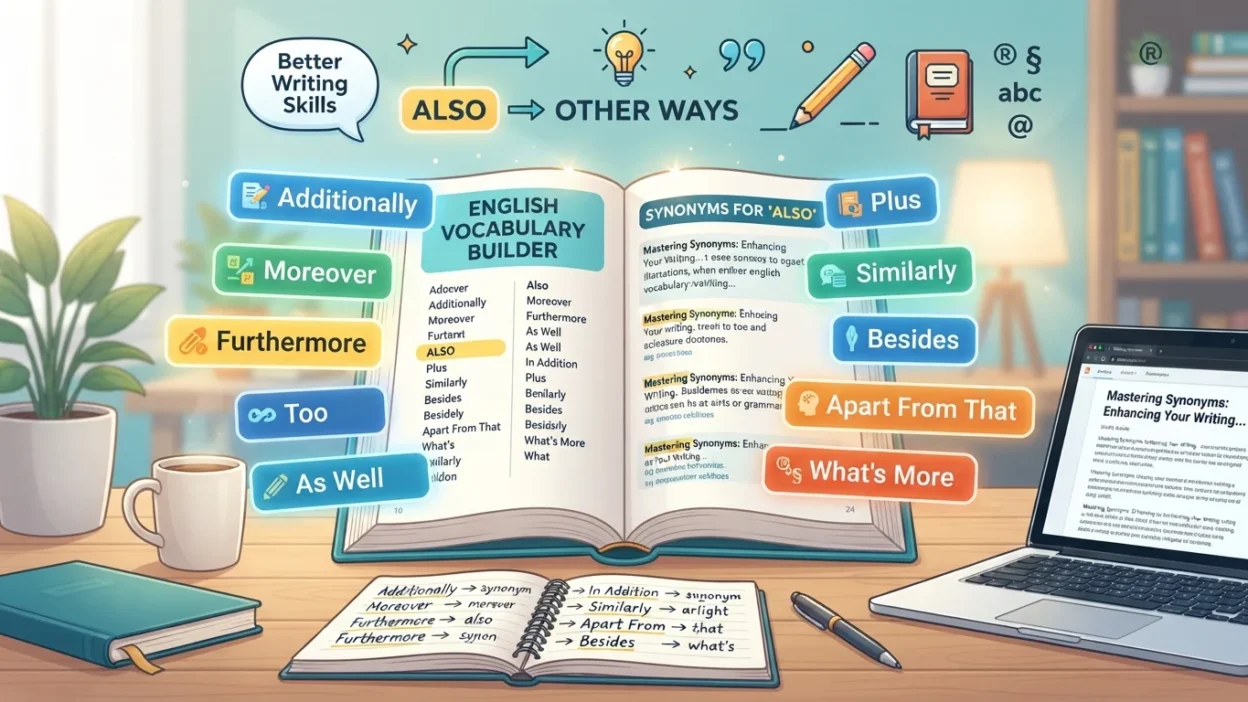
Learning other ways to say also helps your writing and speaking sound more interesting, fresher, and natural every day with simple word choices.
If you are wanting to improve your writing or speaking, learning other ways to say also can make your sentences sound more interesting and fresher. Choosing the right word instead of repeating the same words helps your message feel natural without thinking too much. I often notice even small changes make daily communication smoother.
This article is a simple guide with practical examples to help you start using alternatives easily. Whether you are writing emails, school work, or having conversations, picking different expressions for Also keeps your ideas clear and engaging. The more you practice, the more confident you become in choosing the right say for every situation.
Other Ways to Say Also
Some common alternatives for “also” include:
| Alternative | Best Used For | Example |
| Additionally | Formal writing | Additionally, the company offers training programs. |
| Furthermore | Academic/professional writing | Furthermore, the research supports this idea. |
| Moreover | Adding strong points | Moreover, this method saves time. |
| Besides | Casual conversations | Besides, we already finished the task. |
| Too | Everyday speech | I want to join too. |
| As well | Conversations and emails | She will attend as well. |
| In addition | Reports and essays | In addition, we provide customer support. |
| Likewise | Similar ideas | Likewise, other teams experienced growth. |
| Along with | Adding people/things | He brought his laptop along with his documents. |
| Not only that | Emphasis | Not only that, it improved productivity. |
Section 1: Formal Ways to Say Also
Formal writing requires accurate and professional language. Instead of repeating “also,” writers often use stronger transition words that improve flow and readability.
These alternatives are especially useful in:
- Business emails
- Academic essays
- Research papers
- Reports
- Presentations
- Professional documents
1. Additionally
Meaning:
“Additionally” means adding another point, fact, or piece of information. It is one of the most common formal replacements for “also.”
When to Use:
Use “additionally” when introducing extra information that supports your previous statement.
Examples:
Original:
The company provides health benefits. It also offers retirement plans.
Improved:
The company provides health benefits. Additionally, it offers retirement plans.
Writing Tip:
“Additionally” usually appears at the beginning of a sentence, followed by a comma.
Correct:
Additionally, the team completed the project ahead of schedule.
Incorrect:
The team additionally completed ahead of schedule. (Possible but less natural)
2. Furthermore
Meaning:
“Furthermore” means in addition to what has already been mentioned, another important point follows.
When to Use:
It is commonly used when adding stronger evidence or another supporting argument.
Examples:
The software is easy to use. Furthermore, it requires no technical training.
The product is affordable. Furthermore, it offers excellent quality.
Difference Between Additionally and Furthermore:
| Word | Purpose |
| Additionally | Adds another fact |
| Furthermore | Adds a stronger supporting point |
Example:
Additionally:
The hotel has free Wi-Fi. Additionally, it offers breakfast.
Furthermore:
The hotel has excellent service. Furthermore, it has received five-star reviews.
3. Moreover
Meaning:
“Moreover” means besides that, and more importantly.
It adds emphasis and shows that the next point is significant.
When to Use:
Use “moreover” when you want to strengthen your argument.
Examples:
The plan is cost-effective. Moreover, it reduces environmental impact.
The candidate has experience. Moreover, she has strong leadership skills.
Professional Tip:
“Moreover” is more formal than “also” and may sound too serious in casual conversations.
4. In Addition
Meaning:
“In addition” means another thing is included besides what was already mentioned.
When to Use:
It works well in essays, reports, and explanations.
Examples:
The course teaches writing skills. In addition, students learn communication techniques.
In addition to experience, employers value creativity.
Grammar Pattern:
In addition + sentence
Example:
In addition, the company provides flexible working hours.
In addition to + noun
Example:
In addition to English, she speaks French.
5. As Well As
Meaning:
“As well as” means together with or along with something else.
When to Use:
Use it when connecting two similar items.
Examples:
She speaks Spanish as well as English.
The package includes software as well as technical support.
Common Mistake:
Do not confuse “as well as” with “and.”
Incorrect:
John, as well as Mary, are attending.
Correct:
John, as well as Mary, is attending.
The main subject is “John,” so the verb should be singular.
Section 2: Casual Ways to Say Also
In everyday conversations, using highly formal words like “furthermore” may sound unnatural. Casual alternatives make speech friendlier and more conversational.
6. Too
Meaning:
“Too” means also or as well.
When to Use:
Mostly used in informal conversations and friendly writing.
Examples:
I like this movie too.
She wants to come too.
Placement Rule:
“Too” usually comes at the end of a sentence.
Examples:
✅ I enjoyed the event too.
✅ He is coming too.
7. As Well
Meaning:
“As well” has the same meaning as “too” and is commonly used in spoken English.
Examples:
I will send the documents as well.
She works in marketing as well.
Difference Between “Too” and “As Well”:
| Word | Style | Example |
| Too | More casual | I want one too. |
| As well | Slightly more polite | I would like one as well. |
8. Besides
Meaning:
“Besides” means in addition to that or another reason.
When to Use:
Use it when adding another point, especially in conversations.
Examples:
I don’t want to go. Besides, I have work tomorrow.
Besides English, he knows Arabic.
Note:
“Besides” can introduce a reason, while “also” simply adds information.
9. Plus
Meaning:
“Plus” means another thing.
When to Use:
Common in casual speech and informal writing.
Examples:
The hotel is affordable, plus it is close to the airport.
She is talented, plus she works very hard.
Professional Note:
Avoid using “plus” in formal academic writing.
10. On Top Of That
Meaning:
“On top of that” means in addition to everything already mentioned.
Examples:
The project was difficult, and on top of that, we had a tight deadline.
He forgot the meeting, and on top of that, he arrived late.
Usage:
Best for storytelling and informal conversations.
Section 3: Professional Ways to Say Also
Professional communication requires clarity, confidence, and the right tone. While “also” is acceptable, using stronger alternatives can make emails, reports, proposals, and workplace messages sound more polished.
These alternatives are useful for:
- Business emails
- Workplace communication
- Presentations
- Client messages
- Marketing content
- Professional reports
11. Additionally
(Covered earlier, but widely used in professional writing.)
Meaning:
Adds another important point or detail.
Professional Examples:
The company improved customer service. Additionally, it introduced a new support system.
Additionally, employees will receive training materials before the workshop.
Best For:
✔ Business reports
✔ Formal emails
✔ Presentations
12. Furthermore
Meaning:
Adds another supporting idea, usually one that strengthens the previous statement.
Examples:
Our solution reduces costs. Furthermore, it improves overall efficiency.
The platform is easy to use. Furthermore, it provides advanced security features.
Workplace Tip:
“Furthermore” sounds confident and persuasive, making it useful in proposals and presentations.
13. Moreover
Meaning:
Introduces another important point that adds extra strength.
Examples:
The company has increased sales. Moreover, customer satisfaction has improved.
The strategy saves money. Moreover, it creates long-term benefits.
Difference:
| Word | Effect |
| Additionally | Neutral addition |
| Furthermore | Stronger support |
| Moreover | Adds importance |
14. Not Only That
Meaning:
Used to introduce an additional surprising or impressive point.
When to Use:
Best when emphasizing an extra benefit.
Examples:
The software is affordable. Not only that, it is extremely easy to operate.
She completed the project early. Not only that, she exceeded expectations.
Tone:
Semi-formal and persuasive.
15. Along With
Meaning:
Means together with another person, thing, or idea.
Examples:
The package includes installation along with customer support.
He submitted the report along with the required documents.
Grammar Pattern:
Along with + noun
Examples:
✅ The manager, along with his team, attended the meeting.
16. Coupled With
Meaning:
Means combined with another factor.
When to Use:
Common in professional and analytical writing.
Examples:
Strong leadership, coupled with effective planning, led to success.
Experience coupled with creativity can produce excellent results.
Best For:
✔ Research papers
✔ Business analysis
✔ Reports
17. Combined With
Meaning:
Shows that two or more things work together.
Examples:
Technology combined with innovation creates new opportunities.
Quality products combined with excellent service attract customers.
18. In Conjunction With
Meaning:
Means working together with something or someone.
Examples:
The company developed the program in conjunction with industry experts.
The campaign was launched in conjunction with local organizations.
Tone:
Very formal.
Best Used In:
- Legal documents
- Research
- Corporate writing
19. Together With
Meaning:
Indicates something is included with another thing.
Examples:
The report includes financial data together with market research.
She attended the event together with her colleagues.
20. Similarly
Meaning:
Used when adding a similar idea or example.
Examples:
The first method saves time. Similarly, the second approach improves efficiency.
Many customers prefer online shopping. Similarly, younger buyers choose digital payments.
Important:
“Similarly” does not simply mean “also.” It shows similarity.
Section 4: Academic Ways to Say Also
Academic writing requires logical connections between ideas. Instead of repeating “also,” writers use transition words that show relationships between arguments.
Common academic alternatives include:
- In addition
- Furthermore
- Moreover
- Likewise
- Similarly
- Additionally
- Besides
- Another important factor is
21. Likewise
Meaning:
Means “in the same way” or “similarly.”
When to Use:
Use it when adding a related idea.
Examples:
The first experiment showed positive results. Likewise, the second experiment confirmed the findings.
Students benefit from practical lessons. Likewise, teachers gain valuable feedback.
Academic Tip:
“Likewise” connects similar points, not unrelated information.
22. Another Important Factor Is
Meaning:
Introduces an additional significant point.
Examples:
Another important factor is the impact of technology on education.
Another important factor is employee motivation.
Best For:
✔ Essays
✔ Research papers
✔ Analytical writing
23. Another Advantage Is
Meaning:
Adds another benefit or positive point.
Examples:
The method is affordable. Another advantage is that it saves time.
Another advantage is improved customer satisfaction.
24. Beyond That
Meaning:
Means something exists in addition to what was already mentioned.
Examples:
The product is affordable. Beyond that, it is environmentally friendly.
Beyond that, the company provides excellent customer service.
Tone:
Professional but conversational.
25. Not to Mention
Meaning:
Adds another point, usually something impressive or obvious.
Examples:
The location is convenient, not to mention the beautiful view.
The service was excellent, not to mention the reasonable price.
Usage:
Common in persuasive writing and conversations.
26. What’s More
Meaning:
Introduces an additional point that is often surprising or valuable.
Examples:
The course is affordable. What’s more, it includes lifetime access.
The hotel offers great rooms. What’s more, breakfast is included.
Tone:
Friendly and engaging.
27. Even More Importantly
Meaning:
Adds a point that is considered more significant.
Examples:
The system saves time. Even more importantly, it improves accuracy.
The plan reduces expenses. Even more importantly, it increases productivity.
28. As a Matter of Fact
Meaning:
Introduces additional information that emphasizes a fact.
Examples:
The company has grown rapidly. As a matter of fact, sales doubled last year.
Note:
It does not always mean “also”; it often corrects or strengthens information.
29. Notably
Meaning:
Adds an important or remarkable point.
Examples:
The project improved efficiency, notably in customer service.
Several industries benefited, notably healthcare and technology.
30. Particularly
Meaning:
Highlights a specific additional point.
Examples:
The program supports many skills, particularly communication and teamwork.
The company focuses on innovation, particularly in artificial intelligence.
Comparison Table: Professional vs Casual Alternatives
| Alternative | Formality Level | Example |
| Additionally | Formal | Additionally, the report includes new data. |
| Furthermore | Very Formal | Furthermore, the results support our theory. |
| Moreover | Formal | Moreover, this approach reduces costs. |
| In Addition | Formal | In addition, customers receive support. |
| Likewise | Academic | Likewise, other studies show similar results. |
| Too | Casual | I want to go too. |
| As Well | Casual/Neutral | She joined as well. |
| Plus | Casual | It is cheap plus reliable. |
| Besides | Casual | Besides, we already tried that. |
| On Top Of That | Informal | On top of that, he missed the deadline. |
Common Placement Rules for “Also” Alternatives
Correct placement improves sentence flow.
Rule 1: Beginning of Sentence
Many formal alternatives appear at the beginning.
Examples:
✅ Additionally, the company expanded its services.
✅ Furthermore, the research confirms this result.
Rule 2: Middle of Sentence
Some alternatives can appear before the main verb.
Examples:
✅ She also works remotely.
✅ The company additionally provides training.
Rule 3: End of Sentence
Common with casual alternatives.
Examples:
✅ I would like to join too.
✅ She attended the meeting as well.
Quick Practice Examples
Original:
The website is fast. It is also easy to use.
Professional:
The website is fast. Additionally, it is easy to use.
Original:
He is talented. He also works hard.
Academic:
He is talented. Moreover, he demonstrates strong work ethics.
Original:
I bought a laptop. I also purchased a mouse.
Casual:
I bought a laptop, and I purchased a mouse as well.
Section 5: More Ways to Say Also in Different Situations
The best replacement for “also” depends on the situation. A word that works perfectly in an academic essay may sound unnatural in a casual conversation. Below are more alternatives categorized by purpose.
Other Ways to Say Also in Emails
Professional emails require polite and clear language. These alternatives help avoid repetition and create smoother communication.
31. I Would Also Like to Mention
Meaning:
A polite way to introduce additional information.
Examples:
I would also like to mention that the deadline has been extended.
I would also like to mention our upcoming meeting schedule.
Best For:
✔ Business emails
✔ Client communication
✔ Formal announcements
32. I Would Like to Add
Meaning:
Introduces another thought or point.
Examples:
I would like to add that your feedback was extremely valuable.
I would like to add one more point before we finalize the plan.
33. Please Note That
Meaning:
Draws attention to additional important information.
Examples:
Please note that the office will remain closed tomorrow.
Please note that additional documents are required.
34. Additionally to This
Meaning:
Adds another point.
Better Alternative:
Although understandable, native speakers usually prefer:
✅ Additionally
✅ In addition
✅ Furthermore
Example:
Additionally, we have included the updated files.
35. Alongside This
Meaning:
Adds another related item or action.
Examples:
Alongside this, we will provide technical assistance.
Alongside this initiative, the company will launch training programs.
Other Ways to Say Also in Essays
Academic writing benefits from transitions that clearly connect ideas.
36. Furthermore
Example:
Climate change affects ecosystems. Furthermore, it influences global economies.
37. Moreover
Example:
The method is efficient. Moreover, it reduces operational costs.
38. Additionally
Example:
Additionally, researchers discovered new evidence.
39. Similarly
Example:
Similar results were observed in other studies. Similarly, previous research supports this conclusion.
40. Another Key Point Is
Example:
Another key point is the importance of sustainable development.
Other Ways to Say Also in Conversations
Casual conversations usually need simple and natural expressions.
41. Me Too
Used when agreeing with someone.
Example:
Person A:
I love coffee.
Person B:
Me too.
42. Same Here
Means “I feel the same.”
Example:
I am tired today.
Same here.
43. So Do I
Used when agreeing with a positive statement.
Example:
I enjoy reading.
So do I.
44. Neither Do I
Used when agreeing with a negative statement.
Example:
I don’t like crowded places.
Neither do I.
45. Not Only That
Example:
The restaurant has great food. Not only that, the service is excellent.
Other Ways to Say Also in Business Writing
46. In Addition To This
Example:
In addition to this, the company will provide employee training.
47. Furthermore To This
Rarely used. Better options:
✅ Furthermore
✅ Additionally
48. Expanding On This
Used when adding details.
Example:
Expanding on this, the report highlights several challenges.
49. Building On This
Used when developing an idea.
Example:
Building on this research, we developed a new strategy.
50. Following This
Used to introduce the next point.
Example:
Following this, the team analyzed customer feedback.
Table: Best “Also” Alternatives by Situation
| Situation | Best Alternatives |
| Formal essay | Furthermore, Moreover, Additionally |
| Business email | In addition, Additionally, I would like to add |
| Casual speech | Too, As well, Me too |
| Presentation | Furthermore, Moreover, Not only that |
| Research paper | Likewise, Similarly, Additionally |
| Marketing content | Plus, Not only that, What’s more |
| Conversation | Also, Too, As well |
Grammar Rules for Using Alternatives to Also
Using synonyms correctly is important because not every alternative can replace “also” in every sentence.
Rule 1: Do Not Use Every Synonym the Same Way
Incorrect:
I furthermore like pizza.
Correct:
Furthermore, I like pizza.
or
I also like pizza.
Rule 2: Use Commas After Sentence Starters
Correct:
Additionally, the results were positive.
Moreover, the company expanded.
Incorrect:
Additionally the results were positive.
Rule 3: “Too” Usually Comes at the End
Correct:
She wants to participate too.
Incorrect:
She wants to participate too.
Rule 4: “As Well” Usually Comes at the End
Correct:
They invited us as well.
Incorrect:
As well they invited us.
Rule 5: “Besides” Changes the Meaning Slightly
“Also” simply adds information.
Example:
I bought a book. I also bought a pen.
“Besides” often adds a reason.
Example:
I don’t want to go. Besides, I’m tired.
Common Mistakes When Using Alternatives for Also
Mistake 1: Overusing Formal Words
Using “moreover” and “furthermore” in every sentence can make writing unnatural.
Better:
Mix different expressions.
Example:
Additionally, the company improved services. It also reduced costs.
Mistake 2: Using “Too” in Formal Writing
Incorrect:
The research was successful too.
Better:
Furthermore, the research was successful.
Mistake 3: Confusing “Also” and “Similarly”
Incorrect:
The company increased sales. Similarly, it hired more employees.
Why?
Because hiring employees is not necessarily similar to increasing sales.
Better:
The company increased sales. Additionally, it hired more employees.
Mistake 4: Using “Besides” Incorrectly
Incorrect:
Besides, the project was completed on time.
If you mean another fact:
Better:
Additionally, the project was completed on time.
Mistake 5: Using Too Many Transition Words
Too many connectors make writing repetitive.
Poor:
Additionally, furthermore, moreover, the company expanded.
Better:
Furthermore, the company expanded.
Practical Examples
Example 1: General Writing
Before:
The hotel offers free breakfast. It also provides airport transportation.
After:
The hotel offers free breakfast. Additionally, it provides airport transportation.
Example 2: Professional Email
Before:
I also attached the updated document.
After:
I have attached the updated document as well.
or
Additionally, I have attached the updated document.
Example 3: Academic Writing
Before:
Technology improves education. It also increases accessibility.
After:
Technology improves education. Moreover, it increases accessibility.
Example 4: Casual Conversation
Before:
I like this restaurant. I also like the service.
After:
I like this restaurant. I like the service too.
FAQs
1. What is the best formal alternative for “also”?
The best formal alternatives for “also” are:
- Additionally
- Furthermore
- Moreover
- In addition
The best choice depends on the sentence. “Additionally” is the closest direct replacement.
2. Can I use “too” instead of “also”?
Yes, but “too” is more common in informal conversations.
Example:
I like chocolate too.
For formal writing, use:
Additionally, I like chocolate.
3. Is “moreover” the same as “also”?
They have similar meanings, but “moreover” adds stronger emphasis.
Example:
The product is affordable. Moreover, it is environmentally friendly.
The second point is presented as an important benefit.
4. What is another way to say “also” in an email?
Professional email alternatives include:
- Additionally
- Furthermore
- In addition
- I would also like to mention
- Please note that
5. What can I use instead of “also” in an essay?
For essays, use:
- Furthermore
- Moreover
- Additionally
- Likewise
- Similarly
- Another important point is
6. Is “as well as” formal?
Yes. “As well as” works in both formal and informal English.
Example:
The course teaches writing as well as communication skills.
Final Thoughts
The word “also” is simple and useful, but relying on it too often can make your writing repetitive. Learning different ways to say also allows you to express ideas with more precision and match the tone of every situation.
For formal writing, choose words like additionally, furthermore, moreover, and in addition. For casual conversations, natural options like too, as well, and me too work better. In academic writing, transitions such as likewise, similarly, and another important factor is help create stronger connections between ideas.
The key is not to replace “also” everywhere, but to choose the alternative that best fits your meaning, audience, and writing style.
A strong vocabulary is not about using complicated words—it is about choosing the right words at the right time.