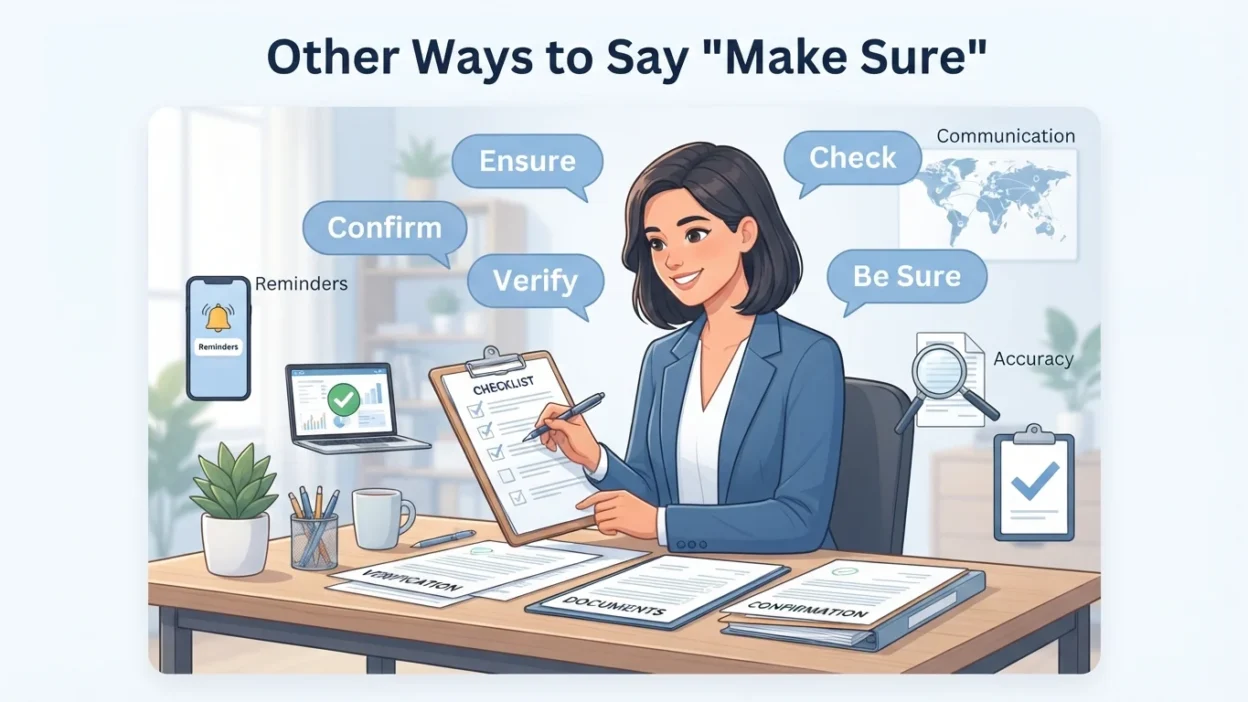
If you need clarity, these other ways to say make sure can help you confirm details, check tasks, and ensure each outcome is done correctly. This common expression is widely used in English writing and speech, but using the same phrase repeatedly may sound basic or repetitive. English learners and professionals can use different alternatives to communicate clearly, sound polished, and choose the right tone for each context.
When speaking informally, a message can use check, Double-check, or Please verify when asking someone to review information or confirm an action. For a report, submission, or formal email, “Please verify the details” sounds clear and professional, while “Double-check the information before sending” gives a direct reminder. These expressions keep instructions simple while preserving the intended meaning.
Using varied expressions can enhance communication across emails, presentations, essays, social media posts, and everyday conversations. The best choice depends on whether the situation is formal, direct, or friendly. For example, “ensure” sounds more professional, while “check” feels more natural in casual communication.
Quick Answer
Common alternatives to “make sure” include ensure, confirm, verify, check, double-check, be certain, and see to it. The best option depends on your intended meaning, level of formality, and context.
Professional Alternatives to “Make Sure”
1. Ensure
Definition: “Ensure” means to make certain that something happens or is completed correctly.
Usage rule: Use it mainly in professional, academic, and formal writing.
Practical example: Please ensure that all information is accurate before submitting the report.
Tips: This is one of the strongest formal alternatives to “make sure.”
2. Confirm
Definition: “Confirm” means to establish that information, plans, or details are correct.
Usage rule: Use it when you need someone to verify a fact, appointment, booking, or decision.
Practical example: Please confirm your attendance before Friday.
Tips: Choose “confirm” when the main idea is receiving definite information.
3. Verify
Definition: “Verify” means to check something carefully and establish that it is accurate or true.
Usage rule: Use it when accuracy or correctness is especially important.
Practical example: Please verify the customer’s account information.
Tips: It works particularly well in business, technical, and official communication.
4. Check
Definition: “Check” means to look at something to make sure it is correct, complete, or suitable.
Usage rule: Use it in both casual and professional communication.
Practical example: Check the address before sending the package.
Tips: It is simple, natural, and easy for English learners to use.
5. Double-Check
Definition: “Double-check” means to check something again to avoid an error.
Usage rule: Use it when a second review is useful or important.
Practical example: Double-check the figures before presenting them.
Tips: It sounds direct but is still natural in workplace communication.
6. Be Certain
Definition: “Be certain” means to have confidence that something is true or correct.
Usage rule: Use it when emphasizing confidence rather than simply reviewing information.
Practical example: Be certain that you have attached the correct document.
Tips: This phrase can sound stronger than the everyday “make sure.”
7. See to It
Definition: “See to it” means to take responsibility for ensuring something happens.
Usage rule: Use it when someone is expected to handle a task personally.
Practical example: Please see to it that the room is ready before the guests arrive.
Tips: It is useful, but “ensure” may sound more polished in formal documents.
Casual and Everyday Ways to Say “Make Sure”
8. Check That
Definition: “Check that” means to look at something and confirm that it meets the required condition.
Usage rule: Use it naturally in everyday instructions.
Practical example: Check that the door is locked before leaving.
Tips: It is one of the easiest replacements for casual speech.
9. Take a Look
Definition: “Take a look” means to examine something briefly.
Usage rule: Use it when asking someone to review something without sounding too formal.
Practical example: Take a look at the document before we send it.
Tips: This expression sounds friendly and conversational.
10. Keep an Eye On
Definition: “Keep an eye on” means to watch or monitor something carefully.
Usage rule: Use it when continued attention is needed rather than a single check.
Practical example: Keep an eye on the oven while the food is cooking.
Tips: Do not use it when you simply need someone to verify a fact.
11. Be Careful to
Definition: “Be careful to” tells someone to pay attention while doing something.
Usage rule: Use it when avoiding a mistake or problem is the main concern.
Practical example: Be careful to enter the correct password.
Tips: It works well when giving friendly warnings or reminders.
12. Don’t Forget to
Definition: “Don’t forget to” reminds someone to complete an important action.
Usage rule: Use it when the concern is remembering rather than checking.
Practical example: Don’t forget to save your work before closing the program.
Tips: This is especially natural in everyday conversations.
13. Remember to
Definition: “Remember to” asks someone to keep a particular action in mind.
Usage rule: Use it for reminders about future actions.
Practical example: Remember to bring your identification tomorrow.
Tips: It is softer and friendlier than a strict instruction.
14. Make Certain
Definition: “Make certain” means to establish that something is definitely true or completed.
Usage rule: Use it as a direct substitute for “make sure,” especially when you want slightly more formal wording.
Practical example: Make certain that every guest receives a copy.
Tips: It is grammatically similar to “make sure,” so the sentence structure is easy to follow.
Formal and Workplace Alternatives
15. Take Care to
Definition: “Take care to” means to pay special attention while completing an action.
Usage rule: Use it when accuracy, caution, or quality matters.
Practical example: Take care to include all required information in the application.
Tips: It sounds professional without being overly formal.
16. Verify That
Definition: “Verify that” specifically asks someone to establish that a condition is correct.
Usage rule: Use it before a complete clause beginning with “that.”
Practical example: Verify that the payment has been received.
Tips: This construction is especially useful in instructions and procedures.
17. Confirm That
Definition: “Confirm that” means to establish that a statement or condition is correct.
Usage rule: Use it when the information needs official or definite confirmation.
Practical example: Confirm that the client has approved the proposal.
Tips: It is common in business emails and administrative communication.
18. Make Certain That
Definition: “Make certain that” means to take action so that a particular condition is guaranteed.
Usage rule: Use it when you want a formal version of “make sure that.”
Practical example: Make certain that all records are stored securely.
Tips: It is clear but can sound more formal than everyday speech.
19. Take Steps to Ensure
Definition: This phrase means to take specific actions designed to produce a desired result.
Usage rule: Use it when describing a deliberate process or responsibility.
Practical example: The company should take steps to ensure customer information remains protected.
Tips: This is useful in reports, policies, and professional recommendations.
20. Establish That
Definition: “Establish that” means to demonstrate or determine that something is true or valid.
Usage rule: Use it when evidence, investigation, or documentation is involved.
Practical example: The audit will establish that the records are accurate.
Tips: Do not use it for simple everyday reminders.
21. Assure Yourself
Definition: “Assure yourself” means to personally become confident that something is correct or safe.
Usage rule: Use it when the person performing the check is responsible for gaining confidence.
Practical example: Assure yourself that the equipment is working before starting.
Tips: This expression focuses more on personal confidence than external confirmation.
Alternatives for Emails, Instructions, and Written Communication
22. Please Confirm
Definition: “Please confirm” is a polite request for definite information or agreement.
Usage rule: Use it when asking someone to respond with confirmation.
Practical example: Please confirm whether you will attend the meeting.
Tips: It is especially useful in professional emails.
23. Please Verify
Definition: “Please verify” is a polite request to check the accuracy of information.
Usage rule: Use it when factual correctness matters.
Practical example: Please verify the figures before approving the document.
Tips: It sounds professional and precise.
24. Kindly Confirm
Definition: “Kindly confirm” is a formal and polite request for confirmation.
Usage rule: Use it in formal correspondence when a respectful tone is appropriate.
Practical example: Kindly confirm receipt of the attached documents.
Tips: In very casual messages, “please confirm” usually sounds more natural.
25. Please Check
Definition: “Please check” politely asks someone to review something.
Usage rule: Use it for documents, details, files, information, or completed work.
Practical example: Please check the attached report for any errors.
Tips: It is direct, clear, and suitable for most workplace situations.
26. Review Carefully
Definition: “Review carefully” means to examine something thoroughly before accepting or using it.
Usage rule: Use it when a basic glance is not enough.
Practical example: Review carefully before signing the agreement.
Tips: This phrase emphasizes attention and thoroughness.
27. Check Before Sending
Definition: “Check before sending” reminds someone to review content before it is delivered.
Usage rule: Use it for emails, messages, documents, and attachments.
Practical example: Check before sending the email to the entire team.
Tips: It is a practical phrase for avoiding preventable communication mistakes.
28. Make Sure Everything Is in Order
Definition: This expression means to confirm that all required details or arrangements are properly completed.
Usage rule: Use it when several elements need to be checked together.
Practical example: Please make sure everything is in order before the meeting begins.
Tips: It is useful when referring to a complete process rather than one detail.
Natural Alternatives for Speaking and Conversation
29. Be Sure
Definition: “Be sure” means to remember or confirm that something is done.
Usage rule: Use it before an infinitive or a clause.
Practical example: Be sure to call me when you arrive.
Tips: It is short, natural, and common in everyday English.
30. Be Certain That
Definition: “Be certain that” means to have no doubt that something is correct or true.
Usage rule: Use it when expressing a strong level of confidence.
Practical example: Be certain that you understand the instructions before beginning.
Tips: It is stronger and more formal than “be sure.”
31. Watch Out for
Definition: “Watch out for” means to pay attention to something that could cause a problem.
Usage rule: Use it mainly for warnings and potential risks.
Practical example: Watch out for spelling mistakes in the final version.
Tips: This is more about caution than confirmation.
32. Keep in Mind
Definition: “Keep in mind” means to remember an important fact while making a decision or taking action.
Usage rule: Use it when someone needs to consider information rather than physically check something.
Practical example: Keep in mind that the deadline is Friday.
Tips: It is useful when “make sure” would otherwise be too direct.
33. Pay Attention to
Definition: “Pay attention to” means to focus carefully on something.
Usage rule: Use it when careful observation is necessary.
Practical example: Pay attention to the formatting requirements.
Tips: This phrase works well for instructions, teaching, and everyday conversation.
34. Look Over
Definition: “Look over” means to examine something quickly or generally.
Usage rule: Use it when a complete formal verification is not necessary.
Practical example: Can you look over my essay before I submit it?
Tips: It is informal and particularly natural in conversation.
35. Go Over
Definition: “Go over” means to review or examine something, often together with another person.
Usage rule: Use it when discussing, checking, or reviewing information.
Practical example: Let’s go over the presentation one more time.
Tips: It is common in workplace and educational conversations.
Placement & Grammar Rules Table
| Synonym or phrase | Sentence position / placement | Tone / formality | Example sentence |
| Ensure | Usually before a clause or noun phrase | Formal | Please ensure that the details are correct. |
| Confirm | Before information or a “that” clause | Professional | Please confirm that the booking is complete. |
| Verify | Before information or a “that” clause | Formal | Verify that the figures are accurate. |
| Check | Before a noun or clause | Neutral | Check the address carefully. |
| Double-check | Before a noun or clause | Neutral | Double-check the attachment before sending. |
| Be sure | Before an infinitive or “that” clause | Casual/neutral | Be sure to save your work. |
| Please confirm | Usually at the beginning of a request | Professional | Please confirm your availability. |
| Please verify | Usually at the beginning of a request | Professional | Please verify the account details. |
| Take care to | Before an infinitive | Professional | Take care to enter the correct information. |
| Keep an eye on | Before the object being monitored | Casual | Keep an eye on the schedule. |
| Look over | Before the object being reviewed | Casual | Look over the document before signing. |
| Go over | Before the object being reviewed | Neutral | Let’s go over the plan together. |
Common Mistakes When Using “Make Sure” Alternatives
One common mistake is treating every alternative as if it has exactly the same meaning. Ensure, verify, confirm, and check overlap, but they are not always interchangeable. “Verify” usually focuses on accuracy, “confirm” focuses on establishing information, and “ensure” focuses on making a desired result happen.
Another mistake is choosing overly formal language for casual situations. Saying “Kindly confirm” to a close friend can sound unnecessarily stiff, while using “check” in a formal policy may not provide the same professional tone. Always consider the audience, purpose, and context before selecting an alternative.
Grammar can also cause problems. For example, “ensure” is normally followed by a noun phrase or a clause, while “be sure” commonly appears with “to” plus a verb. Instead of writing “Ensure to check the file,” write “Ensure that you check the file” or “Be sure to check the file.”
Practical Example Paragraphs
In a workplace setting, clear instructions can prevent unnecessary mistakes. Instead of repeatedly telling employees to “make sure” everything is correct, a manager can say, “Please verify the customer details, confirm the delivery date, and ensure that all required documents are attached.” These choices make each instruction more specific and professional.
In everyday conversation, simpler expressions usually sound better. For example, before a friend leaves for a trip, you might say, “Be sure to take your passport and check that you have your tickets.” There is no need for highly formal wording because the purpose is simply to give a friendly reminder.
In academic writing, careful word choice can make instructions clearer. A teacher might write, “Review carefully before submitting your essay and verify that every source is cited correctly.” Here, the alternatives communicate specific actions instead of relying on one repeated phrase.
FAQs
What is the most professional way to say “make sure”?
“Ensure” is one of the most common professional alternatives. “Verify” and “confirm” are also useful when the specific meaning involves checking accuracy or receiving confirmation.
Is “ensure” the same as “make sure”?
They are often similar, but “ensure” is generally more formal. “Make sure” is more common in everyday conversation, while “ensure” frequently appears in professional and academic writing.
What can I say instead of “make sure” in an email?
Depending on the context, you can use “please confirm,” “please verify,” “please check,” or “ensure that.” The right choice depends on whether you need confirmation, accuracy, or completion.
What is a casual way to say “make sure”?
“Check,” “be sure,” “don’t forget to,” “take a look,” and “look over” are natural casual alternatives.
What is another way to say “make sure that”?
You can use “ensure that,” “confirm that,” “verify that,” “be certain that,” or “make certain that.” Choose the phrase according to the exact meaning and tone.
Can I use “double-check” instead of “make sure”?
Yes, when you want someone to review something again. “Double-check” emphasizes a second check, so it is not always appropriate when no previous check has taken place.
Which alternative is best for formal writing?
“Ensure,” “verify,” “confirm,” and “establish” can work well in formal writing, but the most appropriate option depends on the sentence and intended meaning.
Final Thoughts
Knowing other ways to say make sure helps you avoid repetitive language and communicate with greater precision.
Use ensure for professional writing, verify for accuracy, and confirm when definite information is needed.
For casual conversations, check, be sure, and look over often sound more natural.
The strongest choice is not always the most formal one; it is the phrase that fits your audience and purpose.
With regular practice, these alternatives can make emails, essays, instructions, and conversations clearer and more natural.