Learning other ways to say angry helps you express anger with thoughtful, calm, and clearer words while showing care, respect, and kindness. Finding these alternatives is an important skill because angry can sound harsh, direct, or emotionally heavy. When we speak about anger, it helps to understand your feelings and choose the right words. Using thoughtful and calm language makes it easier to express difficult emotions while showing care, respect, and kindness. Instead of simply saying “I’m angry,” you can choose alternatives that are gentler, clearer, and more meaningful.
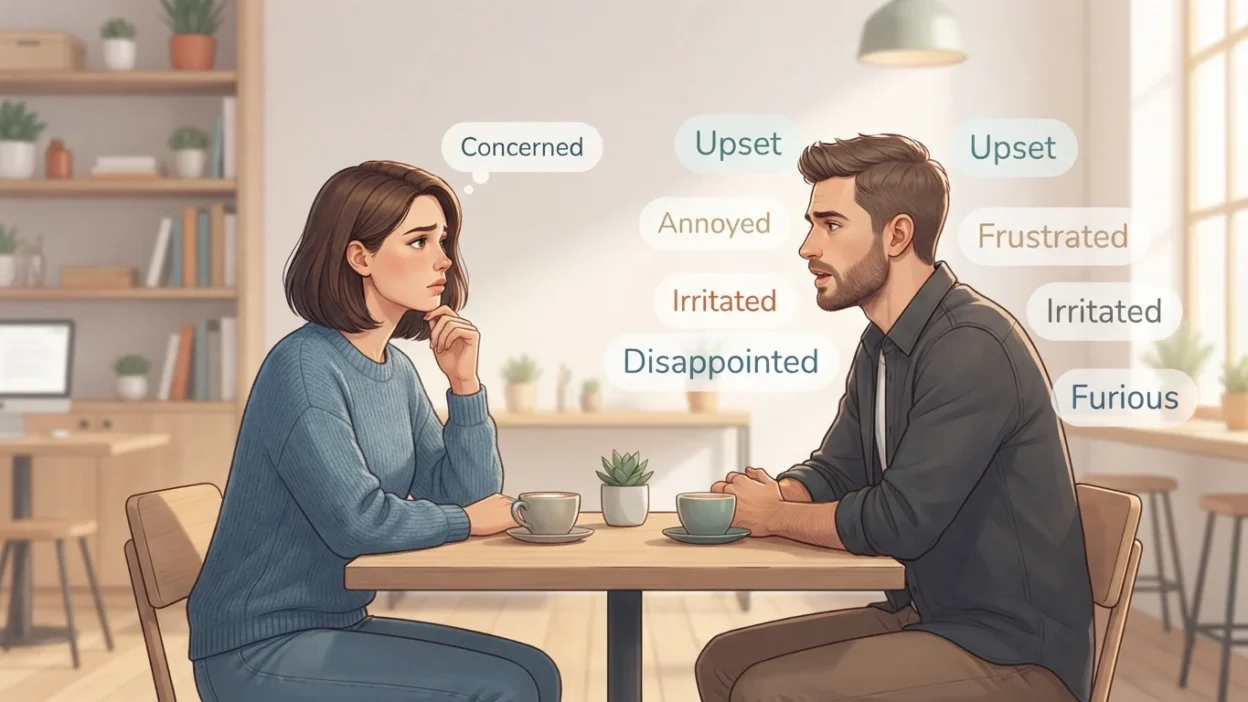
For example, saying “I’m frustrated” can explain that something is bothering you in a less confrontational way. Words such as upset, annoyed, and disappointed can describe different levels of feelings with greater accuracy. This emotional honesty can be emotionally intelligent because it helps you describe your inner experiences instead of simply reacting. Choosing a suitable alternative can help prevent escalating tension and make conversations feel safer and more personal. The goal is not to hide anger, but to communicate it through a suitable expression.
When a person is speaking about difficult emotions thoughtfully, clear wording can help them communicate their genuine feelings with empathy. The other person is more likely to hear us clearly and respond appropriately when the message is specific and respectful. In this way, the right alternative can make conversations more respectful while allowing you to express what you truly feel.
Quick Answer
Common alternatives to “angry” include mad, upset, annoyed, frustrated, irritated, furious, irritated, displeased, resentful, and outraged. The best choice depends on the intensity of your emotion, the reason for it, and whether you are speaking casually or professionally.
Everyday Alternatives to “Angry”
1. Upset
Definition: “Upset” describes emotional distress, disappointment, or unhappiness and can sometimes communicate anger in a softer way.
Usage rule: Use it when you want to express a negative emotional reaction without sounding extremely angry.
Practical example: I was upset when I found out that the meeting had been canceled without notice.
Tips: This is a gentle alternative when “angry” feels too strong.
2. Annoyed
Definition: “Annoyed” means slightly angry or bothered by something unpleasant.
Usage rule: Use it for minor problems, repeated interruptions, or irritating behavior.
Practical example: She was annoyed by the constant noise outside her office.
Tips: It usually describes a lower level of anger than “furious.”
3. Frustrated
Definition: “Frustrated” describes anger or disappointment caused by difficulty, delay, failure, or an obstacle.
Usage rule: Use it when something is preventing you from achieving what you want.
Practical example: I felt frustrated because the software kept crashing.
Tips: This word is useful when the problem, rather than a person, is causing the emotion.
4. Irritated
Definition: “Irritated” means slightly angry or bothered by something.
Usage rule: Use it when someone or something is repeatedly causing discomfort or annoyance.
Practical example: He became irritated after answering the same question several times.
Tips: It sounds slightly more formal than “annoyed.”
5. Bothered
Definition: “Bothered” means disturbed, troubled, or mildly upset by something.
Usage rule: Use it when you want to describe discomfort without directly saying that you are angry.
Practical example: I was bothered by the way the issue was handled.
Tips: It is a softer choice for sensitive conversations.
6. Displeased
Definition: “Displeased” means unhappy or dissatisfied with something.
Usage rule: Use it when you want to express dissatisfaction in a controlled or professional way.
Practical example: The manager was displeased with the quality of the final report.
Tips: This works especially well in formal communication.
7. Frustrated With
Definition: “Frustrated with” describes irritation caused by a person, situation, or repeated difficulty.
Usage rule: Use “with” before the person or situation causing the frustration.
Practical example: I am frustrated with the lack of communication.
Tips: It can sound less confrontational than directly saying, “I’m angry with you.”
Stronger Ways to Express Anger
8. Furious
Definition: “Furious” means extremely angry.
Usage rule: Use it when the emotional intensity is very high.
Practical example: He was furious when he discovered that his personal information had been shared.
Tips: Do not use it for small inconveniences because it suggests strong anger.
9. Enraged
Definition: “Enraged” means extremely angry or filled with intense anger.
Usage rule: Use it for very strong emotional reactions, especially in serious situations.
Practical example: The customer was enraged after receiving the wrong order for the third time.
Tips: This is much stronger than “annoyed” or “irritated.”
10. Infuriated
Definition: “Infuriated” means made extremely angry by something.
Usage rule: Use it when a specific action or event has caused intense anger.
Practical example: The unfair decision infuriated the employees.
Tips: It emphasizes the thing that caused the anger.
11. Livid
Definition: “Livid” is an informal adjective meaning extremely angry.
Usage rule: Use it when describing a very strong emotional reaction.
Practical example: She was livid after discovering that someone had deleted her work.
Tips: It is expressive and more suitable for conversation than formal reports.
12. Outraged
Definition: “Outraged” means extremely angry because something is considered unfair, offensive, or unacceptable.
Usage rule: Use it when anger is connected to a strong sense of injustice or wrongdoing.
Practical example: Residents were outraged by the sudden closure of the local facility.
Tips: This word often communicates both anger and moral disapproval.
13. Seething
Definition: “Seething” describes intense anger that a person is struggling to control or expressing quietly.
Usage rule: Use it when anger is powerful but not necessarily expressed openly.
Practical example: He was seething after hearing the criticism.
Tips: It creates a strong image of controlled or hidden anger.
14. Incensed
Definition: “Incensed” means extremely angry, especially because of something considered unfair or offensive.
Usage rule: Use it in formal or descriptive writing when the cause of anger is significant.
Practical example: The residents were incensed by the unexpected policy change.
Tips: It is stronger and more formal than “annoyed.”
Professional Alternatives to “Angry”
15. Dissatisfied
Definition: “Dissatisfied” means unhappy because something did not meet expectations.
Usage rule: Use it when discussing services, performance, results, or professional situations.
Practical example: The client was dissatisfied with the final product.
Tips: It communicates a problem without sounding unnecessarily emotional.
16. Concerned
Definition: “Concerned” means worried or troubled about a situation.
Usage rule: Use it when you want to raise a serious issue without directly expressing anger.
Practical example: I am concerned about the repeated delays in the project.
Tips: This is useful when you want your message to remain calm and professional.
17. Disappointed
Definition: “Disappointed” means unhappy because reality did not meet your expectations.
Usage rule: Use it when expectations have not been fulfilled.
Practical example: We were disappointed by the lack of communication.
Tips: It often sounds more constructive than saying, “We are angry.”
18. Displeased With
Definition: “Displeased with” means unhappy or dissatisfied with a person, action, or result.
Usage rule: Use “with” to identify the source of dissatisfaction.
Practical example: The supervisor was displeased with the team’s performance.
Tips: This expression is appropriate for professional discussions.
19. Unhappy With
Definition: “Unhappy with” means dissatisfied or displeased about something.
Usage rule: Use it when you want straightforward but relatively controlled language.
Practical example: The customer was unhappy with the response from the support team.
Tips: It is simple and easy to understand.
20. Troubled
Definition: “Troubled” means worried, disturbed, or emotionally affected by a problem.
Usage rule: Use it when anger is mixed with concern or emotional discomfort.
Practical example: She was troubled by the way the complaint was handled.
Tips: This word is less direct than “angry” and can be useful in sensitive situations.
21. Dissatisfied With
Definition: “Dissatisfied with” communicates that someone is unhappy with a specific result, service, or action.
Usage rule: Use it when discussing an unmet expectation in professional or formal settings.
Practical example: The customer was dissatisfied with the delayed response.
Tips: It is a useful alternative in customer service and business writing.
Polite and Gentle Ways to Say Angry
22. I’m Not Happy
Definition: “I’m not happy” is a gentle expression for communicating dissatisfaction or mild anger.
Usage rule: Use it when you want to make your feelings clear without using strong emotional language.
Practical example: I’m not happy with how the situation was handled.
Tips: Your tone of voice can make this phrase sound either gentle or serious.
23. I’m a Little Upset
Definition: “I’m a little upset” communicates mild emotional discomfort or disappointment.
Usage rule: Use it when you want to express feelings without sounding aggressive.
Practical example: I’m a little upset because I was not informed about the change.
Tips: “A little” softens the statement.
24. I’m Disappointed
Definition: “I’m disappointed” communicates dissatisfaction when something has failed to meet your expectations.
Usage rule: Use it when you want to focus on the outcome rather than attack a person.
Practical example: I’m disappointed that the agreement was not followed.
Tips: This is particularly useful during difficult but respectful conversations.
25. This Bothers Me
Definition: “This bothers me” tells someone that their action or a situation is causing emotional discomfort.
Usage rule: Use it when you want to describe your reaction without directly labeling yourself as angry.
Practical example: This bothers me because we discussed this issue yesterday.
Tips: It keeps attention on the problem rather than blaming the person.
26. I’m Frustrated
Definition: “I’m frustrated” explains that repeated difficulty or an unwanted situation is creating emotional pressure.
Usage rule: Use it when you want to express anger while remaining relatively calm.
Practical example: I’m frustrated because we keep running into the same problem.
Tips: This is one of the most useful phrases for workplace communication.
27. I’m Having a Hard Time With This
Definition: This phrase means that a situation is emotionally or practically difficult to handle.
Usage rule: Use it when you want to communicate distress without directly accusing someone.
Practical example: I’m having a hard time with this because I expected clearer communication.
Tips: It is useful when you want to invite understanding rather than confrontation.
28. I Feel Let Down
Definition: “I feel let down” means you feel disappointed because someone or something did not meet your expectations.
Usage rule: Use it when trust, expectations, or promises have been affected.
Practical example: I feel let down because you promised to help and did not show up.
Tips: This phrase communicates emotional impact without directly saying “I’m angry.”
Alternatives for Writing, Emails, and Communication
29. Express Dissatisfaction
Definition: “Express dissatisfaction” means to communicate that you are unhappy with a situation or result.
Usage rule: Use it in formal writing, reports, complaints, and professional communication.
Practical example: The customer used the email to express dissatisfaction with the service.
Tips: This is more formal than simply saying someone was angry.
30. Raise a Concern
Definition: “Raise a concern” means to bring a problem or worry to someone’s attention.
Usage rule: Use it when you want to discuss a problem constructively.
Practical example: I would like to raise a concern about the repeated scheduling changes.
Tips: This is an excellent choice when professionalism and cooperation matter.
31. Voice Your Frustration
Definition: “Voice your frustration” means to openly communicate that something is causing irritation or disappointment.
Usage rule: Use it when describing someone expressing their negative feelings.
Practical example: Several employees voiced their frustration about the new procedure.
Tips: It works well in workplace and descriptive writing.
32. Show Displeasure
Definition: “Show displeasure” means to demonstrate that you are unhappy or dissatisfied.
Usage rule: Use it when describing someone’s reaction rather than directly speaking about your own feelings.
Practical example: The manager showed displeasure with the repeated mistakes.
Tips: This phrase is suitable for formal descriptions.
33. Express Frustration
Definition: “Express frustration” means to communicate feelings caused by difficulty, delay, or repeated problems.
Usage rule: Use it when describing emotional communication in professional or personal situations.
Practical example: She expressed frustration about the lack of clear instructions.
Tips: It is precise because it identifies the emotion more specifically than “anger.”
34. Object Strongly
Definition: “Object strongly” means to communicate serious disagreement or opposition.
Usage rule: Use it when anger is connected to disagreement with a decision, action, or idea.
Practical example: Several residents objected strongly to the proposed changes.
Tips: This phrase focuses more on opposition than emotion.
35. Take Issue With
Definition: “Take issue with” means to disagree strongly with something or consider it unacceptable.
Usage rule: Use it when you want to communicate disagreement in a controlled and often professional way.
Practical example: I take issue with the way this complaint was handled.
Tips: It is useful when you want to sound firm without using highly emotional language.
Placement & Grammar Rules Table
| Synonym or phrase | Sentence position / placement | Tone / formality | Example sentence |
| Upset | After a subject or linking verb | Neutral/gentle | I was upset by the decision. |
| Annoyed | After a linking verb | Casual/neutral | She was annoyed by the delay. |
| Frustrated | After a linking verb | Neutral/professional | I am frustrated with the process. |
| Irritated | After a linking verb | Neutral | He felt irritated by the noise. |
| Disappointed | After a linking verb | Neutral/professional | We were disappointed by the result. |
| Furious | After a linking verb | Strong/emotional | She was furious about the mistake. |
| Outraged | After a linking verb | Strong/formal | Residents were outraged by the decision. |
| Dissatisfied | After a linking verb | Professional | The client was dissatisfied with the service. |
| Concerned | After a linking verb | Professional/gentle | I am concerned about the repeated delays. |
| Raise a concern | Usually before an object | Professional | I would like to raise a concern about the schedule. |
| Express frustration | After a subject | Professional | Employees expressed frustration about the changes. |
| Take issue with | After a subject | Professional/firm | I take issue with this approach. |
Choosing the Right Alternative Based on Anger Level
The best alternative depends heavily on how intense the emotion is. Annoyed, bothered, and irritated generally suggest mild anger. Upset, frustrated, and disappointed can communicate stronger emotional reactions without necessarily suggesting extreme anger. Words such as furious, enraged, livid, and infuriated communicate much greater intensity.
Context also matters. If you are writing to a colleague, saying “I’m frustrated with the repeated delays” may communicate your concern clearly while leaving room for a productive discussion. In a formal complaint, “I would like to raise a concern” can sound more constructive than “I am angry.” In casual conversation, “I’m annoyed” may be perfectly natural.
Mild Anger
Definition: Mild anger describes irritation, inconvenience, or small emotional discomfort.
Usage rule: Choose softer words when the situation is not serious or you want to avoid sounding aggressive.
Practical example: I’m a little annoyed by the constant interruptions.
Tips: Consider “bothered,” “annoyed,” or “irritated.”
Moderate Anger
Definition: Moderate anger is stronger than simple annoyance but does not necessarily involve intense rage.
Usage rule: Use words that communicate meaningful emotional discomfort without exaggerating the situation.
Practical example: I’m frustrated because this problem keeps happening.
Tips: “Frustrated,” “upset,” and “disappointed” are often useful choices.
Strong Anger
Definition: Strong anger involves a significant emotional reaction to an event or behavior.
Usage rule: Use stronger vocabulary only when the situation genuinely supports it.
Practical example: She was furious about the unfair treatment.
Tips: Avoid strong words for minor problems because they can make your message sound exaggerated.
Extreme Anger
Definition: Extreme anger describes a very intense emotional reaction.
Usage rule: Use words such as “enraged,” “livid,” or “infuriated” only when the intensity is appropriate.
Practical example: The customer was enraged after the serious service failure.
Tips: These words are powerful and should be used carefully.
Professional Anger
Definition: Professional anger means communicating dissatisfaction firmly while maintaining respect and control.
Usage rule: Focus on the problem, its impact, and the desired solution.
Practical example: I would like to raise a concern about the repeated delays.
Tips: “Dissatisfied,” “concerned,” and “frustrated” often work better than highly emotional terms.
Personal Anger
Definition: Personal anger describes emotional reactions in relationships and everyday interactions.
Usage rule: Use clear statements that explain how the situation affected you.
Practical example: I feel let down because you did not tell me about the change.
Tips: Describing your feelings can reduce blame and encourage discussion.
Written Anger
Definition: Written anger refers to expressing dissatisfaction through emails, messages, letters, complaints, or other written communication.
Usage rule: Choose words carefully because written messages do not always communicate tone clearly.
Practical example: I would like to express dissatisfaction with the service I received.
Tips: Read the message again before sending it to make sure it sounds firm but respectful.
Common Mistakes When Using Alternatives to “Angry”
One common mistake is treating every alternative as an exact synonym. Annoyed usually describes milder anger, while furious describes very strong anger. Disappointed focuses on unmet expectations, and frustration often describes problems or obstacles. Choosing a word based only on its general connection to anger can make your meaning less precise.
Another mistake is using extremely emotional vocabulary in professional situations. Words such as enraged, livid, and infuriated can sound dramatic in a business email. In many cases, “I’m concerned about this issue,” “I’m dissatisfied with the service,” or “I would like to raise a concern” communicates the problem more effectively.
Grammar is another area where learners can make mistakes. For example, we normally say “I’m frustrated with the process,” not “I’m frustrated on the process.” Similarly, “I’m disappointed with the result” and “I take issue with the decision” require the correct preposition. Learning the complete phrase is often more useful than memorizing the individual word.
Practical Examples
In a workplace situation, a manager may need to communicate dissatisfaction without creating unnecessary conflict. Instead of writing, “I am angry about the repeated mistakes,” a more professional message could say, “I am frustrated by the repeated errors, and I would like to raise a concern about the current review process. I hope we can identify the cause and improve the process.” This approach clearly communicates the problem while keeping the focus on improvement.
In a personal conversation, softer language can help people discuss difficult emotions more openly. For example, someone might say, “I feel upset because I was not told about the change. I’m not trying to argue, but this bothers me, and I would like to understand what happened.” This wording explains the emotional impact without immediately turning the conversation into a confrontation.
In a formal complaint, precise vocabulary can make the message more effective. A customer might write, “I am dissatisfied with the service I received and would like to express dissatisfaction regarding the delayed response. I would appreciate a clear explanation and information about the steps that will be taken to resolve the issue.” The language is firm, specific, and appropriate for professional communication.
FAQs
What are the most common other ways to say angry?
Common alternatives include upset, annoyed, frustrated, irritated, disappointed, displeased, furious, and dissatisfied. The right choice depends on how strong your emotion is and what caused it.
What is a polite way to say “I am angry”?
You can say “I’m upset,” “I’m disappointed,” “I’m concerned,” “I’m frustrated,” or “I’m not happy with the situation.” These expressions can communicate dissatisfaction without sounding overly aggressive.
What is a professional word for angry?
Depending on the context, dissatisfied, displeased, concerned, and frustrated can work well in professional communication. “Raise a concern” is also useful when you want to discuss a problem constructively.
What is a stronger word than angry?
Words such as furious, enraged, livid, infuriated, outraged, and incensed communicate stronger forms of anger. Use them only when the situation genuinely involves intense emotion.
Is “frustrated” the same as “angry”?
Not exactly. Frustrated usually describes anger caused by difficulty, delays, obstacles, or repeated problems. A person can be frustrated without being extremely angry.
Can I use “upset” instead of “angry”?
Yes. “Upset” is often a softer alternative, but it can also describe sadness, worry, or emotional distress. The exact meaning depends on context.
What can I say instead of “I’m angry with you”?
You can say “I’m upset with you,” “I’m frustrated with you,” “I’m disappointed with you,” or “I’m bothered by what happened.” For sensitive situations, explaining the specific behavior may be clearer than labeling the emotion.
How do I express anger professionally?
Focus on the specific issue rather than attacking a person. Phrases such as “I would like to raise a concern,” “I’m concerned about,” and “I’m dissatisfied with” can help you communicate firmly and respectfully.
Final Thoughts
Knowing other ways to say angry helps you communicate emotions with greater precision. Words such as annoyed, frustrated, upset, and disappointed can describe different forms of emotional discomfort, while stronger terms such as furious and enraged should be reserved for genuinely intense situations.
In professional communication, choosing controlled expressions such as dissatisfied, concerned, or raising a concern can make difficult conversations more productive. The most effective word is not necessarily the strongest one; it is the one that accurately communicates what you feel and what you want the other person to understand.