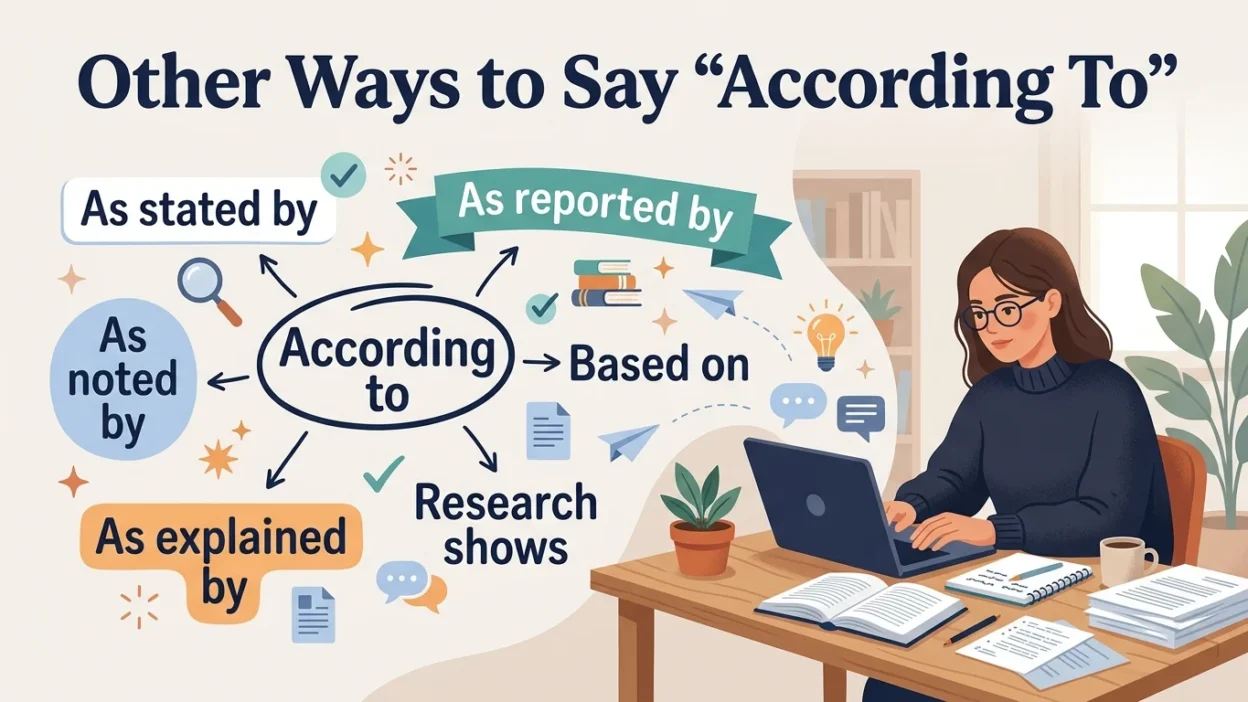
Finding the right words to express According to can make your message more thoughtful, natural, and caring. Whether you are writing an email, essay, or heartfelt note, choosing different ways to communicate can add warmth and personality.
Learning other ways to say according to can help you choose clear, natural wording for emails, essays, notes, and everyday communication today.
The phrase can have a specific meaning, but changing the wording can improve writing flow in daily use. Rather than making a message repetitive or overly formal, I often explore creative alternatives based on the tone and the needs of different situations. A professional, friendly, or casual message may each need a different approach, and this variety can make a huge difference in communication. When sharing information, repeated wording can feel lacking, while natural speech and personal writing often benefit from more flexible expressions. In my work as a writer who edits content daily, I have seen how carefully choosing words helps readers understand information more easily.
From a practical standpoint, engines search for useful and clear writing, so I confidently share this approach through academic blogs and professional content in an easy guide style. Every word should remain practical and beginner-friendly, especially for people who are learning writing. Repeating the same expression often weakens the experience for readers, making alternatives to the word according to a smart move for stronger communication skills, better sentence variety, and clear writing. These ideas are explained through simple human English and are shaped by real writing projects, experience, and practical use rather than theory.
Quick Answer
Common alternatives include as stated by, as reported by, as noted by, as mentioned by, as explained by, as indicated by, based on, in the words of, and as per. The best choice depends on whether you are attributing a statement, referring to evidence, or following a rule or source.
1. Professional Alternatives to “According To”
1. As Stated By
Definition: “As stated by” introduces information or an opinion that someone has explicitly stated.
Usage rule: Use it when the source has clearly expressed the information in words.
Practical example: “As stated by the director, the company will expand its training programme next year.”
Tips: This is especially useful in reports, formal correspondence, and professional documents where accurate attribution matters.
2. As Noted By
Definition: “As noted by” indicates that a person or source has pointed out or recorded particular information.
Usage rule: Use it when referring to an observation, detail, or issue highlighted by another source.
Practical example: “As noted by the project manager, the final stage requires additional testing.”
Tips: It sounds professional without being unnecessarily formal, making it useful for reports and business writing.
3. As Mentioned By
Definition: “As mentioned by” refers to information previously brought up by a person or source.
Usage rule: Use it when the information has already been mentioned in a conversation, document, meeting, or source.
Practical example: “As mentioned by our consultant, the revised schedule should reduce delays.”
Tips: This expression works particularly well when connecting one part of a discussion with another.
4. As Explained By
Definition: “As explained by” attributes an explanation or clarification to a particular person or source.
Usage rule: Use it when the source has provided reasons, details, or clarification.
Practical example: “As explained by the technician, the system needs a short restart after installation.”
Tips: Choose this phrase when the source did more than simply state a fact.
5. As Indicated By
Definition: “As indicated by” points to information suggested or demonstrated by a source, result, or piece of evidence.
Usage rule: Use it when evidence or data points toward a particular conclusion.
Practical example: “As indicated by the survey results, customer satisfaction improved during the quarter.”
Tips: This is particularly suitable for analytical, technical, and professional writing.
6. As Reported By
Definition: “As reported by” identifies a source that has reported particular information.
Usage rule: Use it when referring to information presented in a report, article, news source, or official statement.
Practical example: “As reported by the agency, applications increased significantly this year.”
Tips: Name the source when possible so readers can understand where the information came from.
7. As Confirmed By
Definition: “As confirmed by” introduces information that has been verified or officially confirmed by someone or something.
Usage rule: Use it when the source has explicitly verified the information.
Practical example: “As confirmed by the supplier, the equipment will arrive on Monday.”
Tips: Do not use this expression when the source merely suggests or predicts something.
2. Academic and Research Alternatives
1. Research Shows
Definition: “Research shows” introduces a conclusion or finding supported by research.
Usage rule: Use it when referring to evidence from research rather than simply attributing a personal statement.
Practical example: “Research shows that regular feedback can improve learning outcomes.”
Tips: Identify the study or research source when your writing requires strong academic support.
2. Studies Indicate
Definition: “Studies indicate” presents a conclusion suggested by one or more studies.
Usage rule: Use it when research evidence points toward a particular result without claiming absolute certainty.
Practical example: “Studies indicate that clear instructions can reduce workplace errors.”
Tips: This phrase is useful when discussing evidence while maintaining appropriately cautious academic language.
3. Evidence Suggests
Definition: “Evidence suggests” introduces a conclusion supported by available evidence.
Usage rule: Use it when the evidence supports an interpretation but does not necessarily prove it conclusively.
Practical example: “Evidence suggests that early planning can improve project efficiency.”
Tips: This is a useful alternative when you want to distinguish evidence from personal opinion.
4. Findings Show
Definition: “Findings show” refers to results discovered through research, analysis, or investigation.
Usage rule: Use it when you are discussing specific findings from a study, survey, review, or investigation.
Practical example: “The findings show that participants preferred the revised training format.”
Tips: Make sure the findings actually support the statement that follows.
5. Research Indicates
Definition: “Research indicates” presents information that research points toward or supports.
Usage rule: Use it when summarising evidence without overstating the certainty of the result.
Practical example: “Research indicates that practical exercises can strengthen skill development.”
Tips: This expression is suitable for academic articles, reports, and evidence-based content.
6. The Study States
Definition: “The study states” attributes a specific statement or position directly to a study.
Usage rule: Use it when the study itself explicitly presents the information.
Practical example: “The study states that participants completed the programme within six weeks.”
Tips: Use “states” for what the study says rather than using it to describe an interpretation that the study does not directly make.
7. According to the Research
Definition: “According to the research” remains a useful direct form when referring generally to research evidence.
Usage rule: Use it when the specific research source is already clear from the surrounding context.
Practical example: “According to the research, consistent practice can support long-term learning.”
Tips: Avoid repeating it in every paragraph; alternate it with accurate research-focused expressions where appropriate.
3. Alternatives for Essays and Formal Writing
1. In the Words of
Definition: “In the words of” introduces a direct quotation or a distinctive statement associated with a person.
Usage rule: Use it before quoting or closely referring to someone’s own wording.
Practical example: “In the words of the author, effective communication begins with careful listening.”
Tips: This phrase works best when the wording itself is important to your discussion.
2. As Described By
Definition: “As described by” attributes a description or account to a person or source.
Usage rule: Use it when explaining how a source portrays a person, event, process, or idea.
Practical example: “As described by the researcher, the experiment involved three stages.”
Tips: It is useful in essays where you compare different descriptions of the same subject.
3. As Defined By
Definition: “As defined by” introduces a definition established by a person, organisation, academic source, or authority.
Usage rule: Use it when the exact definition comes from an identifiable source.
Practical example: “As defined by the organisation, sustainable development includes long-term environmental planning.”
Tips: This phrase is especially valuable when a term has several possible meanings.
4. As Observed By
Definition: “As observed by” attributes an observation to a person or source.
Usage rule: Use it when the source has directly noticed or recorded something.
Practical example: “As observed by the researcher, participants became more confident during the second session.”
Tips: Use it for observations rather than general facts that the source did not personally observe.
5. As Discussed By
Definition: “As discussed by” identifies an idea that a source has examined or considered.
Usage rule: Use it when referring to a topic, argument, or issue explored in a source.
Practical example: “As discussed by several scholars, language changes naturally over time.”
Tips: This is a useful academic expression when reviewing existing literature.
6. As Suggested By
Definition: “As suggested by” introduces an idea or conclusion proposed by a source.
Usage rule: Use it when the source suggests a possibility rather than directly confirms a fact.
Practical example: “As suggested by the findings, additional training may be beneficial.”
Tips: “Suggested” is often preferable to stronger wording when evidence remains limited.
7. As Pointed Out By
Definition: “As pointed out by” highlights an observation, fact, or issue emphasised by someone.
Usage rule: Use it when the source specifically draws attention to something important.
Practical example: “As pointed out by the author, small changes can have lasting effects.”
Tips: It is natural in essays and analytical writing, although “as noted by” may sound more formal.
4. Alternatives Based on Sources, Evidence, and Information
1. Based On
Definition: “Based on” indicates that a statement, decision, or conclusion relies on particular information or evidence.
Usage rule: Use it when you are explaining the foundation for a conclusion rather than directly attributing a quotation.
Practical example: “Based on the available data, the team revised its forecast.”
Tips: Do not treat “based on” as an exact substitute for every use of “according to.”
2. In Light Of
Definition: “In light of” means considering information, evidence, or circumstances.
Usage rule: Use it when new or relevant information influences an interpretation or decision.
Practical example: “In light of the latest findings, the company updated its policy.”
Tips: This phrase is more suitable for explaining a response to information than simply identifying its source.
3. On The Basis Of
Definition: “On the basis of” identifies the information or evidence used to support a decision or conclusion.
Usage rule: Use it in formal contexts when explaining why something was decided or concluded.
Practical example: “The application was reviewed on the basis of the submitted documents.”
Tips: It has a formal tone and works well in reports, policies, and official documents.
4. As Demonstrated By
Definition: “As demonstrated by” connects a claim with evidence that clearly illustrates or supports it.
Usage rule: Use it when an example, result, or observation demonstrates the point being made.
Practical example: “As demonstrated by the test results, the updated system performs more efficiently.”
Tips: Make sure the evidence genuinely demonstrates the claim rather than merely relating to it.
5. As Shown By
Definition: “As shown by” introduces evidence that visibly or clearly supports a statement.
Usage rule: Use it when referring to charts, results, records, examples, or other observable evidence.
Practical example: “As shown by the monthly figures, sales increased after the campaign.”
Tips: It is straightforward and easy to understand, making it useful in general and professional writing.
6. As Reflected In
Definition: “As reflected in” connects an idea with information represented in a record, result, document, or measurement.
Usage rule: Use it when evidence or information mirrors a particular trend or situation.
Practical example: “As reflected in the annual report, operating costs decreased.”
Tips: This expression is especially useful in business reports and formal analysis.
7. In Reference To
Definition: “In reference to” means concerning or relating to a particular subject or source.
Usage rule: Use it when directing attention to a specific matter rather than directly attributing a statement.
Practical example: “In reference to the recent report, several recommendations require further review.”
Tips: Do not use it as a universal replacement for “according to”; its meaning is closer to “regarding.”
5. Conversational and Everyday Alternatives
1. As I Understand It
Definition: “As I understand it” introduces information based on the speaker’s understanding.
Usage rule: Use it when you want to communicate your interpretation without presenting it as absolute fact.
Practical example: “As I understand it, the meeting has been moved to Friday.”
Tips: This phrase is useful when you want to leave room for correction.
2. From What I Hear
Definition: “From what I hear” introduces information the speaker has heard from others.
Usage rule: Use it in informal conversation when the source is indirect or not formally documented.
Practical example: “From what I hear, the new café will open next month.”
Tips: Avoid this phrase in formal reports when you need verifiable sourcing.
3. From What I’ve Read
Definition: “From what I’ve read” identifies information the writer has learned through reading.
Usage rule: Use it when summarising information from books, articles, reports, or other written sources.
Practical example: “From what I’ve read, the new method can save considerable time.”
Tips: Name the source when accuracy and credibility are important.
4. As Far As I Know
Definition: “As far as I know” signals that the information reflects the speaker’s current knowledge.
Usage rule: Use it when you are reasonably confident but do not want to imply complete certainty.
Practical example: “As far as I know, the office remains closed on Sundays.”
Tips: This is conversational and should generally be avoided when a precise source is required.
5. From My Understanding
Definition: “From my understanding” introduces information based on the writer’s interpretation.
Usage rule: Use it when explaining how you understand a situation or instruction.
Practical example: “From my understanding, everyone needs to submit the form before Friday.”
Tips: It is useful when discussing instructions or situations that may need confirmation.
6. In My Understanding
Definition: “In my understanding” presents an interpretation from the speaker’s perspective.
Usage rule: Use it when clarifying your personal interpretation of information.
Practical example: “In my understanding, the agreement covers both services.”
Tips: “As I understand it” is often more natural in everyday English.
7. From What I Gather
Definition: “From what I gather” means based on the information the speaker has collected or understood.
Usage rule: Use it when forming a general understanding from several pieces of information.
Practical example: “From what I gather, the team is considering several options.”
Tips: This is informal and conversational, so it is better suited to discussions than formal academic writing.
Placement & Grammar Rules Table
| Synonym or phrase | Sentence position / placement | Tone / formality | Example sentence |
| As stated by | Before the source or clause | Professional | As stated by the manager, the deadline remains unchanged. |
| As noted by | Before the source or clause | Professional | As noted by the researcher, the results require further review. |
| As mentioned by | Before the source or clause | Neutral | As mentioned by Sarah, the meeting starts at nine. |
| As explained by | Before the source or clause | Professional | As explained by the technician, the update requires a restart. |
| As indicated by | Before evidence or source | Formal | As indicated by the figures, demand has increased. |
| As reported by | Before the reporting source | Formal | As reported by the agency, applications increased. |
| As confirmed by | Before the confirming source | Professional | As confirmed by the supplier, delivery is scheduled for Monday. |
| Research shows | At the beginning of a statement | Academic | Research shows that practice improves retention. |
| Studies indicate | At the beginning of a research statement | Academic | Studies indicate that clear feedback supports learning. |
| Evidence suggests | Before an evidence-based conclusion | Academic | Evidence suggests that early planning reduces delays. |
| In the words of | Before a quotation or attributed statement | Formal | In the words of the author, communication requires attention. |
| As defined by | Before a defining source | Formal | As defined by the organisation, the term covers three areas. |
| Based on | Before evidence or information | Neutral to professional | Based on the data, the team changed its approach. |
| As demonstrated by | Before supporting evidence | Formal | As demonstrated by the results, the method was effective. |
| As shown by | Before visible evidence | Neutral | As shown by the chart, sales increased. |
| As I understand it | At the beginning of a statement | Conversational | As I understand it, the appointment is tomorrow. |
| As far as I know | Usually at the beginning | Casual | As far as I know, the store closes at six. |
| As per | Before a rule, instruction, or document | Formal/business | As per the agreement, payment is due Friday. |
Common Mistakes When Using Alternatives to “According To”
One common mistake is treating every alternative as an exact synonym. Expressions such as based on, in reference to, and in light of have related meanings but perform different grammatical and logical functions. “According to” usually identifies the source of information, whereas “based on” often identifies the evidence behind a conclusion.
Another mistake is overstating what a source actually says. For example, as confirmed by should not be used when a source merely suggests something. Likewise, research shows should only be used when the available research genuinely supports the statement. Accurate attribution is more important than finding a sophisticated-sounding phrase.
Writers should also avoid using informal expressions such as from what I hear or as far as I know in situations that require documented evidence. In academic and professional writing, identify the source whenever practical and choose wording that accurately describes whether the source stated, suggested, demonstrated, reported, or confirmed the information.
Finally, avoid forcing alternatives into sentences where they sound unnatural. Good writing is not about replacing every occurrence of “according to.” Sometimes repeating a familiar phrase is clearer than using an unusual synonym simply to create variation.
Practical Example Paragraphs
Academic writing:
Research-based writing benefits from precise attribution. Studies indicate that learners often benefit from clear feedback, while evidence suggests that practical activities can improve engagement. As noted by several researchers, the learning environment also affects how students respond to new material.
Professional report:
As reported by the operations team, delivery times improved during the previous quarter. As indicated by the monthly figures, fewer orders experienced delays. Based on these results, the company decided to review the process and identify additional opportunities for improvement.
Business email:
As mentioned by the client during our meeting, the revised proposal should include the updated pricing information. As confirmed by our finance team, the figures are now ready. Please review the attached document and let me know if anything needs to be changed.
Everyday conversation:
As far as I know, the event starts at seven. From what I’ve read, parking is available near the entrance, and from what I gather, most people arrive about thirty minutes early. I would still check the latest details before leaving.
Formal essay:
As defined by the relevant organisation, sustainability involves long-term planning that considers environmental and social factors. As discussed by several scholars, the concept has developed over time. As demonstrated by recent examples, its practical application can vary across different industries.
FAQs
1. What is another way to say “according to” in an essay?
Useful alternatives include as stated by, as noted by, as discussed by, as described by, as suggested by, and in the words of. Choose one according to what the source actually says.
2. What can I say instead of “according to” in academic writing?
Academic alternatives include research indicates, studies show, evidence suggests, as demonstrated by, and as noted by. The appropriate choice depends on whether you are referring to research findings, evidence, or a specific author’s statement.
3. What is a professional alternative to “according to”?
As stated by, as noted by, as reported by, as indicated by, and as confirmed by can work well in professional writing when their meanings accurately match the source.
4. What is a casual way to say “according to”?
In casual conversation, you can use as I understand it, from what I hear, from what I’ve read, as far as I know, or from what I gather.
5. Is “based on” the same as “according to”?
Not always. “According to” normally identifies the source of information, while “based on” usually explains what information or evidence a conclusion relies upon. They can overlap in some contexts but should not automatically replace one another.
6. Can I use “as per” instead of “according to”?
Yes, in some formal and business contexts. As per commonly refers to a rule, instruction, agreement, request, or document. For example, “As per the agreement, payment is due Friday.”
7. How do I avoid repeating “according to” in an essay?
First identify what the source is doing. If it makes a statement, use as stated by; if it reports information, use as reported by; if it suggests a conclusion, use as suggested by; and if it provides evidence, use as demonstrated by.
8. What is another way to say “according to the author”?
Depending on the context, you can use as stated by the author, as noted by the author, as explained by the author, as described by the author, or in the words of the author.
9. What can I use instead of “according to research”?
You can write research shows, research indicates, studies indicate, evidence suggests, or research findings show, provided the wording accurately represents the evidence.
Final Thoughts
Knowing other ways to say according to gives you more control over tone, clarity, and source attribution.
Professional, academic, conversational, and formal contexts each allow different expressions.
The key is to match the alternative with what the source actually states or demonstrates.
Use variation to improve readability, not simply to avoid repeating a familiar phrase.
Precise attribution also makes essays, reports, emails, and articles easier to trust and understand.