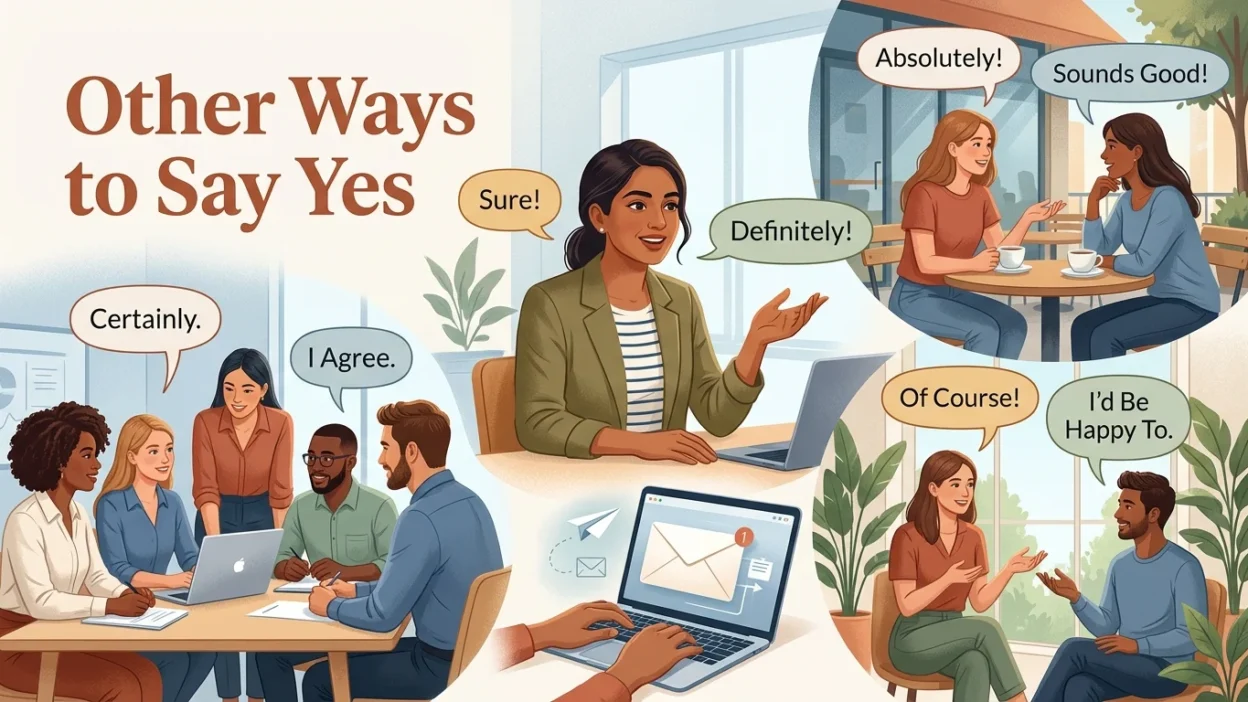
Finding other ways to say yes can make your English sound more natural because one simple word can express agreement, permission, excitement, acceptance, confidence, or support. At work, in conversations with friends, during formal meetings, and even in life-changing moments, the right response can communicate a specific feeling. Repeating yes in every situation may sound flat, rushed, or unclear, so choosing a suitable alternative can make your message more precise.
The key is to notice different situations and different tones before choosing your response. Alternative ways of saying yes can improve your communication and help you sound natural, professional, polite, enthusiastic, careful, or confident. The right response can help you express what you feel without sounding forced. I have found that selecting the right phrase instead of repeating the same answer makes everyday conversations feel more genuine, while a thoughtful alternative can show support when the moment calls for it.
Learning useful expressions matters because real communication depends on context rather than one fixed response. This guide offers 400+ clear, human-sounding alternatives for real-life use, with each option explained simply and practically so you can understand what fits. Instead of trying to replace one word with another without thinking, you can choose an expression that communicates your intended meaning clearly and naturally.
Quick Answer
Some natural alternatives to “yes” include absolutely, certainly, definitely, of course, sure, exactly, indeed, I agree, that works, sounds good, I’d be happy to, and by all means. The best choice depends on your relationship with the listener, the level of formality, and the meaning you want to express.
Professional and Formal Ways to Say Yes
1. Certainly
Definition: “Certainly” is a polite and confident way to show agreement or willingness.
Usage rule: Use it in professional conversations, workplace discussions, emails, and formal requests when you want to sound respectful without being overly formal.
Practical examples: “Certainly, I can send the report this afternoon.” “Certainly, we can discuss the proposal tomorrow.”
Tips: Use “certainly” when you want your agreement to sound clear and dependable. It is especially useful when responding to requests.
2. Absolutely
Definition: “Absolutely” expresses strong agreement, certainty, or enthusiastic approval.
Usage rule: Use it when you strongly agree with something or want to make your positive response more emphatic.
Practical examples: “Absolutely, I agree with your recommendation.” “Absolutely, we should review the figures before the meeting.”
Tips: “Absolutely” works in both professional and casual English, but it can sound more enthusiastic than a simple “yes”.
3. Definitely
Definition: “Definitely” means certainly or without doubt and communicates strong agreement.
Usage rule: Use it when you are confident about your answer, decision, intention, or willingness.
Practical examples: “Definitely, I’ll join the meeting.” “We should definitely consider that option.”
Tips: It is a useful alternative when you want to sound confident rather than merely agreeable.
4. Of Course
Definition: “Of course” is a natural expression used to show agreement, willingness, or permission.
Usage rule: Use it when the request or suggestion is reasonable and you are comfortable agreeing.
Practical examples: “Of course, I can help you with that.” “Of course, you can use my notes.”
Tips: Your tone matters. A warm tone makes “of course” sound helpful, while a sarcastic tone can make it sound dismissive.
5. I Agree
Definition: “I agree” directly communicates that you share another person’s opinion or position.
Usage rule: Use it when responding to an argument, suggestion, opinion, or statement rather than simply accepting a request.
Practical examples: “I agree that the current process needs improvement.” “I agree with your point.”
Tips: Add “with you,” “with that,” or a specific point when you want to make your agreement more precise.
6. I’d Be Happy To
Definition: “I’d be happy to” shows willingness while adding a friendly and professional tone.
Usage rule: Use it when accepting a task, offer, request, or responsibility.
Practical examples: “I’d be happy to prepare the presentation.” “I’d be happy to answer any questions.”
Tips: This expression is particularly useful in professional emails because it sounds cooperative without being too casual.
7. By All Means
Definition: “By all means” means that you are giving permission or strongly encouraging someone to proceed.
Usage rule: Use it when someone asks whether they may do something and you want to give clear permission.
Practical examples: “By all means, feel free to contact me.” “By all means, use the conference room.”
Tips: This phrase is more formal than “sure” and works particularly well in polite conversations.
Casual and Everyday Alternatives to Yes
1. Sure
Definition: “Sure” is one of the most common informal alternatives to yes.
Usage rule: Use it with friends, colleagues you know well, family members, or in relaxed conversations.
Practical examples: “Sure, I can help.” “Sure, let’s meet after work.”
Tips: Keep “sure” for situations where a relaxed tone is appropriate. In very formal writing, choose a more professional expression.
2. Sounds Good
Definition: “Sounds good” shows that you approve of an idea, plan, suggestion, or arrangement.
Usage rule: Use it when someone proposes something and you want to accept it naturally.
Practical examples: “Let’s meet at six.” “Sounds good.” “I’ll send the details tonight.” “Sounds good.”
Tips: It is especially natural in text messages, chats, emails between familiar colleagues, and everyday speech.
3. That Works
Definition: “That works” means that a suggested plan, time, arrangement, or solution is acceptable.
Usage rule: Use it when you agree that a practical arrangement is suitable.
Practical examples: “Can we meet on Thursday?” “That works for me.” “Would 3 p.m. be okay?” “That works.”
Tips: Add “for me” when you want to make your acceptance especially clear.
4. Sure Thing
Definition: “Sure thing” is a friendly way to agree to a request.
Usage rule: Use it mainly in casual or semi-casual conversations.
Practical examples: “Can you send me the file?” “Sure thing.” “Could you save me a seat?” “Sure thing.”
Tips: Avoid it in highly formal correspondence because it can sound too conversational.
5. You Got It
Definition: “You got it” communicates agreement and willingness to complete a request.
Usage rule: Use it when someone asks you to do something and you want to respond in a friendly, confident way.
Practical examples: “Can you call the client?” “You got it.” “Please send the invoice today.” “You got it.”
Tips: This expression is common in spoken English and informal workplace communication.
6. For Sure
Definition: “For sure” is an informal expression meaning definitely or certainly.
Usage rule: Use it in relaxed conversations when you want to show confident agreement.
Practical examples: “Are you coming tonight?” “For sure.” “Can you help me tomorrow?” “For sure.”
Tips: It is natural in conversation but usually less suitable for formal reports or official letters.
7. Definitely
Definition: “Definitely” communicates strong and confident agreement in everyday situations.
Usage rule: Use it when you want to make your positive answer stronger than a simple “yes”.
Practical examples: “Want to grab lunch?” “Definitely.” “Should we try that restaurant?” “Definitely.”
Tips: Because it expresses certainty, do not use it if you are still unsure about your decision.
Enthusiastic Ways to Say Yes
1. Absolutely!
Definition: “Absolutely!” is an enthusiastic way to show very strong agreement.
Usage rule: Use it when you genuinely feel excited or strongly supportive of an idea.
Practical examples: “Would you like to come with us?” “Absolutely!” “Should we celebrate tonight?” “Absolutely!”
Tips: The exclamation mark is useful in informal writing when you want to make your enthusiasm visible.
2. Definitely!
Definition: “Definitely!” communicates strong enthusiasm and certainty.
Usage rule: Use it when you are excited about accepting an invitation, suggestion, or opportunity.
Practical examples: “Are you joining the trip?” “Definitely!” “Do you want to see the new film?” “Definitely!”
Tips: It is stronger than a neutral “yes” because it communicates confidence as well as agreement.
3. I’d Love To
Definition: “I’d love to” expresses enthusiastic willingness to accept an invitation or opportunity.
Usage rule: Use it when you genuinely want to do what the other person suggests.
Practical examples: “Would you like to join us for dinner?” “I’d love to.” “Would you like to speak at the event?” “I’d love to.”
Tips: This phrase sounds warm and natural and is useful in both personal and professional settings.
4. Absolutely, Let’s Do It
Definition: This phrase shows strong agreement combined with enthusiasm for taking action.
Usage rule: Use it when a decision has been made and you are ready to move forward.
Practical examples: “Should we launch the project next month?” “Absolutely, let’s do it.” “Want to try the new activity?” “Absolutely, let’s do it.”
Tips: It is most appropriate when you want to sound energetic and decisive.
5. Count Me In
Definition: “Count me in” means that you want to participate in a planned activity or event.
Usage rule: Use it when someone invites you to join something.
Practical examples: “We’re going hiking Saturday.” “Count me in.” “We need volunteers for the event.” “Count me in.”
Tips: This is an informal but highly natural expression of enthusiastic agreement.
6. I’m In
Definition: “I’m in” communicates that you agree to participate or support a plan.
Usage rule: Use it when you have decided to join an activity, project, or plan.
Practical examples: “We’re starting a new study group.” “I’m in.” “How about trying something different this weekend?” “I’m in.”
Tips: It is short, confident, and especially common in spoken English.
7. Sounds Great
Definition: “Sounds great” shows positive approval and enthusiasm about an idea or plan.
Usage rule: Use it when someone suggests something that you genuinely like.
Practical examples: “Let’s have lunch together.” “Sounds great.” “I’ll send you the schedule tonight.” “Sounds great.”
Tips: It is a useful alternative to “yes” when you want to show both agreement and positive emotion.
Polite Ways to Say Yes
1. Certainly
Definition: “Certainly” is a courteous expression of agreement or willingness.
Usage rule: Use it when you want your response to sound respectful and composed.
Practical examples: “Certainly, I can arrange that for you.” “Certainly, please take a seat.”
Tips: It is suitable for customer service, professional communication, and formal conversations.
2. Of Course
Definition: “Of course” can politely communicate agreement or willingness.
Usage rule: Use it when helping someone or accepting a reasonable request.
Practical examples: “Could you explain that again?” “Of course.” “May I ask a question?” “Of course.”
Tips: A friendly tone keeps this expression warm and welcoming.
3. Please Do
Definition: “Please do” gives polite permission or encouragement.
Usage rule: Use it when someone asks whether they may take an action.
Practical examples: “May I contact you next week?” “Please do.” “Can I send you the document?” “Please do.”
Tips: It is especially useful when you want to sound courteous without using a long response.
4. Certainly, Go Ahead
Definition: “Certainly, go ahead” combines agreement with permission to proceed.
Usage rule: Use it when someone asks for approval before taking an action.
Practical examples: “May I begin the presentation?” “Certainly, go ahead.” “Can I open the window?” “Certainly, go ahead.”
Tips: This expression makes your permission especially clear.
5. That Would Be Fine
Definition: “That would be fine” politely indicates that a suggested arrangement is acceptable.
Usage rule: Use it when responding to a proposed time, plan, or arrangement.
Practical examples: “Would Friday afternoon work for you?” “That would be fine.” “Could we move the meeting?” “That would be fine.”
Tips: It is useful when you want a calm and professional tone rather than enthusiastic language.
6. I’d Be Pleased To
Definition: “I’d be pleased to” expresses willingness in a formal and courteous manner.
Usage rule: Use it when accepting a professional invitation, responsibility, or request.
Practical examples: “Would you be willing to attend the meeting?” “I’d be pleased to.” “Could you assist with the project?” “I’d be pleased to.”
Tips: This expression works best in formal professional contexts.
7. With Pleasure
Definition: “With pleasure” communicates willing and polite agreement.
Usage rule: Use it when accepting a request or offering help in a courteous way.
Practical examples: “Could you help me with this?” “With pleasure.” “Would you like me to introduce you?” “With pleasure.”
Tips: It has a polished tone and is more formal than “sure”.
Ways to Say Yes in Emails and Workplace Communication
1. I Agree
Definition: “I agree” clearly confirms that you share an opinion or position.
Usage rule: Use it when responding to a workplace proposal, argument, or recommendation.
Practical examples: “I agree that we should update the policy.” “I agree with your assessment.”
Tips: Follow it with a short reason when your agreement needs additional context.
2. That Works for Me
Definition: “That works for me” confirms that a proposed arrangement is suitable.
Usage rule: Use it when discussing schedules, deadlines, meeting times, or practical arrangements.
Practical examples: “Can we meet at 10 a.m.?” “That works for me.” “Would Friday be suitable?” “That works for me.”
Tips: This is one of the most useful alternatives to “yes” in workplace communication.
3. I’m Happy to Confirm
Definition: “I’m happy to confirm” provides a positive and professional confirmation.
Usage rule: Use it when confirming an appointment, arrangement, decision, or agreement.
Practical examples: “I’m happy to confirm that the meeting will take place on Monday.” “I’m happy to confirm your booking.”
Tips: This expression works particularly well in professional emails.
4. I Can Confirm
Definition: “I can confirm” communicates that information or an arrangement is officially verified.
Usage rule: Use it when you have reliable information and want to provide a clear confirmation.
Practical examples: “I can confirm that your request has been received.” “I can confirm that the meeting is scheduled.”
Tips: Use it when you are confirming facts rather than simply expressing personal agreement.
5. That Is Acceptable
Definition: “That is acceptable” indicates that a proposal or condition meets your requirements.
Usage rule: Use it when you want a formal, neutral way to approve something.
Practical examples: “The revised deadline is acceptable.” “That arrangement is acceptable to us.”
Tips: This phrase is formal and should be used when a neutral business tone is appropriate.
6. I’m Happy to Proceed
Definition: “I’m happy to proceed” communicates willingness to move forward with a plan.
Usage rule: Use it after reviewing information or discussing a proposal.
Practical examples: “I’ve reviewed the terms, and I’m happy to proceed.” “We’re happy to proceed with the next stage.”
Tips: It is more informative than simply saying “yes” because it makes your intention clear.
7. Agreed
Definition: “Agreed” is a concise professional expression confirming shared understanding or approval.
Usage rule: Use it when both sides have discussed a matter and reached the same decision.
Practical examples: “We’ll review the contract tomorrow.” “Agreed.” “Let’s move the deadline to Friday.” “Agreed.”
Tips: It works particularly well in meetings, project discussions, and concise professional messages.
Creative and Natural Alternatives to Yes
1. Exactly
Definition: “Exactly” shows that you strongly agree with what someone has just said.
Usage rule: Use it when another person’s statement accurately matches your own thoughts.
Practical examples: “The main issue is communication.” “Exactly.” “We need a simpler process.” “Exactly.”
Tips: Do not use “exactly” for every kind of yes. It specifically signals agreement with a statement or idea.
2. Indeed
Definition: “Indeed” is a formal expression used to affirm or reinforce a statement.
Usage rule: Use it when you want your response to sound polished, formal, or somewhat emphatic.
Practical examples: “This is an important consideration.” “Indeed, it is.” “The results are encouraging.” “Indeed.”
Tips: “Indeed” is more common in formal or written English than in casual conversation.
3. That’s Right
Definition: “That’s right” confirms that something is correct or accurate.
Usage rule: Use it when agreeing with information, a statement, or a conclusion.
Practical examples: “The meeting starts at nine?” “That’s right.” “You wanted the updated version?” “That’s right.”
Tips: It is particularly useful when confirming facts.
4. You’re Absolutely Right
Definition: “You’re absolutely right” strongly confirms that another person’s statement or opinion is correct.
Usage rule: Use it when you genuinely agree with the person’s point.
Practical examples: “We need to communicate earlier.” “You’re absolutely right.” “The current process takes too long.” “You’re absolutely right.”
Tips: This expression can make your agreement sound more supportive and personal.
5. Fair Enough
Definition: “Fair enough” indicates that you accept or understand another person’s point.
Usage rule: Use it when you recognise that someone’s argument or decision is reasonable, even if you do not fully share their view.
Practical examples: “I think we should wait until Monday.” “Fair enough.” “You have a different approach.” “Fair enough.”
Tips: It does not always mean enthusiastic agreement, so use it when your acceptance is qualified or measured.
6. That Makes Sense
Definition: “That makes sense” shows that you understand and accept the reasoning behind an idea.
Usage rule: Use it when someone explains a decision, suggestion, or point that you find logical.
Practical examples: “We moved the deadline because the client needed more time.” “That makes sense.” “We should test it first.” “That makes sense.”
Tips: This phrase is excellent when you want to show understanding rather than simple agreement.
7. I’m With You
Definition: “I’m with you” communicates support for another person’s idea, position, or plan.
Usage rule: Use it when you want to show that you support someone’s direction or opinion.
Practical examples: “I think we should simplify the process.” “I’m with you.” “We need to focus on quality first.” “I’m with you.”
Tips: It is friendly and supportive, making it particularly useful in collaborative conversations.
Placement & Grammar Rules Table
| Synonym or phrase | Sentence position / placement | Tone / formality | Example sentence |
| Certainly | Beginning or standalone response | Polite, professional | “Certainly, I can help with that.” |
| Absolutely | Beginning or standalone response | Strong, enthusiastic | “Absolutely, I agree with you.” |
| Definitely | Beginning, middle, or standalone | Confident, natural | “Definitely, I’ll attend the meeting.” |
| Of course | Beginning or standalone response | Polite, friendly | “Of course, you can ask a question.” |
| I agree | Beginning or standalone | Professional, direct | “I agree with your recommendation.” |
| I’d be happy to | Beginning of a response | Warm, professional | “I’d be happy to review the document.” |
| By all means | Beginning or standalone | Polite, formal | “By all means, please continue.” |
| Sure | Beginning or standalone | Casual, friendly | “Sure, I can help.” |
| Sounds good | Standalone or after a proposal | Casual, positive | “Sounds good. Let’s meet tomorrow.” |
| That works for me | Standalone or after a proposed arrangement | Neutral, professional | “Thursday afternoon works for me.” |
| I’d love to | Beginning or standalone | Warm, enthusiastic | “I’d love to join you.” |
| Count me in | Standalone | Casual, enthusiastic | “Count me in for the event.” |
| Please do | Standalone response | Polite | “Please do, and let me know how it goes.” |
| Agreed | Standalone or beginning | Concise, professional | “Agreed. We’ll proceed tomorrow.” |
| Exactly | Standalone or beginning | Conversational, emphatic | “Exactly. That is the main issue.” |
| That makes sense | Standalone or beginning | Neutral, conversational | “That makes sense to me.” |
| With pleasure | Standalone response | Formal, courteous | “With pleasure. I’d be glad to assist.” |
| I’m happy to proceed | Beginning of a sentence | Professional | “I’m happy to proceed with the proposal.” |
| That is acceptable | Beginning or standalone | Formal, neutral | “That is acceptable to our team.” |
| You got it | Standalone response | Casual, confident | “You got it. I’ll send it today.” |
Common Mistakes When Using Other Ways to Say Yes
One common mistake is choosing an expression based only on its dictionary meaning rather than its tone. For example, “sure thing” may be perfectly natural with a friend but can sound too casual in a formal business letter. Similarly, “with pleasure” is polite but may sound unusually formal in a relaxed text message.
Another mistake is using phrases that express a slightly different type of agreement as if they were interchangeable. “Exactly” normally confirms that a statement is correct, while “that makes sense” shows that you understand someone’s reasoning. “By all means” gives permission, whereas “I agree” expresses agreement with an opinion or idea.
A third mistake is overusing strong expressions. Words such as “absolutely” and “definitely” communicate confidence and emphasis. If you are uncertain, saying “definitely” can make your message sound stronger than you intend. Choose an expression that accurately reflects your actual level of certainty.
It is also important to consider punctuation and context. In casual messages, “Absolutely!” can sound warm and enthusiastic, while “Absolutely.” can feel more restrained. In professional emails, a complete sentence often sounds clearer than relying on a one-word response.
Practical Example Paragraphs
When a colleague asks whether you can review a document before a meeting, simply saying “yes” is correct, but a more useful response could be: “Certainly, I’d be happy to review it before the meeting. That works for me, and I can send you my comments this afternoon.” This response confirms agreement, shows willingness, and gives the other person useful information.
For a casual invitation, you might say: “Absolutely! I’d love to come. Sounds great, and you can count me in.” These expressions communicate more enthusiasm than a basic “yes” and make the conversation feel more natural and friendly.
When someone presents an idea you strongly support, you could respond: “Exactly. That makes sense, and I’m with you on that. I definitely think we should move forward.” Here, each expression has a slightly different function: “exactly” confirms the point, “that makes sense” shows understanding, “I’m with you” expresses support, and “definitely” adds confidence.
For permission, a polite response might be: “Of course. By all means, please go ahead.” This sounds more welcoming than a short “yes” and clearly tells the other person that they have permission to continue.
FAQs
What is a professional way to say yes?
Professional alternatives include certainly, absolutely, I agree, I’d be happy to, I’m happy to proceed, that works for me, and agreed. The best choice depends on whether you are confirming an opinion, accepting a request, or approving an arrangement.
What is a polite way to say yes?
Polite options include certainly, of course, please do, by all means, with pleasure, and I’d be pleased to. These expressions are useful when you want to sound respectful and helpful.
What is a casual way to say yes?
Common casual alternatives include sure, sounds good, that works, sure thing, you got it, for sure, I’m in, and count me in. These expressions work well with friends, family, and familiar colleagues.
How can I say yes without sounding repetitive?
Choose an expression based on what you actually mean. Use I agree for opinions, sounds good for plans, certainly for polite acceptance, by all means for permission, and absolutely for strong agreement.
What is another way to say yes in an email?
For professional emails, you can certainly write, I’d be happy to, I agree, that works for me, I’m happy to proceed, I can confirm, or I’d be pleased to. Complete sentences are usually clearer than very short responses.
What is an enthusiastic way to say yes?
You can use absolutely, definitely, I’d love to, sounds great, count me in, I’m in, or absolutely, let’s do it. These phrases communicate positive emotion as well as agreement.
Is “sure” a professional way to say yes?
“Sure” can be acceptable in friendly workplace conversations, especially with familiar colleagues, but it is more casual than certainly or I’d be happy to. For formal emails, a more specific expression is usually preferable.
Is “absolutely” stronger than “yes”?
Usually, yes. “Absolutely” generally adds emphasis and communicates strong agreement or confidence. It is useful when you want your positive response to sound enthusiastic or certain.
What is the difference between “I agree” and “that makes sense”?
“I agree” directly indicates that you share someone’s opinion or conclusion. “That makes sense” indicates that you understand the reasoning and consider it logical, but it does not necessarily express complete agreement.
What is the best alternative to yes?
There is no single alternative that fits every situation. The most suitable expression depends on your intended meaning, relationship with the listener, level of formality, and degree of enthusiasm.
Final Thoughts
Knowing other ways to say yes helps you make everyday and professional communication more precise.
Instead of repeating one word, you can choose an expression that matches your tone and purpose.
Use certainly for polite agreement, sounds good for plans, and absolutely for strong enthusiasm.
For professional emails, choose clear expressions such as I’d be happy to or I can confirm.
The key is to match your words with the situation and the meaning you genuinely want to communicate.