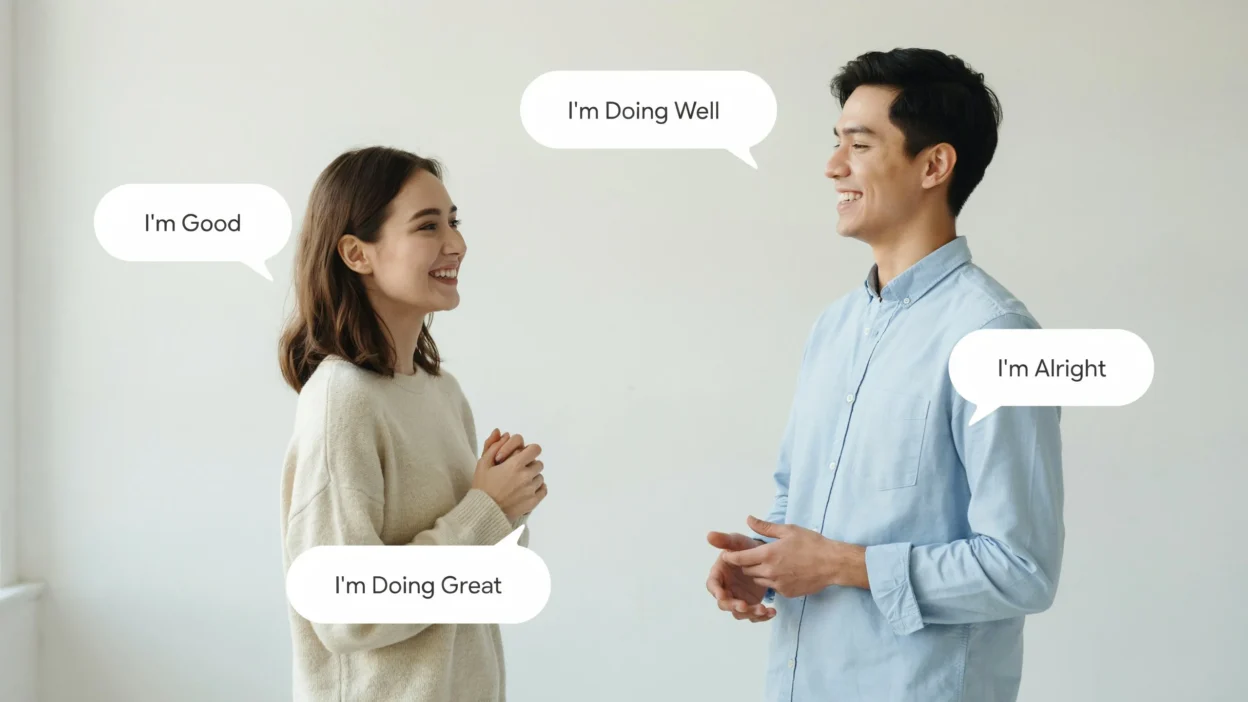
“I’m fine” is one of the most common responses when someone asks how you are, but it can sometimes sound repetitive, distant, or overly simple. Depending on the situation, you may want to sound more cheerful, relaxed, professional, honest, or reassuring.
Knowing other ways to say I’m fine gives you more flexibility when speaking or writing. Whether you are replying to a friend, answering a colleague, responding to a customer, or having a casual conversation, choosing the right expression helps you communicate your mood more naturally.
Quick Answer
Some natural alternatives to “I’m fine” include “I’m doing well,” “I’m good,” “I’m doing great,” “I’m alright,” “I’m doing okay,” “Everything’s good,” and “I’m feeling pretty good.” The best choice depends on your mood, relationship, and level of formality.
Casual and Everyday Ways to Say I’m Fine
These expressions are useful in everyday conversations with friends, family, classmates, neighbours, and acquaintances. They sound natural and relaxed without being overly formal.
I’m Good
Definition: “I’m good” is a casual way to say that you are fine, well, or doing satisfactorily.
Usage rule: Use it in informal conversations when someone asks how you are.
Practical example: “How are you?” “I’m good, thanks. How about you?”
Tips: This is one of the most common conversational alternatives to “I’m fine.”
I’m Doing Well
Definition: “I’m doing well” means that things are generally going positively for you.
Usage rule: Use it in both casual and professional conversations.
Practical example: “I’m doing well, thanks. Work has been busy, but everything is going smoothly.”
Tips: This is a versatile alternative when you want to sound polite and positive.
I’m Alright
Definition: “I’m alright” means that you are okay or reasonably well.
Usage rule: Use it in relaxed conversations when you want a neutral response.
Practical example: “I’m alright, thanks. Just a little tired today.”
Tips: It can communicate that you are okay without suggesting that everything is perfect.
I’m Okay
Definition: “I’m okay” means that you are fine or managing reasonably well.
Usage rule: Use it when you want a simple, neutral response.
Practical example: “Don’t worry about me. I’m okay.”
Tips: Depending on your tone, it can sometimes suggest that you are not feeling especially good.
I’m Doing Okay
Definition: “I’m doing okay” means that you are managing or feeling reasonably well.
Usage rule: Use it when things are acceptable but not necessarily excellent.
Practical example: “How have you been?” “I’m doing okay, just dealing with a lot of work.”
Tips: Choose this when “I’m great” would sound too positive.
I’m Pretty Good
Definition: “I’m pretty good” means that you are feeling generally positive or well.
Usage rule: Use it in informal conversations.
Practical example: “I’m pretty good. I’ve had a productive week.”
Tips: It sounds relaxed and conversational.
Not Too Bad
Definition: “Not too bad” is an informal way of saying that you are reasonably well.
Usage rule: Use it when things are acceptable or better than expected.
Practical example: “How’s everything going?” “Not too bad, thanks.”
Tips: This phrase is common in casual British English and often sounds understated.
Positive and Cheerful Alternatives
When you genuinely feel good, these expressions communicate more enthusiasm than the basic “I’m fine.”
I’m Great
Definition: “I’m great” means that you are feeling very good or that things are going well.
Usage rule: Use it when you want to give a clearly positive response.
Practical example: “I’m great, thanks! How are you?”
Tips: It sounds enthusiastic without being excessive.
I’m Doing Great
Definition: “I’m doing great” indicates that your circumstances or mood are particularly positive.
Usage rule: Use it in friendly and informal conversations.
Practical example: “I’m doing great since starting my new job.”
Tips: It works well when you genuinely have something positive to share.
I’m Feeling Good
Definition: “I’m feeling good” describes a positive current emotional or physical state.
Usage rule: Use it when talking about how you feel at the moment.
Practical example: “I’m feeling good today and ready to get started.”
Tips: It focuses more directly on your present feelings.
I’m Feeling Great
Definition: “I’m feeling great” expresses strong positivity about your current state.
Usage rule: Use it when you are particularly happy, energetic, or satisfied.
Practical example: “I’m feeling great after getting some rest.”
Tips: It is more enthusiastic than “I’m feeling good.”
Things Are Going Well
Definition: “Things are going well” means that your circumstances are generally positive.
Usage rule: Use it when responding to broader questions about your life or situation.
Practical example: “Things are going well. I’ve settled into my new role.”
Tips: This is useful when you want to talk about your circumstances rather than your feelings.
Everything’s Good
Definition: “Everything’s good” means that there are no major problems or concerns.
Usage rule: Use it in informal conversations.
Practical example: “Thanks for checking in. Everything’s good.”
Tips: It can be particularly useful when reassuring someone.
All Is Well
Definition: “All is well” means that everything is fine and there are no significant problems.
Usage rule: Use it when you want a slightly more polished or expressive response.
Practical example: “No need to worry—everything is sorted and all is well.”
Tips: It can sound more formal or literary than everyday alternatives.
Neutral and Honest Ways to Say I’m Fine
Sometimes you are neither especially happy nor particularly unhappy. These alternatives communicate that you are managing without exaggerating your feelings.
I’m Doing Alright
Definition: “I’m doing alright” means that you are managing reasonably well.
Usage rule: Use it when you want a neutral but honest response.
Practical example: “I’m doing alright, just taking things one day at a time.”
Tips: It is useful when “I’m great” would not accurately describe your situation.
I’m Managing
Definition: “I’m managing” means that you are coping with your current circumstances.
Usage rule: Use it when things may be challenging but you are handling them.
Practical example: “It has been a busy month, but I’m managing.”
Tips: This expression can subtly communicate that things are not completely easy.
I’m Getting By
Definition: “I’m getting by” means that you are coping or managing, even if circumstances are difficult.
Usage rule: Use it when you are doing adequately rather than exceptionally well.
Practical example: “I’m getting by, although work has been stressful lately.”
Tips: It is more honest and subdued than “I’m doing great.”
I’m Hanging In There
Definition: “I’m hanging in there” means that you are continuing to cope despite difficulties.
Usage rule: Use it when life is challenging but you are remaining positive or persistent.
Practical example: “It has been a difficult week, but I’m hanging in there.”
Tips: This phrase often invites empathy or a follow-up conversation.
I’m Getting Along Fine
Definition: “I’m getting along fine” means that you are managing successfully.
Usage rule: Use it when describing how you are coping with a situation or period of time.
Practical example: “I’m getting along fine in my new flat.”
Tips: It is useful when talking about adjustment or progress.
I’m Doing Okay for Now
Definition: This expression means that you are currently managing satisfactorily.
Usage rule: Use it when your situation may change but is acceptable at present.
Practical example: “I’m doing okay for now, so there’s no need to worry.”
Tips: The phrase “for now” makes the response more realistic and measured.
I’m Taking Things as They Come
Definition: This expression means that you are dealing with situations one at a time rather than worrying too far ahead.
Usage rule: Use it when your circumstances are uncertain or changing.
Practical example: “I’m taking things as they come and trying to stay positive.”
Tips: It sounds thoughtful and can be appropriate when you do not want to give a detailed explanation.
Professional Ways to Say I’m Fine
In workplace conversations, interviews, emails, and professional meetings, a polished alternative can sound more confident than simply saying “I’m fine.”
I’m Doing Well, Thank You
Definition: This is a polite and professional response to a question about your wellbeing.
Usage rule: Use it with colleagues, managers, clients, interviewers, and professional contacts.
Practical example: “How are you today?” “I’m doing well, thank you. I appreciate you asking.”
Tips: It is one of the safest professional alternatives.
I’m Very Well, Thank You
Definition: “I’m very well, thank you” is a polite and somewhat formal expression of positive wellbeing.
Usage rule: Use it in formal or traditional professional conversations.
Practical example: “I’m very well, thank you. How have you been?”
Tips: It sounds more formal than “I’m good.”
I’m Doing Quite Well
Definition: “I’m doing quite well” communicates that things are generally positive.
Usage rule: Use it in professional or semi-formal conversations.
Practical example: “I’m doing quite well, thank you. The project is progressing nicely.”
Tips: It sounds measured and professional.
Things Are Going Well, Thank You
Definition: This expression communicates that your current circumstances are positive.
Usage rule: Use it when someone asks about your general wellbeing or work situation.
Practical example: “Things are going well, thank you. We have made good progress this quarter.”
Tips: It works especially well when discussing work or projects.
Everything Is Going Smoothly
Definition: “Everything is going smoothly” means that there are no significant problems or disruptions.
Usage rule: Use it when discussing work, projects, plans, or professional responsibilities.
Practical example: “Everything is going smoothly with the new project.”
Tips: This is more appropriate for describing circumstances than personal feelings.
I’m Well, Thank You
Definition: “I’m well, thank you” is a concise and polished way to say that you are fine.
Usage rule: Use it in formal conversations and professional settings.
Practical example: “I’m well, thank you. It’s good to see you again.”
Tips: It is particularly useful when you want a brief and courteous response.
I’m Keeping Well
Definition: “I’m keeping well” means that you continue to be in good condition or health.
Usage rule: Use it in polite or slightly formal conversations, particularly in British English.
Practical example: “I’m keeping well, thank you. I hope you are too.”
Tips: It sounds warm and courteous without being overly formal.
Warm and Friendly Alternatives
When someone genuinely cares about you, you may want to respond in a way that feels more personal and engaging.
I’m Doing Well, Thanks
Definition: This is a friendly and polite variation of “I’m doing well.”
Usage rule: Use it in casual or semi-formal conversations.
Practical example: “I’m doing well, thanks. It’s lovely to hear from you.”
Tips: It works well in both speech and text.
I’m Doing Pretty Well
Definition: “I’m doing pretty well” communicates that you are generally in a good place.
Usage rule: Use it in relaxed conversations.
Practical example: “I’m doing pretty well. Things have been much calmer recently.”
Tips: This sounds natural and conversational.
I Can’t Complain
Definition: “I can’t complain” means that things are satisfactory even if they are not perfect.
Usage rule: Use it as a casual response when you want to sound relaxed and modest.
Practical example: “How have you been?” “I can’t complain.”
Tips: It is especially common in informal conversation.
I’m Doing Just Fine
Definition: “I’m doing just fine” strongly communicates that you are okay or doing well.
Usage rule: Use it when reassuring someone or responding confidently.
Practical example: “Thanks for checking on me. I’m doing just fine.”
Tips: Depending on tone, it can sound reassuring or slightly defensive.
I’m Happy and Well
Definition: This expression communicates both emotional positivity and general wellbeing.
Usage rule: Use it when you want to give a warmer, more personal answer.
Practical example: “I’m happy and well, and I’m enjoying my new routine.”
Tips: It works best when you want to share a little more than a one-word answer.
I’m in Good Spirits
Definition: “I’m in good spirits” means that you are feeling positive, cheerful, or optimistic.
Usage rule: Use it when describing your emotional outlook.
Practical example: “I’m in good spirits despite having a busy week.”
Tips: This is a more expressive alternative than simply saying “I’m fine.”
I’m Feeling Positive
Definition: “I’m feeling positive” means that you currently have an optimistic or hopeful outlook.
Usage rule: Use it when discussing your emotional state or attitude towards a situation.
Practical example: “I’m feeling positive about the changes at work.”
Tips: This phrase works particularly well when there is a specific reason for your optimism.
Reassuring Ways to Say I’m Fine
Sometimes “I’m fine” is used to reassure another person that they do not need to worry. These alternatives make that intention clearer.
I’m Fine, Don’t Worry
Definition: This expression directly reassures someone that you are okay.
Usage rule: Use it when someone appears concerned about you.
Practical example: “I’m fine, don’t worry. Everything is under control.”
Tips: Use a calm tone so that the phrase sounds reassuring rather than dismissive.
Everything’s Okay
Definition: “Everything’s okay” means that there are no major problems.
Usage rule: Use it when someone is concerned about a situation.
Practical example: “Everything’s okay now, so you don’t need to worry.”
Tips: It can refer to circumstances as well as personal wellbeing.
There’s Nothing to Worry About
Definition: This phrase reassures someone that a situation is not serious or concerning.
Usage rule: Use it when another person is worried about you or something that happened.
Practical example: “There’s nothing to worry about. I’m feeling much better now.”
Tips: Use it only when you genuinely believe there is no reason for concern.
I’m Doing Just Fine
Definition: “I’m doing just fine” strongly reassures someone that you are managing well.
Usage rule: Use it when someone has specifically expressed concern.
Practical example: “Thanks for checking in, but I’m doing just fine.”
Tips: It can sound confident and reassuring.
I’m All Good
Definition: “I’m all good” is a casual way of saying that everything is okay.
Usage rule: Use it in informal conversations with friends and acquaintances.
Practical example: “Are you sure you’re okay?” “Yes, I’m all good.”
Tips: Avoid it in highly formal professional writing.
No Need to Worry About Me
Definition: This phrase tells someone that they do not need to be concerned about your wellbeing.
Usage rule: Use it when someone has shown particular concern.
Practical example: “No need to worry about me. I’ve got everything sorted.”
Tips: It is warmer when followed by a brief explanation.
I’m Okay, Honestly
Definition: “I’m okay, honestly” emphasises that your reassurance is genuine.
Usage rule: Use it when someone continues to ask whether you are alright.
Practical example: “I’m okay, honestly. You can focus on your own plans.”
Tips: The word “honestly” adds emphasis, so use it naturally rather than excessively.
Placement & Grammar Rules Table
| Synonym or phrase | Sentence position / placement | Tone / formality | Example sentence |
| I’m good | Usually as a direct response | Casual | I’m good, thanks. |
| I’m doing well | Direct response or opening sentence | Neutral / professional | I’m doing well, thank you. |
| I’m alright | Direct response | Casual / neutral | I’m alright, thanks. |
| I’m okay | Direct response | Neutral | I’m okay, don’t worry. |
| I’m doing great | Direct response or opening | Friendly / positive | I’m doing great these days. |
| Things are going well | Opening or standalone response | Neutral / professional | Things are going well at work. |
| Not too bad | Direct response | Casual | Not too bad, thanks. |
| I can’t complain | Direct response | Casual | I can’t complain; things are going well. |
| I’m keeping well | Direct response | Polite / British | I’m keeping well, thank you. |
| I’m in good spirits | Opening or middle | Warm / expressive | I’m in good spirits despite the busy schedule. |
| I’m managing | Direct response or follow-up | Neutral / honest | I’m managing, thanks for asking. |
| I’m hanging in there | Direct response | Casual / honest | I’m hanging in there. |
| Everything’s okay | Standalone or reassurance | Neutral | Everything’s okay now. |
| I’m all good | Direct response | Casual | Don’t worry, I’m all good. |
Common Mistakes When Saying I’m Fine
Using the Same Response Every Time
Repeating “I’m fine” in every conversation can make your communication sound mechanical. Try alternatives such as “I’m doing well,” “I’m pretty good,” or “things are going well.”
Saying “I’m Great” When You Are Not
“I’m great” is strongly positive. If you are only managing, “I’m doing okay” or “I’m alright” may communicate your actual mood more accurately.
Using Casual Expressions in Formal Settings
Expressions such as “I’m all good” and “not too bad” are natural in casual speech but may be unsuitable in formal correspondence.
For professional settings, use “I’m doing well, thank you” or “I’m well, thank you.”
Giving a Negative Impression Accidentally
“I’m getting by” and “I’m hanging in there” can suggest that you are experiencing difficulties. Do not use them if you want to communicate that everything is going exceptionally well.
Forgetting to Return the Question
After answering “How are you?”, it is often polite to ask the other person the same question.
For example: “I’m doing well, thanks. How about you?”
Overexplaining a Simple Greeting
When someone casually asks how you are, a long explanation may feel unnatural. A short response such as “I’m good, thanks” is often enough.
Ignoring Tone
The same words can sound different depending on tone and context. “I’m fine” can sometimes sound cheerful, neutral, or even irritated.
Choose words that accurately reflect the feeling you want to communicate.
Practical Example Paragraphs
With a Friend
When my friend asked how I was doing after a busy week, I replied, “I’m doing pretty well, thanks. I’ve had a lot going on, but things are finally calming down.” This sounds more natural and informative than simply saying, “I’m fine.”
At Work
During a professional meeting, a colleague asked how I was doing. I responded, “I’m doing well, thank you. The project is progressing smoothly, and we are on track for the deadline.” This answer sounds confident and professional.
With Family
A family member called to check on me, so I said, “I’m good, thanks for asking. Everything’s okay here, and I’m taking some time to relax.” The response is reassuring while still sounding warm.
When Things Are Difficult
If life is challenging but you are coping, you might say, “I’m hanging in there. It has been a busy few weeks, but I’m taking things one day at a time.” This is more honest than saying “I’m great” when that is not how you feel.
In a Text Message
A friend might text, “How are you?” A natural response could be, “I’m pretty good, thanks! Just taking it easy tonight. How about you?”
With an Acquaintance
If someone you know casually asks how you are, you could say, “I’m alright, thanks. Hope you’re doing well too.” This keeps the conversation polite without becoming overly personal.
For Reassurance
If someone is worried about you, you can say, “I’m doing just fine, honestly. Everything is under control, so there’s no need to worry.” This makes the reassuring purpose of your response clear.
FAQs
What Is Another Way to Say “I’m Fine”?
Common alternatives include “I’m good,” “I’m doing well,” “I’m alright,” “I’m okay,” “I’m doing great,” “I’m pretty good,” and “things are going well.”
What Is a Professional Way to Say “I’m Fine”?
The safest professional alternatives are “I’m doing well, thank you,” “I’m well, thank you,” “I’m doing quite well,” and “things are going well.”
What Is a Casual Way to Say “I’m Fine”?
In casual conversations, you can say “I’m good,” “I’m alright,” “I’m pretty good,” “not too bad,” “I can’t complain,” or “I’m all good.”
How Do You Say “I’m Fine” in a More Positive Way?
Try “I’m great,” “I’m doing great,” “I’m feeling good,” “I’m feeling fantastic,” “things are going really well,” or “I’m in good spirits.”
How Do You Say “I’m Fine” When You Are Not Really Fine?
You can say “I’m doing okay,” “I’m managing,” “I’m getting by,” or “I’m hanging in there.” These expressions communicate that you are coping without pretending everything is perfect.
Is “I’m Good” Correct English?
Yes. “I’m good” is widely used in everyday English as a response to “How are you?” It is informal but completely natural in conversational English.
Is “I’m Well” More Formal Than “I’m Good”?
Generally, “I’m well” sounds more polished or formal, while “I’m good” is more conversational. Both are natural when answering a question about wellbeing.
What Can I Say Instead of “I’m Fine, Thanks”?
You can say “I’m doing well, thank you,” “I’m pretty good, thanks,” “I’m doing great,” “I’m alright, thanks,” or “I’m good, thanks for asking.”
Final Thoughts
Knowing other ways to say I’m fine helps you express your actual mood and match your language to different social situations. A small change in wording can make a response sound warmer, more confident, honest, or professional.
For casual conversations, “I’m good” and “I’m pretty good” are natural choices. In professional settings, “I’m doing well, thank you” is a reliable option, while “I’m managing” or “I’m hanging in there” can be more honest when circumstances are challenging.