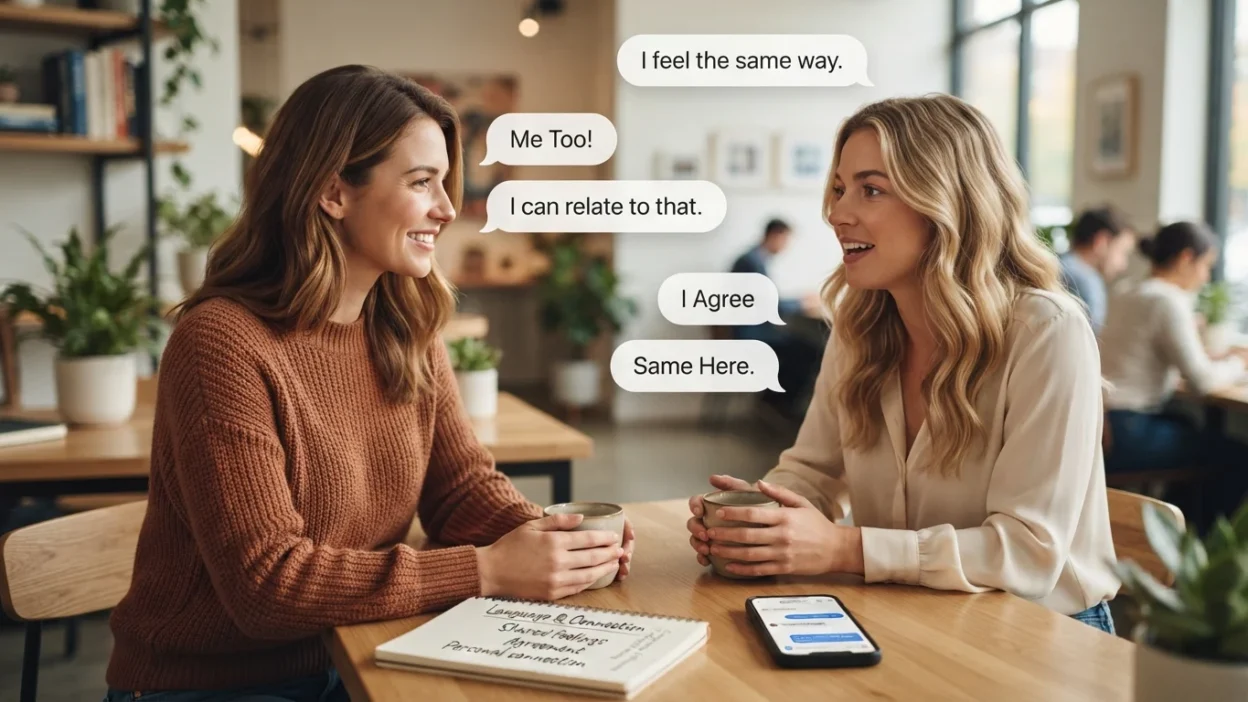
Using other ways to say same here can make everyday communication warmer, clearer, and more personal when you want to share feelings. Communication is about more than words because it helps people connect, understand, and express empathy. In everyday conversations, simple phrases like “Same Here” are useful because their meaning is easy to understand, but the alternative can sometimes feel short, plain, or repetitive. Using different expressions to show agreement can add warmth, personality, and thoughtfulness to your conversations. When you share thoughts and experiences, natural, genuine language can make your response feel more human.
Using different phrases can strengthen relationships with friends, family, and colleagues because they create a deeper understanding and show genuine care. Instead of simply saying Same Here, phrases such as “I feel the same way” and “I can relate to that” can communicate a stronger personal connection. In my experience, these subtle changes in language can make the other person feel acknowledged and valued, while helping both people connect on a personal level. This kind of thoughtful communication can build trust, empathy, and meaningful interaction without making the conversation feel forced.
Quick Answer
The most natural alternatives to “same here” include “me too,” “I feel the same way,” “I can relate to that,” “so do I,” “I agree,” “I’m in the same boat,” and “I feel similarly.” Choose your phrase according to the tone, context, and type of agreement you want to express.
1. Casual Alternatives to “Same Here”
Me Too
Definition: “Me too” is a short and natural way to say that you have the same feeling, opinion, or experience.
Usage rule: Use it mainly in informal conversations when someone says something that applies to you as well.
Practical example: “I love quiet mornings.” — “Me too.”
Tips: This is probably the easiest replacement for “same here.” It sounds friendly and natural in texting and everyday conversation.
Same
Definition: “Same” is an informal expression showing that you strongly relate to what someone has just said.
Usage rule: Use it in casual speech, texts, social media, or conversations with people you know well.
Practical example: “I could sleep all weekend.” — “Same.”
Tips: It is very casual, so avoid it in formal emails or academic writing.
Me as Well
Definition: “Me as well” communicates agreement and means that the same statement applies to you.
Usage rule: Use it when you want something slightly more polished than “me too.”
Practical example: “I enjoy working from home.” — “Me as well.”
Tips: It works in both casual and moderately formal conversations.
So Do I
Definition: “So do I” means that you share the same action, preference, or opinion.
Usage rule: Use “so do I” after a positive statement with a suitable auxiliary verb.
Practical example: “I enjoy reading before bed.” — “So do I.”
Tips: Remember that the auxiliary verb can change: “So am I,” “So can I,” and “So will I” are also possible.
So Am I
Definition: “So am I” expresses agreement with a statement using the verb “be.”
Usage rule: Use it when the original statement contains “am,” “is,” or “are” and you share the same condition.
Practical example: “I’m excited about the trip.” — “So am I.”
Tips: This is grammatically precise but may sound slightly more formal than “me too.”
I Feel the Same
Definition: “I feel the same” tells someone that you have a similar emotional response or opinion.
Usage rule: Use it when discussing emotions, preferences, or personal reactions.
Practical example: “I’m nervous about tomorrow.” — “I feel the same.”
Tips: It is more expressive than simply saying “same.”
Totally
Definition: “Totally” can be used as an informal way to show strong agreement.
Usage rule: Use it when you strongly agree with the other person’s statement.
Practical example: “That movie was surprisingly good.” — “Totally!”
Tips: Because it is highly conversational, use it mainly with friends or in casual online communication.
2. Ways to Say “Same Here” When You Relate to Someone
I Can Relate to That
Definition: This phrase means that you understand someone’s experience because you have experienced something similar.
Usage rule: Use it when the other person’s situation feels familiar to you.
Practical example: “I find it difficult to balance work and family.” — “I can relate to that.”
Tips: This phrase often sounds more caring than “same here.”
I Know Exactly What You Mean
Definition: This expression shows that you understand someone’s feelings, thoughts, or experience.
Usage rule: Use it when you genuinely understand the person’s situation.
Practical example: “I always overthink important decisions.” — “I know exactly what you mean.”
Tips: Use it sincerely; avoid claiming complete understanding when the person’s experience is very different from yours.
I’ve Been There Too
Definition: This means that you have experienced a similar situation in the past.
Usage rule: Use it when someone shares a problem, challenge, or difficult experience.
Practical example: “I struggled during my first month at the new job.” — “I’ve been there too.”
Tips: It can create a sense of connection without minimizing the other person’s experience.
I Understand How You Feel
Definition: This phrase expresses empathy and recognition of someone’s emotions.
Usage rule: Use it when you want to acknowledge someone’s feelings.
Practical example: “I’m disappointed that the plan did not work.” — “I understand how you feel.”
Tips: It is warmer and more empathetic than a simple “same here.”
I’ve Felt That Way Too
Definition: This means that you have experienced the same emotional response.
Usage rule: Use it specifically when discussing feelings.
Practical example: “Sometimes I feel like I’m not making enough progress.” — “I’ve felt that way too.”
Tips: This is especially useful when responding supportively to friends or family.
I’m With You on That
Definition: This phrase shows that you agree with someone’s opinion or position.
Usage rule: Use it when you share someone’s viewpoint.
Practical example: “We should give the project another week.” — “I’m with you on that.”
Tips: It is informal but confident.
I’m in the Same Boat
Definition: This idiom means that you are in a similar situation or facing a similar problem.
Usage rule: Use it when two people are dealing with comparable circumstances.
Practical example: “I’m trying to save money this month.” — “I’m in the same boat.”
Tips: This phrase is friendly and conversational, especially when discussing shared difficulties.
3. Warm and Empathetic Alternatives
I Feel the Same Way
Definition: This phrase directly communicates that your emotional reaction is similar to another person’s.
Usage rule: Use it when responding to feelings, opinions, or personal experiences.
Practical example: “I really appreciate having you as a friend.” — “I feel the same way.”
Tips: It sounds sincere and is a strong choice when you want to add emotional warmth.
I Feel You
Definition: “I feel you” is an informal expression meaning that you understand or relate to someone’s feelings.
Usage rule: Use it mainly in casual conversations.
Practical example: “I’ve had such a long week.” — “I feel you.”
Tips: It is common in conversational English but may not suit formal situations.
I Understand
Definition: “I understand” acknowledges that you recognize someone’s feelings, position, or situation.
Usage rule: Use it when empathy or acknowledgment is more important than stating that you had the exact same experience.
Practical example: “I’m worried about the changes.” — “I understand.”
Tips: Add a short explanation when appropriate to make the response feel more personal.
I’m Right There With You
Definition: This phrase means that you share someone’s feelings, opinion, or situation.
Usage rule: Use it in supportive and conversational contexts.
Practical example: “I think we need a break.” — “I’m right there with you.”
Tips: It sounds warm, encouraging, and natural.
I Share That Feeling
Definition: This expression indicates that you experience the same emotion.
Usage rule: Use it when the topic involves feelings or emotional reactions.
Practical example: “I’m excited to see everyone again.” — “I share that feeling.”
Tips: It is more polished than “me too” and works well in thoughtful conversations.
I Feel Similarly
Definition: “I feel similarly” means that your emotional response is close to another person’s.
Usage rule: Use it when you want a calm, measured, or professional tone.
Practical example: “I’m concerned about the changes.” — “I feel similarly.”
Tips: This is useful when you want to avoid overly casual language.
I Appreciate That, and I Feel the Same
Definition: This phrase combines acknowledgment with agreement.
Usage rule: Use it when someone expresses a positive or personal sentiment toward you.
Practical example: “I’m grateful that you always support me.” — “I appreciate that, and I feel the same.”
Tips: It creates a warmer response than simply saying “same here.”
4. Professional Alternatives to “Same Here”
I Agree
Definition: “I agree” directly communicates that you share someone’s opinion or position.
Usage rule: Use it when responding to an idea, recommendation, or argument.
Practical example: “We should review the figures before submitting the report.” — “I agree.”
Tips: It is concise, professional, and appropriate for meetings and emails.
I Agree With You
Definition: This phrase explicitly identifies the person whose opinion you share.
Usage rule: Use it when you want to make your agreement clear and direct.
Practical example: “The deadline needs to be extended.” — “I agree with you.”
Tips: Add a reason when discussing important professional decisions.
I Share Your View
Definition: “I share your view” means that you hold the same opinion.
Usage rule: Use it in professional, academic, or formal discussions.
Practical example: “We need to improve the customer experience.” — “I share your view.”
Tips: This sounds more polished than “same here.”
I Feel Similarly
Definition: In professional settings, this phrase indicates that your feelings or concerns are comparable.
Usage rule: Use it when discussing attitudes, concerns, or reactions rather than factual agreement.
Practical example: “I’m concerned about the current timeline.” — “I feel similarly.”
Tips: It is useful when you want to sound measured and diplomatic.
I Have the Same Perspective
Definition: This means that you approach an issue from a similar point of view.
Usage rule: Use it when discussing professional, strategic, or academic opinions.
Practical example: “Customer retention should be our priority.” — “I have the same perspective.”
Tips: It works particularly well in meetings and written discussions.
I’m in Agreement
Definition: “I’m in agreement” is a formal way to state that you agree.
Usage rule: Use it in formal communication when a neutral tone is appropriate.
Practical example: “I’m in agreement with the proposed approach.”
Tips: It can sound stiff in casual conversation, so reserve it for formal contexts.
I Share Your Concern
Definition: This phrase means that you have the same concern about a situation.
Usage rule: Use it when someone raises a problem or risk.
Practical example: “I’m concerned that we may not finish on time.” — “I share your concern.”
Tips: This expression is especially useful in workplace communication because it shows agreement without sounding overly casual.
5. Alternatives for Texting and Social Conversations
Same Here
Definition: “Same here” means that the speaker shares the same feeling, opinion, or situation.
Usage rule: Use it in casual conversations when you want a short response.
Practical example: “I’m exhausted today.” — “Same here.”
Tips: It is perfectly natural; alternatives are useful mainly when you want more variety.
Same!
Definition: “Same!” is an extremely brief way to show strong relatability.
Usage rule: Use it in texting, social media, and informal conversations.
Practical example: “I need a vacation.” — “Same!”
Tips: Its short form makes it especially common in digital communication.
Literally Me
Definition: “Literally me” is an informal internet-style expression showing strong identification with a statement or situation.
Usage rule: Use it only in highly casual contexts.
Practical example: “I make a to-do list and then ignore it.” — “Literally me.”
Tips: Avoid this phrase in professional or academic communication.
That’s Me Too
Definition: “That’s me too” communicates that the same description applies to you.
Usage rule: Use it when someone describes a habit, preference, or personality trait that you share.
Practical example: “I always check my phone before bed.” — “That’s me too.”
Tips: It is casual and easy to understand.
You’re Not Alone
Definition: “You’re not alone” reassures someone that other people experience something similar.
Usage rule: Use it when someone shares a struggle, concern, or personal experience.
Practical example: “I feel nervous before every presentation.” — “You’re not alone.”
Tips: This response offers emotional support rather than simply expressing agreement.
I’m the Same
Definition: “I’m the same” means that your behavior, feeling, or preference is similar.
Usage rule: Use it in casual conversations.
Practical example: “I always need coffee in the morning.” — “I’m the same.”
Tips: It is natural but slightly less common than “me too.”
Couldn’t Agree More
Definition: “Couldn’t agree more” expresses very strong agreement.
Usage rule: Use it when you strongly support someone’s opinion.
Practical example: “We need better communication.” — “Couldn’t agree more.”
Tips: This phrase means “I completely agree,” not disagreement.
Comparison Table: Which Alternative Should You Use?
| Phrase | Best for | Tone | Strength of agreement |
| Me too | General agreement | Casual | Moderate |
| Same! | Texting and social media | Very casual | Strong |
| I feel the same way | Feelings and emotions | Warm | Strong |
| I can relate to that | Shared experiences | Empathetic | Moderate |
| I agree | Opinions | Professional / neutral | Strong |
| I share your view | Professional opinions | Formal | Strong |
| I’m in the same boat | Shared problems | Casual | Moderate |
| I share your concern | Workplace concerns | Professional | Strong |
| So do I | Shared preferences | Neutral | Moderate |
| Couldn’t agree more | Strong opinions | Casual / professional | Very strong |
| We’re on the same page | Shared understanding | Professional / casual | Strong |
Placement & Grammar Rules Table
| Synonym or phrase | Sentence position / placement | Tone / formality | Example sentence |
| Me too | Usually as a complete response | Casual | “I love this song.” “Me too.” |
| Same here | Usually as a complete response | Casual / neutral | “I’m tired.” “Same here.” |
| I feel the same way | Complete response or second sentence | Warm / neutral | “I’m excited.” “I feel the same way.” |
| I can relate to that | Usually a complete response | Warm / conversational | “This week has been stressful.” “I can relate to that.” |
| So do I | Complete response after a positive statement | Neutral | “I enjoy reading.” “So do I.” |
| I agree | Complete sentence | Neutral / professional | “We need more time.” “I agree.” |
| I share your view | Complete sentence | Formal | “The plan needs revision.” “I share your view.” |
| I share your concern | Complete sentence | Professional | “The deadline is tight.” “I share your concern.” |
| I’m in the same boat | Complete response | Casual / idiomatic | “I’m behind on my work.” “I’m in the same boat.” |
| Couldn’t agree more | Complete response | Casual / emphatic | “This is the best option.” “Couldn’t agree more.” |
| We’re on the same page | Complete sentence | Neutral / professional | “We both want the same result.” “We’re on the same page.” |
| I feel similarly | Complete sentence | Formal / measured | “I’m concerned about the change.” “I feel similarly.” |
| Absolutely | Complete response | Neutral / emphatic | “We should improve the process.” “Absolutely.” |
| I’m with you | Complete response | Casual / supportive | “We should wait.” “I’m with you.” |
Common Mistakes When Saying “Same Here”
One common mistake is using a casual phrase in a situation that requires professional language. Saying “Same!” or “Literally me” may work perfectly in a text message but can sound too informal in a business email. In professional communication, “I agree,” “I share your view,” or “I feel similarly” is usually more suitable.
Another mistake is using the wrong grammatical structure. For example, “So do I” does not work with every sentence. If someone says, “I am tired,” the correct response is “So am I,” not “So do I.” Similarly, “I can relate to that” is best used for a shared experience or feeling, not simply as a replacement for every type of agreement.
It is also important not to minimize someone’s experience. If a person shares something deeply personal, immediately saying “Same here” can shift attention toward yourself. A more thoughtful response might be “I understand how you feel,” “I’ve felt that way too,” or “I can relate to that.” The goal is not simply to agree but to make the other person feel heard.
Practical Examples
1 — Friends:
“My weekend was exhausting, but I’m glad I got some time to relax.” “Me too,” Sarah replied. “I really needed a break.” This response sounds natural because both friends are sharing a similar experience.
2 — Emotional Conversation:
“I’ve been feeling nervous about starting my new job.” “I feel the same way,” he said. “I’m excited, but I’m also unsure about what to expect.” Here, the longer response adds empathy instead of making the conversation feel abrupt.
3 — Workplace:
“I think we should review the proposal before sending it to the client.” “I agree,” Maria replied. “I’d like to check the figures one more time.” This version is more professional than simply saying “same here.”
4 — Shared Problem:
“I’m struggling to finish everything before the deadline.” “I’m in the same boat,” Tom said. “Maybe we can divide the remaining tasks.” The phrase establishes shared understanding and naturally moves the conversation toward a solution.
FAQs
What is another way to say “same here”?
Common alternatives include “me too,” “I feel the same way,” “I can relate to that,” “so do I,” “I agree,” “I’m with you,” and “I’m in the same boat.”
What is a better way to say “same here” in a text?
For casual texting, “me too,” “same,” “same!,” “I feel you,” and “literally me” can sound natural. Choose the phrase based on how casual your relationship is.
How do I say “same here” professionally?
Use expressions such as “I agree,” “I share your view,” “I feel similarly,” “I share your concern,” or “I have the same perspective.”
What can I say instead of “same here” when someone shares a feeling?
You can say “I feel the same way,” “I’ve felt that way too,” “I understand how you feel,” or “I can relate to that.” These phrases usually sound more empathetic.
Is “me too” the same as “same here”?
In many casual situations, yes. Both can show that you share a feeling, opinion, preference, or experience. “Me too” is often slightly more common in everyday conversation.
What is the difference between “I agree” and “I feel the same way”?
“I agree” usually responds to an opinion, idea, or statement. “I feel the same way” focuses more on emotions, personal reactions, or feelings.
What does “I’m in the same boat” mean?
It means that you are experiencing a similar situation or problem. It is an informal idiom often used to create a feeling of shared experience.
Is “same” grammatically correct as a response?
Yes. “Same” is widely used as an informal conversational response, particularly in texting and social media. It is not normally appropriate for formal writing.
Final Thoughts
Knowing other ways to say same here gives you more flexibility in everyday and professional communication. A short phrase can show agreement, empathy, shared experience, or emotional connection.
The best expression depends on the situation, your relationship with the listener, and the strength of your agreement. By choosing phrases such as “me too,” “I can relate to that,” “I feel the same way,” or “I agree,” you can make conversations more natural, thoughtful, and engaging.