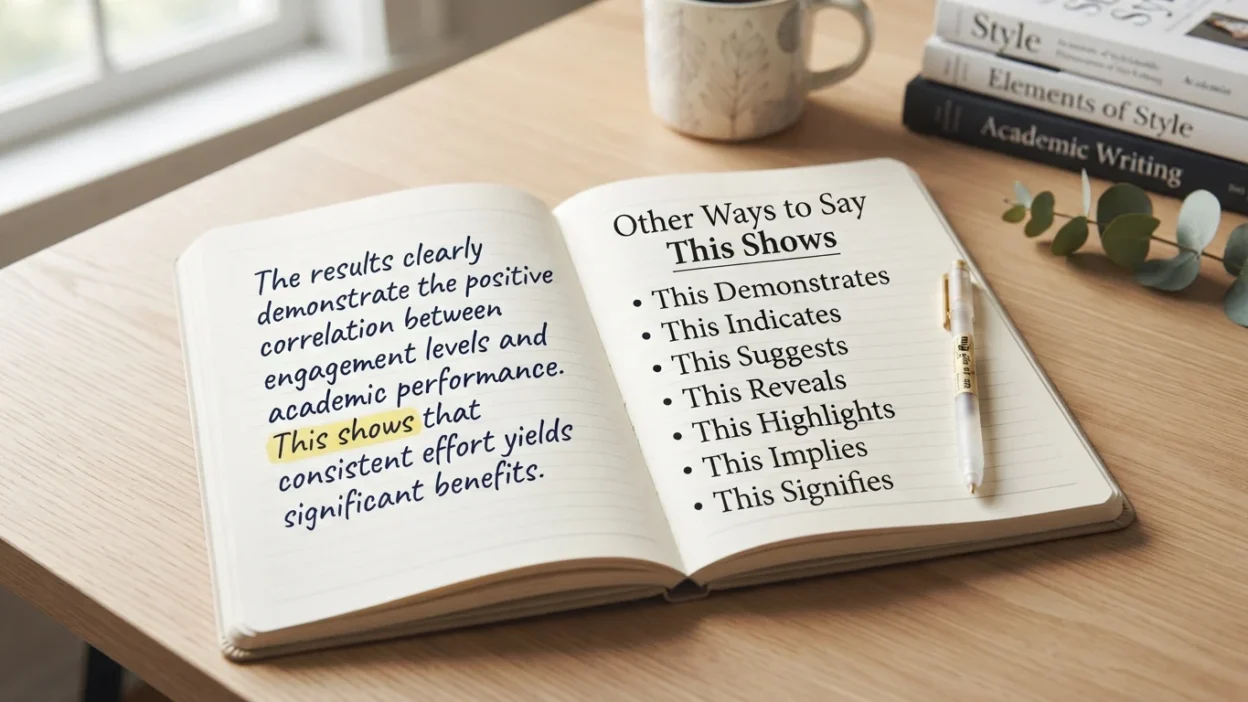
Exploring other ways to say this shows can make your writing clearer, more natural, and more effective when explaining evidence, meaning, or results. Choosing the right words is one of the most powerful ways to communicate effectively, especially when the phrase “This Shows” is used to explain results, express meaning, or highlight important points. In writing and conversation, it is clear and easy to understand, but repeating it frequently can make your language feel mechanical, flat, or impersonal. Using suitable alternatives can create sentences that sound more engaging, thoughtful, and meaningful, helping readers and listeners connect with the message on a deeper level.
There are multiple ways to communicate the same idea while improving clarity and emotional impact. In everyday writing, such as emails, essays, and reports, writers often need to present evidence, proof, and significance without making their style repetitive. Instead of using “This Shows” repeatedly, you can vary expressions so your points stand out with greater precision. In my experience with professional communication and personal communication, thoughtful wording makes it easier to convey the right tone, nuance, professionalism, warmth, and insight according to the context.
Quick Answer
Some useful alternatives to “This Shows” include “This demonstrates,” “This indicates,” “This suggests,” “This reveals,” “This highlights,” “This illustrates,” “This proves,” and “This reflects.” The best choice depends on whether you are presenting strong evidence, making an observation, suggesting an interpretation, or emphasizing an important point.
1. Professional Alternatives to “This Shows”
This Demonstrates
Definition: “This demonstrates” means that something clearly displays or provides evidence of a particular fact, quality, or result.
Usage rule: Use it when the evidence strongly supports the statement that follows.
Practical example: “The successful project demonstrates the value of careful planning.”
Tips: This is one of the best alternatives for reports, presentations, academic writing, and professional documents.
This Indicates
Definition: “This indicates” means that something points toward a particular fact, result, or conclusion.
Usage rule: Use it when evidence provides a reasonable sign rather than absolute proof.
Practical example: “The increase in sales indicates growing customer demand.”
Tips: Choose this phrase when you want to sound objective and evidence-focused.
This Suggests
Definition: “This suggests” means that something gives you a possible idea or interpretation.
Usage rule: Use it when the evidence supports an interpretation but does not completely prove it.
Practical example: “The survey result suggests that customers prefer simpler designs.”
Tips: This phrase is especially useful when you want to avoid making an overly strong claim.
This Reveals
Definition: “This reveals” means that something makes an important fact or detail noticeable or known.
Usage rule: Use it when your evidence brings an underlying fact to attention.
Practical example: “The interview reveals several problems within the current process.”
Tips: It works particularly well when discussing findings, research, behavior, or hidden information.
This Highlights
Definition: “This highlights” means that something draws attention to an important fact, issue, or idea.
Usage rule: Use it when your purpose is to emphasize significance rather than simply prove a statement.
Practical example: “The comparison highlights the importance of customer service.”
Tips: This is a strong choice for essays, reports, presentations, and explanatory writing.
This Illustrates
Definition: “This illustrates” means that something provides a clear example of an idea or concept.
Usage rule: Use it when the evidence helps readers understand an abstract point through a specific example.
Practical example: “The case study illustrates how effective communication can improve teamwork.”
Tips: Use this phrase when explaining concepts rather than claiming definite proof.
This Confirms
Definition: “This confirms” means that new information supports something that was already suspected, stated, or established.
Usage rule: Use it when the available evidence provides strong support for an existing conclusion.
Practical example: “The latest results confirm the effectiveness of the new strategy.”
Tips: Make sure your evidence is strong enough before using “confirms.”
2. Academic and Essay Alternatives
The Evidence Shows
Definition: “The evidence shows” directly connects information with a conclusion.
Usage rule: Use it when discussing research, statistics, observations, or documented facts.
Practical example: “The evidence shows that regular practice improves performance.”
Tips: It is simple, direct, and appropriate for academic writing.
The Findings Indicate
Definition: “The findings indicate” means that research results point toward a particular conclusion.
Usage rule: Use it when discussing the results of a study, investigation, survey, or analysis.
Practical example: “The findings indicate that employees value flexible working arrangements.”
Tips: This phrase sounds professional and research-oriented.
The Results Demonstrate
Definition: “The results demonstrate” emphasizes that research or testing provides strong evidence.
Usage rule: Use it when results clearly support your interpretation.
Practical example: “The results demonstrate a significant improvement in productivity.”
Tips: It is particularly suitable for research papers and formal reports.
The Data Suggest
Definition: “The data suggest” means that numerical or collected information points toward a possible conclusion.
Usage rule: Use it when the data supports an interpretation without providing absolute proof.
Practical example: “The data suggest that younger customers respond well to mobile advertising.”
Tips: This is useful when maintaining an appropriately cautious academic tone.
The Study Reveals
Definition: “The study reveals” introduces an important discovery made through research.
Usage rule: Use it when research uncovers information that deserves attention.
Practical example: “The study reveals a connection between preparation and performance.”
Tips: Avoid using “reveals” if the study merely repeats an already established fact.
The Analysis Demonstrates
Definition: “The analysis demonstrates” connects a detailed examination with a strong conclusion.
Usage rule: Use it after analyzing data, arguments, patterns, or evidence.
Practical example: “The analysis demonstrates why the original strategy was unsuccessful.”
Tips: This phrase is effective in analytical essays and professional reports.
The Example Illustrates
Definition: “The example illustrates” explains how a specific case represents a broader idea.
Usage rule: Use it when moving from a specific example to a general concept.
Practical example: “The example illustrates the importance of adapting to customer needs.”
Tips: It is a useful alternative when “This Shows” feels too repetitive.
3. Natural Alternatives for Everyday Communication
This Makes It Clear
Definition: “This makes it clear” emphasizes that information helps someone understand a situation.
Usage rule: Use it when the main purpose is clarity rather than formal evidence.
Practical example: “Her explanation makes it clear why the decision was necessary.”
Tips: This sounds natural in conversation, emails, and general writing.
This Makes Clear That
Definition: This phrase directly introduces the conclusion or meaning that the evidence supports.
Usage rule: Follow it with a complete statement.
Practical example: “The response makes clear that customers expect faster service.”
Tips: It is useful when you want a direct connection between evidence and interpretation.
This Points To
Definition: “This points to” means that something provides an indication of a particular possibility or conclusion.
Usage rule: Use it when evidence gives you a direction rather than definite proof.
Practical example: “The repeated complaints point to a problem with the ordering system.”
Tips: This phrase is conversational but can also work in less formal professional writing.
This Reflects
Definition: “This reflects” means that something represents or mirrors a particular condition, attitude, value, or situation.
Usage rule: Use it when an action or result represents something broader.
Practical example: “The company’s decision reflects its commitment to customer satisfaction.”
Tips: It is especially useful when discussing attitudes, values, behavior, and organizational culture.
This Demonstrates How
Definition: “This demonstrates how” introduces an explanation of the way something works or happens.
Usage rule: Follow it with a process, relationship, or action.
Practical example: “This demonstrates how preparation can improve confidence.”
Tips: It is a natural choice for explanatory paragraphs.
This Helps Explain
Definition: “This helps explain” means that something provides part of the reason behind a situation.
Usage rule: Use it when the evidence contributes to an explanation without being the entire answer.
Practical example: “The survey helps explain why customers are changing their preferences.”
Tips: This is a cautious and useful alternative when several factors may be involved.
This Makes Evident
Definition: “This makes evident” means that something makes a fact or condition noticeable or apparent.
Usage rule: Use it in formal writing when evidence clearly brings an issue to light.
Practical example: “The results make evident the need for better communication.”
Tips: It is more formal than “This makes it clear.”
4. Strong Alternatives When Discussing Evidence
This Proves
Definition: “This proves” expresses a very strong claim that evidence establishes something as true.
Usage rule: Use it only when the evidence genuinely supports a definitive conclusion.
Practical example: “The documented records prove that the transaction occurred.”
Tips: Do not use “proves” simply because evidence supports your opinion. In academic writing, “demonstrates” or “indicates” may be safer.
This Provides Evidence That
Definition: This phrase directly explains what the evidence supports.
Usage rule: Use it when you want to connect facts or observations to a specific conclusion.
Practical example: “The survey provides evidence that customers value responsive support.”
Tips: It is precise and particularly useful in research-based writing.
This Supports the Idea That
Definition: This phrase means that information strengthens a particular argument or interpretation.
Usage rule: Use it when your evidence supports an idea without necessarily proving it.
Practical example: “The results support the idea that regular feedback improves performance.”
Tips: It is excellent for argumentative and analytical essays.
This Establishes
Definition: “This establishes” means that evidence helps firmly demonstrate or set a fact.
Usage rule: Use it when the evidence provides a strong foundation for a conclusion.
Practical example: “The documented results establish a clear pattern of improvement.”
Tips: Use it carefully because it communicates considerable certainty.
This Verifies
Definition: “This verifies” means that something confirms the accuracy or truth of information.
Usage rule: Use it when evidence checks or validates a claim.
Practical example: “The original records verify the accuracy of the report.”
Tips: This works well when discussing documents, records, measurements, or factual information.
This Validates
Definition: “This validates” means that something provides support for the correctness, value, or effectiveness of an idea.
Usage rule: Use it when evidence strengthens confidence in a method, decision, or conclusion.
Practical example: “The positive customer response validates the decision to update the service.”
Tips: Use “validates” when the focus is on credibility or effectiveness.
This Serves as Evidence of
Definition: This phrase identifies something as evidence supporting a particular fact or condition.
Usage rule: Follow it with a noun or noun phrase.
Practical example: “The consistent results serve as evidence of the program’s effectiveness.”
Tips: It is formal and useful in academic, legal, and professional contexts.
5. Alternatives Based on Tone and Meaning
This Emphasizes
Definition: “This emphasizes” means that something gives additional importance or attention to an idea.
Usage rule: Use it when the purpose is emphasis rather than proof.
Practical example: “The final paragraph emphasizes the importance of long-term planning.”
Tips: Choose this when you want to draw attention to an important point.
This Underscores
Definition: “This underscores” means that something strongly emphasizes or reinforces an important idea.
Usage rule: Use it in formal or polished writing when emphasizing significance.
Practical example: “The decline in performance underscores the need for immediate action.”
Tips: It has a professional tone and works well in reports and essays.
This Reinforces
Definition: “This reinforces” means that something strengthens an existing idea, argument, or conclusion.
Usage rule: Use it when new evidence adds strength to something already established.
Practical example: “The customer feedback reinforces the need for simpler instructions.”
Tips: It is useful when building an argument step by step.
This Demonstrates the Importance of
Definition: This phrase explains how evidence establishes the value or necessity of something.
Usage rule: Follow it with a noun or activity.
Practical example: “The outcome demonstrates the importance of careful preparation.”
Tips: This is excellent for essay conclusions within individual paragraphs.
This Highlights the Need for
Definition: This phrase emphasizes that a particular action or change is necessary.
Usage rule: Use it when evidence points toward a required response.
Practical example: “The repeated errors highlight the need for better training.”
Tips: It is especially effective in recommendations and professional reports.
This Brings Attention to
Definition: This means that something makes an issue more noticeable.
Usage rule: Use it when you want readers to focus on a particular concern or idea.
Practical example: “The survey brings attention to concerns about service quality.”
Tips: It sounds natural and works well in explanatory writing.
This Reflects the Fact That
Definition: This phrase connects an observation with an underlying reality.
Usage rule: Follow it with a complete clause beginning with “that.”
Practical example: “The change reflects the fact that customer expectations are evolving.”
Tips: Avoid overusing this structure because shorter alternatives can make writing more concise.
Placement & Grammar Rules Table
| Synonym or phrase | Sentence position / placement | Tone / formality | Example sentence |
| This demonstrates | Usually at the beginning of a sentence | Formal / professional | This demonstrates the value of preparation. |
| This indicates | Beginning or middle | Formal / objective | This indicates a change in customer behavior. |
| This suggests | Beginning or middle | Neutral / academic | This suggests that the strategy needs revision. |
| This reveals | Usually at the beginning | Neutral / formal | This reveals a major weakness in the process. |
| This highlights | Beginning or middle | Professional / neutral | This highlights the importance of planning. |
| This illustrates | Beginning or middle | Academic / explanatory | This illustrates how the process works. |
| This proves | Beginning or middle | Strong / direct | This proves that the records were accurate. |
| This reflects | Beginning or middle | Neutral / professional | This reflects changing customer expectations. |
| This reinforces | Beginning or middle | Formal / analytical | This reinforces the argument presented earlier. |
| This underscores | Beginning or middle | Formal / polished | This underscores the need for improvement. |
| This confirms | Beginning or middle | Formal / evidence-based | This confirms the accuracy of the original findings. |
| This points to | Beginning or middle | Neutral / conversational | This points to a possible communication problem. |
| This makes it clear | Beginning or middle | Neutral / natural | This makes it clear why the decision was made. |
| The evidence shows | Beginning of a sentence | Academic / objective | The evidence shows a consistent pattern. |
| The findings indicate | Beginning of a sentence | Academic / formal | The findings indicate a significant improvement. |
Common Mistakes When Using Alternatives to “This Shows”
One common mistake is choosing a stronger phrase than the evidence deserves. For example, “This proves” suggests certainty, while “This suggests” communicates a more cautious interpretation. If your evidence only points toward a conclusion, choose “suggests,” “indicates,” or “points to” instead of making an absolute claim.
Another mistake is replacing “This Shows” with another phrase without considering meaning. “This highlights” emphasizes importance, while “This demonstrates” focuses on strong evidence and “This illustrates” introduces an example. These expressions are related, but they are not always interchangeable.
Writers should also avoid repeating alternatives in the same pattern. Replacing “This Shows” with “This demonstrates” in every paragraph does not solve the underlying problem. Strong writing uses a natural mix of sentence structures, precise verbs, evidence, explanations, and transitions.
Practical Examples
1 — Academic Writing:
The survey results indicate that students prefer flexible learning options. The high participation rate supports the idea that online resources remain valuable for many learners. This pattern highlights the importance of providing different learning formats.
2 — Professional Report:
Customer complaints increased significantly during the final quarter. This suggests that the current support process may need improvement. The response times also reinforce the need for a more efficient communication system.
3 — Everyday Communication:
She arrived early, prepared all the materials, and helped everyone before the meeting began. This demonstrates how seriously she takes her responsibilities. Her actions also reflect a strong sense of teamwork.
4 — Analytical Writing:
The company experienced higher sales after simplifying its checkout process. The results demonstrate the value of reducing unnecessary steps. The customer feedback further confirms that convenience influenced purchasing decisions.
FAQs
What is the best alternative to “This Shows”?
“This demonstrates” is one of the strongest general alternatives because it clearly connects evidence with a conclusion. However, “this indicates,” “this suggests,” and “this highlights” may be better depending on your intended meaning.
What can I say instead of “This Shows” in an essay?
You can use “This demonstrates,” “This indicates,” “This suggests,” “This illustrates,” “The evidence shows,” “The findings indicate,” or “The results demonstrate.” Choose the phrase according to the strength and purpose of your evidence.
What is a formal way to say “This Shows”?
Formal options include “This demonstrates,” “This indicates,” “This reveals,” “This establishes,” “This confirms,” and “This provides evidence that.”
What can I use instead of “This Shows” in academic writing?
For academic writing, useful choices include “This indicates,” “This suggests,” “The findings demonstrate,” “The evidence supports,” “The results reveal,” and “The data suggest.” These phrases help maintain an objective academic tone.
Is “This Proves” stronger than “This Shows”?
Yes. “This proves” makes a much stronger claim because it suggests that the evidence establishes something as true. Use it only when the available evidence genuinely justifies that level of certainty.
Can I use “This Suggests” instead of “This Shows”?
Yes, but the meaning changes slightly. “This suggests” is more cautious and indicates that the evidence points toward a possible interpretation rather than proving it.
What is a good alternative to “This Shows” in a professional report?
“This demonstrates,” “This indicates,” “This highlights,” and “The findings reveal” are strong professional choices. The best option depends on whether you are emphasizing evidence, meaning, importance, or discovery.
How can I avoid repeating “This Shows”?
Vary your sentence structure and choose alternatives according to meaning. Use demonstrates for strong evidence, indicates for signs, suggests for cautious interpretations, highlights for emphasis, and illustrates for examples.
Final Thoughts
Knowing other ways to say this shows helps you communicate evidence, meaning, and significance with greater precision. The strongest alternative is not always the most formal one; it is the phrase that accurately matches your evidence and intended tone.
For academic, professional, and everyday communication, vary your wording naturally rather than replacing one repeated phrase with another. Choosing precise alternatives such as demonstrates, indicates, suggests, reveals, highlights, and illustrates can make your writing clearer, more engaging, and more credible.