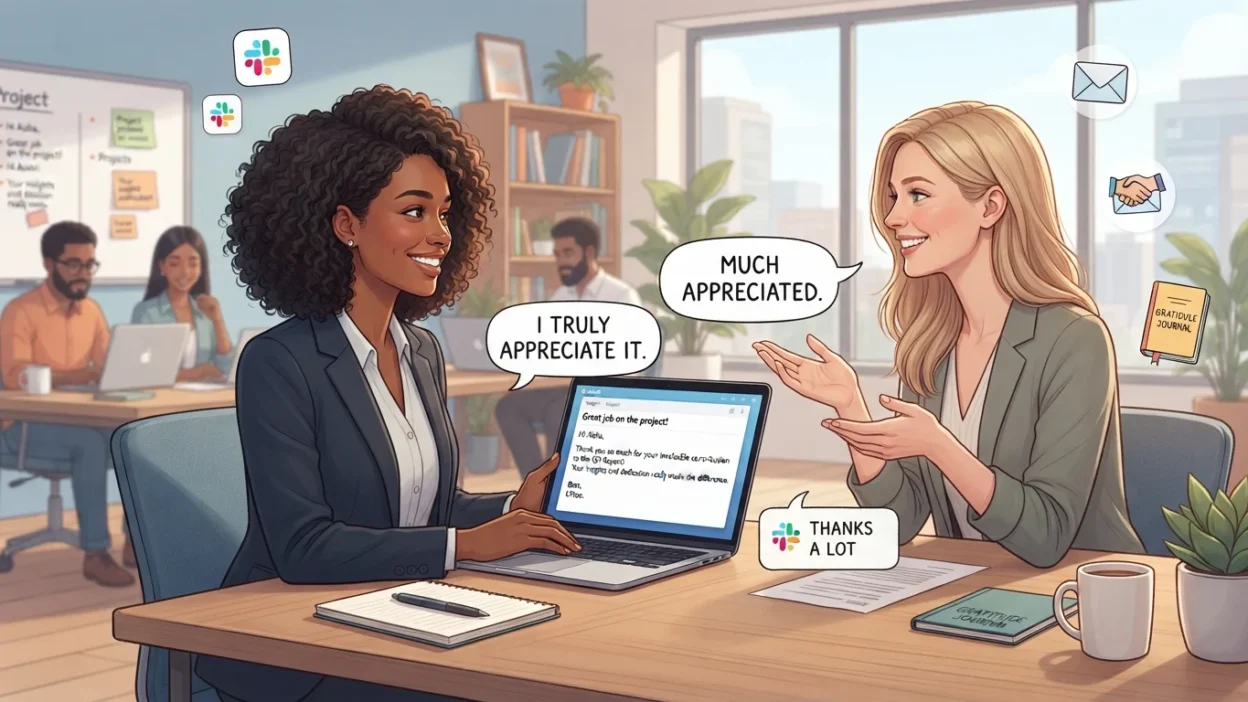
Learning other ways to say thank you so much helps you choose appreciation that fits the formality, channel, relationship, and recipient naturally. There are dozens of alternatives, but the right choice depends on the situation, channel, relationship, and recipient. In the workplace, a professional expression can make your appreciation sound sincere without becoming overly stiff or too casual. For non-native speakers, picking the right wording is especially helpful because the wrong register can change the tone of your communication.
This guide includes 400+ professional ways to say thank you, organized by situation, with useful example sentences for emails, Slack, and spoken English. From my experience, matching the expression to the person and setting makes your communication more natural, respectful, and confident. The best alternative is not always the most formal expression; choose one that fits the moment and helps the recipient feel genuinely appreciated.
Quick Answer
Some natural alternatives to “thank you so much” include I really appreciate it, I’m very grateful, Many thanks, I truly appreciate your help, and I can’t thank you enough. The best choice depends on the situation, relationship, and tone you want to create.
Warm and Natural Ways to Express Gratitude
1. I Really Appreciate It
Definition: A warm way to show that you genuinely value someone’s help or kindness.
Usage rule: Use it in everyday conversations, messages, and professional situations.
Practical example: “You stayed late to help me finish this. I really appreciate it.”
Tips: This is one of the safest alternatives because it sounds sincere without being overly formal.
2. I Truly Appreciate It
Definition: A slightly stronger version of “I really appreciate it.”
Usage rule: Use it when you want to emphasize genuine gratitude.
Practical example: “I truly appreciate everything you did for me.”
Tips: It works well when the person’s effort was meaningful or generous.
3. I’m Very Grateful
Definition: A direct expression of strong gratitude.
Usage rule: Use it when someone has provided meaningful support or assistance.
Practical example: “I’m very grateful for your guidance during the project.”
Tips: This phrase is suitable for both personal and professional communication.
4. I’m So Grateful
Definition: A warm and emotional way to express appreciation.
Usage rule: Use it in personal conversations and friendly messages.
Practical example: “I’m so grateful that you were there when I needed help.”
Tips: It sounds more personal and emotional than a standard professional thank-you.
5. I Can’t Thank You Enough
Definition: An expression showing that ordinary thanks do not feel sufficient.
Usage rule: Use it when someone has done something especially helpful or meaningful.
Practical example: “You helped me prepare for the interview. I can’t thank you enough.”
Tips: Use it for significant favors rather than very small everyday actions.
6. You Have My Thanks
Definition: A respectful and slightly formal expression of appreciation.
Usage rule: Use it when you want your gratitude to sound deliberate and respectful.
Practical example: “You have my thanks for handling the matter so quickly.”
Tips: It can sound formal, so it may not be the best choice for casual texting.
7. I’m So Thankful
Definition: A simple expression that communicates genuine appreciation.
Usage rule: Use it mainly in personal or warm conversations.
Practical example: “I’m so thankful you helped me through this.”
Tips: This phrase feels heartfelt and works particularly well when emotions matter.
Professional Alternatives for Emails and Work
8. Many Thanks
Definition: A concise and professional way to express gratitude.
Usage rule: Use it at the end of emails, especially when thanking someone for assistance.
Practical example: “Many thanks for sending the updated report.”
Tips: It is brief, polite, and useful for routine workplace communication.
9. Much Appreciated
Definition: A concise expression showing that someone’s effort is valued.
Usage rule: Use it in professional messages when you want to keep your response short.
Practical example: “Much appreciated for taking care of this request.”
Tips: “Much appreciated” is natural, although “I really appreciate it” may sound warmer in some situations.
10. I Appreciate Your Help
Definition: A direct way to recognize someone’s assistance.
Usage rule: Use it when a person has specifically helped you with a task or problem.
Practical example: “I appreciate your help with preparing the presentation.”
Tips: Mentioning the specific help makes your gratitude more meaningful.
11. Thank You for Your Support
Definition: A professional phrase used to recognize someone’s ongoing assistance.
Usage rule: Use it when someone has supported you, your team, or your work.
Practical example: “Thank you for your support throughout the project.”
Tips: This works particularly well in business emails and formal correspondence.
12. I’m Grateful for Your Assistance
Definition: A formal way to show appreciation for someone’s help.
Usage rule: Use it in professional emails, official messages, and formal situations.
Practical example: “I’m grateful for your assistance with this matter.”
Tips: It sounds polished and respectful without being excessively complicated.
13. Your Help Means a Lot
Definition: A warm statement showing that someone’s assistance has personal value.
Usage rule: Use it when you want to add emotion to professional or personal gratitude.
Practical example: “Your help means a lot as we work toward completing this project.”
Tips: This sounds more personal than a standard “thank you.”
14. I’m Much Obliged
Definition: A traditional and somewhat formal expression of gratitude.
Usage rule: Use it when a formal, old-fashioned, or distinctive tone is appropriate.
Practical example: “I’m much obliged for your assistance.”
Tips: It may sound old-fashioned in modern everyday English, so use it selectively.
Casual Alternatives for Friends and Everyday Conversations
15. Thanks a Lot
Definition: A common informal way to express appreciation.
Usage rule: Use it with friends, family, classmates, or familiar coworkers.
Practical example: “Thanks a lot for picking me up.”
Tips: Your tone matters because “thanks a lot” can sound sarcastic in some contexts.
16. Thanks So Much
Definition: A friendly variation of “thank you so much.”
Usage rule: Use it in casual conversations, texts, and friendly messages.
Practical example: “Thanks so much for helping me move.”
Tips: It is warm and natural but still very similar to the original phrase.
17. Thanks a Million
Definition: An enthusiastic informal expression of strong gratitude.
Usage rule: Use it when someone has done something especially helpful.
Practical example: “Thanks a million for helping me finish this today.”
Tips: Keep it for casual settings because it is more expressive than formal.
18. You’re a Lifesaver
Definition: A friendly expression used when someone’s help solves an important problem.
Usage rule: Use it informally when someone’s assistance makes a big difference.
Practical example: “You found my missing file? You’re a lifesaver!”
Tips: It is not meant literally; it emphasizes how valuable the person’s help was.
19. I Owe You One
Definition: An informal way to acknowledge a favor.
Usage rule: Use it with friends or people you know well.
Practical example: “Thanks for covering my shift. I owe you one.”
Tips: It suggests that you may return the favor later.
20. You’re Too Kind
Definition: A gracious response to someone’s generosity, compliment, or helpful action.
Usage rule: Use it when you want to sound warm and appreciative.
Practical example: “You brought coffee for everyone? You’re too kind.”
Tips: It can work in both casual and moderately professional situations.
21. That Means a Lot
Definition: A personal expression showing that someone’s action or words are meaningful.
Usage rule: Use it when you want to communicate emotional appreciation.
Practical example: “You remembered my birthday. That means a lot.”
Tips: It is especially effective when the gesture has personal significance.
Thoughtful and Heartfelt Ways to Say Thank You
22. I’m Deeply Grateful
Definition: A strong expression of sincere and meaningful appreciation.
Usage rule: Use it for important favors, support, or significant moments.
Practical example: “I’m deeply grateful for everything you have done for my family.”
Tips: Because it is emotionally strong, avoid using it for very minor favors.
23. I’m Truly Thankful
Definition: A heartfelt way to communicate sincere gratitude.
Usage rule: Use it when someone’s actions have had a meaningful effect on you.
Practical example: “I’m truly thankful for your kindness during a difficult time.”
Tips: This phrase works best when your gratitude is genuine and personal.
24. Your Kindness Means So Much
Definition: A warm expression that focuses on someone’s generosity or compassion.
Usage rule: Use it when thanking someone for a thoughtful gesture.
Practical example: “Your kindness means so much to me. Thank you for being there.”
Tips: It is particularly suitable for heartfelt messages and personal notes.
25. I’m Beyond Grateful
Definition: An informal but powerful expression of deep appreciation.
Usage rule: Use it with friends, family, or in expressive social media writing.
Practical example: “I’m beyond grateful for everyone who supported me.”
Tips: It is emotional and modern, so it may be less suitable for highly formal emails.
26. I’m Touched by Your Kindness
Definition: A sincere expression showing that someone’s action emotionally affected you.
Usage rule: Use it for thoughtful gestures, personal support, or meaningful gifts.
Practical example: “I’m touched by your kindness and generosity.”
Tips: This phrase emphasizes emotion rather than simply acknowledging assistance.
27. I’ll Always Appreciate This
Definition: A strong statement that you will continue to value someone’s action.
Usage rule: Use it when someone has done something memorable or significant.
Practical example: “You gave me confidence when I needed it most. I’ll always appreciate this.”
Tips: Reserve it for meaningful situations where long-term gratitude is appropriate.
28. I’m Grateful Beyond Words
Definition: A heartfelt expression suggesting that ordinary language cannot fully express your gratitude.
Usage rule: Use it for deeply meaningful personal moments.
Practical example: “I’m grateful beyond words for everything you have done.”
Tips: This is emotional and should not normally be used for routine workplace requests.
Short and Versatile Alternatives
29. Thanks
Definition: A simple and widely used expression of gratitude.
Usage rule: Use it for quick responses in casual or familiar situations.
Practical example: “Thanks for sending that over.”
Tips: It is convenient, but add more detail when the situation deserves stronger appreciation.
30. Many Thanks
Definition: A short phrase that adds a little more warmth than “thanks.”
Usage rule: Use it in emails, messages, and professional communication.
Practical example: “Many thanks for your quick response.”
Tips: It is especially useful as an email closing.
31. Much Obliged
Definition: A concise expression of gratitude with a traditional tone.
Usage rule: Use it when a slightly old-fashioned or formal style fits.
Practical example: “Much obliged for your assistance.”
Tips: It is less common in modern everyday English, so consider your audience.
32. I Appreciate That
Definition: A short phrase used to acknowledge someone’s words, effort, or action.
Usage rule: Use it when you want to respond naturally without sounding overly emotional.
Practical example: “I appreciate that. It was very helpful.”
Tips: It works well in both casual and professional conversations.
33. Thanks for Everything
Definition: A broad expression of gratitude for several acts of help or kindness.
Usage rule: Use it when one specific action does not fully describe what you appreciate.
Practical example: “Thanks for everything you did while I was away.”
Tips: It is warm and useful when someone has helped you in several ways.
34. I’m Grateful
Definition: A short but meaningful statement of appreciation.
Usage rule: Use it when you want a simple expression with more emotional weight than “thanks.”
Practical example: “I’m grateful for your support.”
Tips: Add the reason for your gratitude when you want the message to feel more personal.
35. Thank You Kindly
Definition: A polite and somewhat formal variation of “thank you.”
Usage rule: Use it in respectful correspondence or when you want a slightly traditional tone.
Practical example: “Thank you kindly for your assistance.”
Tips: It can sound more formal than necessary in casual conversation.
Placement & Grammar Rules Table
| Synonym or phrase | Sentence position / placement | Tone / formality | Example sentence |
| I really appreciate it | Usually after receiving help or at the end of a response | Warm, neutral | “I really appreciate it.” |
| I’m very grateful | Standalone sentence or before the reason | Warm, professional | “I’m very grateful for your support.” |
| Many thanks | Usually at the beginning or end of an email | Professional, concise | “Many thanks for your quick reply.” |
| Thanks a lot | Usually at the beginning or end of a casual response | Casual | “Thanks a lot for helping me.” |
| I can’t thank you enough | Usually followed by the reason for gratitude | Warm, emphatic | “I can’t thank you enough for your help.” |
| Thank you for your support | Usually followed by a specific noun or activity | Professional | “Thank you for your support during the project.” |
| Your help means a lot | Usually after describing someone’s assistance | Warm, personal | “Your help means a lot to me.” |
| You’re a lifesaver | Usually a standalone response | Casual, expressive | “You’re a lifesaver!” |
| I’m deeply grateful | Standalone or followed by the reason | Formal, heartfelt | “I’m deeply grateful for your guidance.” |
| Thanks for everything | Usually at the beginning or end of a message | Warm, casual | “Thanks for everything you’ve done.” |
Common Mistakes When Using Thank-You Alternatives
One common mistake is choosing an expression that is too casual for the situation. Phrases such as “You’re a lifesaver” or “I owe you one” can work wonderfully with friends but may feel inappropriate in a formal business email. In professional communication, expressions such as “I appreciate your assistance” or “Thank you for your support” are usually safer.
Another mistake is using very emotional language for a small favor. Saying “I’m grateful beyond words” after someone simply sends you a document can sound exaggerated. It is better to match the strength of your gratitude with the importance of the person’s action. Also, avoid repeating the same phrase in every email; varying your wording can make your communication sound more natural.
Practical Examples
In a workplace email, you could write: “Thank you for reviewing the proposal before the meeting. I really appreciate it, especially because I know you had a busy schedule. Your feedback helped me improve several sections, and I’m very grateful for the time you gave me.”
For a friend, a more relaxed response could be: “Thanks a million for helping me move this weekend. You’re a lifesaver, and I honestly don’t know how I would have managed everything alone. I owe you one!”
For a heartfelt personal message, you could say: “I want you to know that I’m deeply grateful for your support. Your kindness means so much to me, and I’ll always appreciate the way you stood by me when I needed someone.”
FAQs
What is another way to say “thank you so much” professionally?
I really appreciate your help, thank you for your support, I’m grateful for your assistance, and many thanks are strong professional alternatives.
What is a warmer way to say “thank you so much”?
Try I can’t thank you enough, your help means a lot, I’m so grateful, or your kindness means so much.
What can I say instead of “thank you so much” in an email?
For a professional email, use many thanks. I appreciate your assistance, thank you for your support, or I’m very grateful for your help.
Is “thanks a lot” professional?
It can be acceptable in friendly workplace communication, but I really appreciate it or many thanks is usually safer for formal emails.
What is a short way to say “thank you so much”?
Thanks, many thanks, much appreciated, and I appreciate that they are concise alternatives.
How can I sound sincere when saying thank you?
Mention what you are thankful for. Instead of only saying “thank you,” explain the specific action, support, time, or kindness you appreciated.
What is the difference between “I appreciate it” and “I’m grateful”?
I appreciate it is versatile and commonly used for specific help or actions. I’m grateful often sounds more personal or emotionally meaningful.
Final Thoughts
There are many useful other ways to say thank you so much, from short expressions such as thanks and many thanks to warmer choices such as I can’t thank you enough. The key is matching your words with the situation, relationship, and level of gratitude.
In professional settings, keep your wording clear and respectful. In personal conversations, you can be warmer and more expressive. From a practical writing perspective, choosing a specific reason for your gratitude often makes even a simple thank-you sound more genuine and memorable.