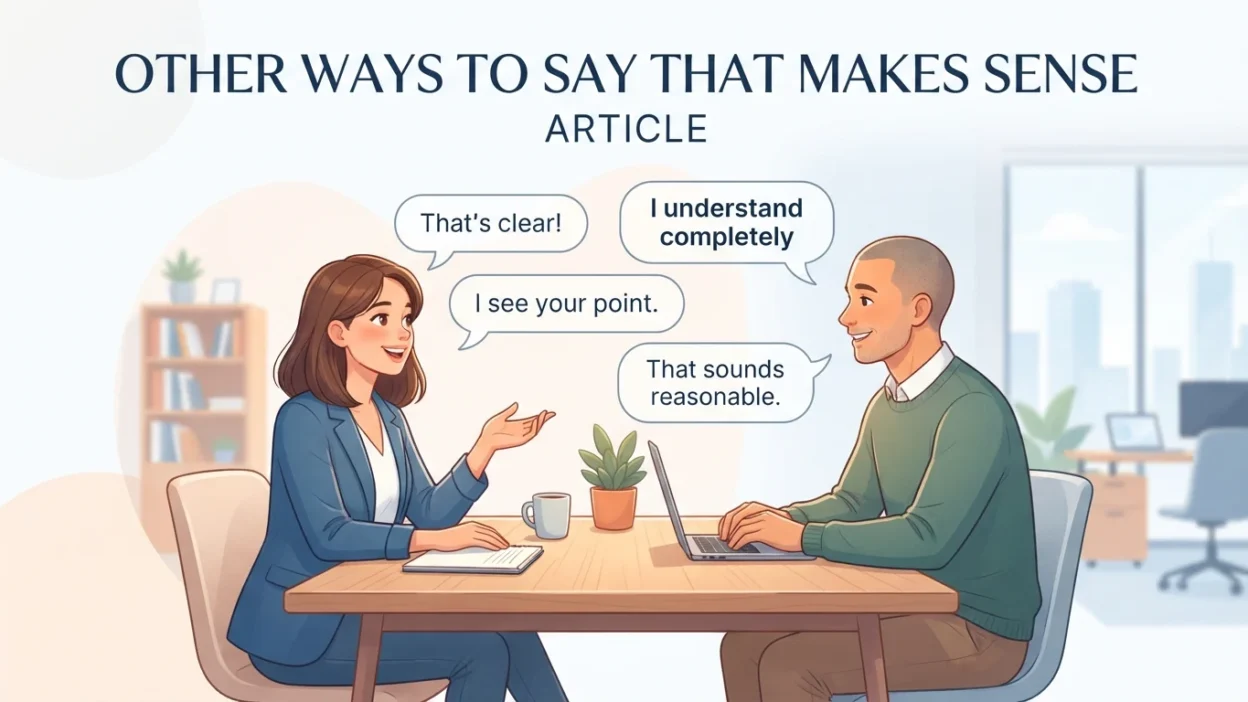
Other ways to say that makes sense can help your English sound more natural when people want to show understanding, agreement, or logical acceptance of an idea. The phrase makes sense is a common expression because it is simple and useful, but repeating the same phrase again and again may make your English sound basic or flat. From my experience, learning alternative expressions matters because the right words can make your communication clearer and more natural.
Different situations call for different tones, so the best alternative depends on the type of conversation. A professional setting may need a clear and respectful expression, while a friendly conversation can use more relaxed and casual wording. In a formal setting, careful wording can help you respond naturally, and choosing alternatives lets you express the same original meaning without sounding repetitive.
Quick Answer
Some useful alternatives to “that makes sense” include “I understand,” “That sounds reasonable,” “I see what you mean,” “That’s clear,” “That adds up,” and “I follow your reasoning.” Choose the phrase according to your meaning, relationship, and level of formality.
Simple and Everyday Alternatives
1. I Understand
Definition: This means you understand what another person has explained.
Usage rule: Use it when you want to clearly confirm understanding.
Practical example: “I understand why you changed the schedule.”
Tips: It is simple, natural, and suitable for most everyday conversations.
2. I See What You Mean
Definition: This phrase shows that you now understand another person’s point or perspective.
Usage rule: Use it when an explanation has helped you understand someone’s idea.
Practical example: “I see what you mean about making the design simpler.”
Tips: It sounds warmer and more conversational than “That makes sense.”
3. That’s Clear
Definition: This means the information or explanation is easy to understand.
Usage rule: Use it after someone has clarified something confusing.
Practical example: “Thanks for explaining the process. That’s clear now.”
Tips: Adding “now” emphasizes that the explanation solved your confusion.
4. I Follow You
Definition: This means you are following and understanding what someone is saying.
Usage rule: Use it in conversations when someone is explaining an idea or situation.
Practical example: “I follow you. We need to finish this part before moving on.”
Tips: It is natural and conversational but slightly less formal.
5. I Get It
Definition: This is an informal way to say that you understand something.
Usage rule: Use it with friends, family, classmates, or familiar coworkers.
Practical example: “Okay, I get it now.”
Tips: Avoid it in highly formal communication because it can sound too casual.
6. I See
Definition: This short expression shows that you understand or recognize a point.
Usage rule: Use it when someone gives you information or explains their reasoning.
Practical example: “I see. That explains why the meeting was moved.”
Tips: Your tone matters because “I see” can sound interesting, neutral, or skeptical.
7. That’s Understandable
Definition: This means that a situation, decision, or reaction is reasonable and easy to understand.
Usage rule: Use it when you want to acknowledge why someone feels or acts a certain way.
Practical example: “You were concerned about the deadline? That’s understandable.”
Tips: It works especially well when showing empathy.
Professional Alternatives
8. That Sounds Reasonable
Definition: This means an idea seems logical, practical, or acceptable.
Usage rule: Use it when responding positively to a suggestion or proposal.
Practical example: “Your plan sounds reasonable, so let’s move forward.”
Tips: It is a strong choice for workplace conversations and professional emails.
9. I Understand Your Point
Definition: This phrase confirms that you understand another person’s argument or position.
Usage rule: Use it during discussions, meetings, or professional disagreements.
Practical example: “I understand your point about reducing the budget.”
Tips: It can acknowledge someone’s view without necessarily agreeing with it.
10. I Follow Your Reasoning
Definition: This means you understand the logic behind someone’s conclusion.
Usage rule: Use it when discussing decisions, explanations, or arguments.
Practical example: “I follow your reasoning, and the proposed solution seems practical.”
Tips: It sounds professional and works well in analytical discussions.
11. That’s Logical
Definition: This means something follows a reasonable pattern of thought.
Usage rule: Use it when an explanation or conclusion is logically sound.
Practical example: “That’s logical given the information we have.”
Tips: It is concise and useful in business, academic, and professional settings.
12. That’s Reasonable
Definition: This means a suggestion, decision, or explanation seems fair or sensible.
Usage rule: Use it when accepting a proposal or acknowledging a viewpoint.
Practical example: “That’s reasonable. We can review the figures tomorrow.”
Tips: It can express agreement without sounding overly enthusiastic.
13. I Can See the Logic
Definition: This means you recognize the reasoning behind an idea.
Usage rule: Use it when you understand why someone reached a particular conclusion.
Practical example: “I can see the logic behind changing the delivery schedule.”
Tips: This phrase is useful when you want to sound thoughtful and measured.
14. Your Point Is Clear
Definition: This means another person has communicated their main idea successfully.
Usage rule: Use it after someone explains an argument or position.
Practical example: “Your point is clear, and I understand the concern.”
Tips: It is professional and direct without being overly formal.
Alternatives for Showing Agreement
15. Absolutely
Definition: This means you strongly agree with what someone has said.
Usage rule: Use it when you want to give a confident positive response.
Practical example: “Absolutely. That approach should save us time.”
Tips: It expresses stronger agreement than the neutral “That makes sense.”
16. Exactly
Definition: This means you completely agree with the point someone has made.
Usage rule: Use it when another person has expressed the same idea you have in mind.
Practical example: “Exactly. That’s why we need to plan ahead.”
Tips: It is natural in both casual and professional conversations.
17. I Agree
Definition: This directly states that you share another person’s opinion or conclusion.
Usage rule: Use it when agreement is more important than simply showing understanding.
Practical example: “I agree. This option gives us more flexibility.”
Tips: Remember that understanding and agreement are not always the same thing.
18. That’s a Good Point
Definition: This phrase acknowledges that someone has made a useful or valid observation.
Usage rule: Use it when another person adds something valuable to the discussion.
Practical example: “That’s a good point. We should consider the customer’s perspective.”
Tips: It is friendly, respectful, and useful during meetings.
19. You’re Right
Definition: This means you accept that another person’s statement or conclusion is correct.
Usage rule: Use it when you genuinely agree with their assessment.
Practical example: “You’re right; we should check the figures again.”
Tips: Use it when you want to clearly acknowledge someone’s correctness.
20. I Agree With You
Definition: This directly communicates agreement with another person.
Usage rule: Use it when you want to make your position completely clear.
Practical example: “I agree with you about the importance of clear communication.”
Tips: It is suitable for friendly and professional discussions.
21. That’s a Fair Point
Definition: This means another person has made a reasonable observation or argument.
Usage rule: Use it when acknowledging a valid point, especially during a disagreement.
Practical example: “That’s a fair point, and we should consider it before deciding.”
Tips: It can sound diplomatic because it recognizes another view without automatically accepting everything.
Casual and Friendly Alternatives
22. I Get What You’re Saying
Definition: This means you understand another person’s message or viewpoint.
Usage rule: Use it in relaxed conversations with people you know.
Practical example: “I get what you’re saying about the new schedule.”
Tips: It sounds natural and friendly but is not ideal for very formal writing.
23. I Know What You Mean
Definition: This shows that you understand someone’s experience, feeling, or point.
Usage rule: Use it when you can relate to what someone is explaining.
Practical example: “I know what you mean; sometimes the instructions are confusing.”
Tips: It can create a stronger sense of connection in personal conversations.
24. That Checks Out
Definition: This informal phrase means that information appears correct or consistent.
Usage rule: Use it when confirming facts, details, or an explanation.
Practical example: “The numbers match the report, so that checks out.”
Tips: It is common in casual speech but should generally be avoided in formal writing.
25. That Adds Up
Definition: This means information seems logical or consistent with the facts.
Usage rule: Use it when an explanation fits the available information.
Practical example: “Now that you explain it that way, it adds up.”
Tips: It is conversational and especially useful when discussing numbers or reasons.
26. Gotcha
Definition: This informal expression means “I understand.”
Usage rule: Use it in relaxed conversations and informal messages.
Practical example: “Gotcha. I’ll send the file after lunch.”
Tips: It is friendly but too casual for formal business communication.
27. Makes Total Sense
Definition: This emphasizes that something is completely understandable or logical.
Usage rule: Use it when you strongly agree with an explanation.
Practical example: “That makes total sense now that I know the background.”
Tips: It keeps the original expression but adds stronger emphasis.
28. I’m With You
Definition: This means you understand and generally support someone’s position.
Usage rule: Use it in friendly or informal discussions.
Practical example: “I’m with you. We should finish this before starting anything else.”
Tips: Because it can imply support as well as understanding, use it when both meanings fit.
Formal and Academic Alternatives
29. I Understand Your Reasoning
Definition: This formally acknowledges the logic behind another person’s position.
Usage rule: Use it in professional, academic, or structured discussions.
Practical example: “I understand your reasoning, although I would suggest another approach.”
Tips: It is useful when you want to acknowledge an argument without necessarily agreeing.
30. That Is Consistent With the Information
Definition: This means a statement or conclusion agrees with the available facts.
Usage rule: Use it when evaluating evidence, reports, or information.
Practical example: “That is consistent with the information presented in the report.”
Tips: This is more formal and precise than “That makes sense.”
31. The Reasoning Is Sound
Definition: This means the logic behind an argument appears strong and reasonable.
Usage rule: Use it in academic, analytical, business, or professional contexts.
Practical example: “The reasoning is sound, and the evidence supports the conclusion.”
Tips: This phrase focuses on the quality of the reasoning rather than simply saying you understand it.
32. I Find That Reasonable
Definition: This means you personally consider an idea or proposal acceptable.
Usage rule: Use it when giving a measured professional response.
Practical example: “I find that reasonable based on the current circumstances.”
Tips: It sounds calm and professional rather than overly enthusiastic.
33. That Is Understandable
Definition: This means the explanation, decision, or reaction can be understood logically.
Usage rule: Use it in formal or professional communication when acknowledging a situation.
Practical example: “Given the circumstances, that is understandable.”
Tips: It is useful when responding with empathy and professionalism.
34. I Can Appreciate That Perspective
Definition: This means you understand and recognize the value of another person’s viewpoint.
Usage rule: Use it when discussing different opinions or perspectives respectfully.
Practical example: “I can appreciate that perspective, especially given the recent changes.”
Tips: It is diplomatic and useful when you want to avoid sounding dismissive.
35. I Understand the Reasoning
Definition: This phrase confirms that you understand why something was suggested or decided.
Usage rule: Use it when discussing decisions, policies, or professional recommendations.
Practical example: “I understand the reasoning behind the new policy.”
Tips: It is especially suitable for workplace and formal discussions.
Placement & Grammar Rules Table
| Synonym or phrase | Sentence position / placement | Tone / formality | Example sentence |
| I understand | Usually at the beginning | Neutral / professional | “I understand your concern.” |
| I see what you mean | Beginning or middle | Friendly / neutral | “I see what you mean now.” |
| That’s clear | Usually at the beginning | Neutral | “That’s clear now.” |
| That sounds reasonable | Beginning | Professional | “That sounds reasonable to me.” |
| I follow your reasoning | Beginning | Professional / formal | “I follow your reasoning.” |
| That’s logical | Beginning or after explanation | Neutral / professional | “That’s logical given the circumstances.” |
| Exactly | Beginning | Casual / neutral | “Exactly. That is the main issue.” |
| I agree | Beginning | Neutral / professional | “I agree with your suggestion.” |
| That’s a good point | Beginning | Friendly / professional | “That’s a good point.” |
| You’re right | Beginning | Casual / neutral | “You’re right about the timing.” |
| That adds up | Beginning or end | Casual | “Now it adds up.” |
| That checks out | Beginning or end | Casual | “Everything checks out.” |
| The reasoning is sound | Beginning | Formal / academic | “The reasoning is sound.” |
| I can appreciate that perspective | Beginning | Professional / diplomatic | “I can appreciate that perspective.” |
Common Mistakes When Using Alternatives
Confusing Understanding With Agreement
Saying “I understand” does not always mean “I agree.” You can understand someone’s argument without supporting it, so choose “I agree” only when you genuinely share the opinion.
Using Casual Expressions in Formal Writing
Expressions such as “Gotcha,” “I get it,” and “That checks out” are natural in casual communication but can sound too informal in business emails, academic writing, or official messages.
Using Formal Expressions Everywhere
The opposite mistake is making ordinary conversations unnecessarily formal. Phrases such as “The reasoning is sound” may feel stiff when a simple “I see what you mean” would be more natural.
Repeating One Alternative
Replacing “makes sense” with another phrase does not solve the problem if you repeat the new phrase constantly. Rotate expressions according to meaning and context.
Choosing a Phrase That Changes the Meaning
Some expressions communicate more than understanding. “Absolutely” and “Exactly” usually show strong agreement, while “I understand” may only confirm comprehension.
Ignoring the Relationship
Your relationship with the listener matters. A phrase that sounds friendly with a close coworker may not be appropriate for a client, manager, professor, or formal audience.
Forgetting Tone
The same words can sound supportive, doubtful, or dismissive depending on tone. In spoken English, pay attention to your voice and facial expression as well as your choice of words.
Practical Examples
In a workplace meeting, a colleague might explain why a project deadline needs to change. Instead of repeatedly saying “That makes sense,” you could say, “I understand your reasoning. That sounds reasonable given the current workload. I can see the logic behind moving the deadline, and I agree that the team needs enough time to complete the work properly.” These alternatives make the response more specific and professional.
In a casual conversation, the language can be much simpler. A friend might explain why they decided to change their plans, and you could respond, “I see what you mean. That adds up now. I know what you mean, and honestly, I’d probably make the same choice.” This sounds natural without making the conversation unnecessarily formal.
FAQs
What is another way to say “that makes sense”?
Common alternatives include “I understand,” “I see what you mean,” “That’s clear,” “That sounds reasonable,” “That’s logical,” and “I follow your reasoning.”
What is a professional way to say “that makes sense”?
For professional communication, use “That sounds reasonable,” “I understand your point,” “I follow your reasoning,” “That’s logical,” or “The reasoning is sound.”
What is a casual way to say “that makes sense”?
Casual options include “I get it,” “I see what you mean,” “Gotcha,” “That adds up,” and “That checks out.”
Does “I understand” mean the same as “I agree”?
Not always. “I understand” confirms comprehension, while “I agree” clearly communicates that you share the other person’s opinion.
How can I avoid repeating “makes sense”?
Choose alternatives based on your intended meaning. Use “I understand” for comprehension, “I agree” for agreement, “That’s logical” for reasoning, and “That’s reasonable” for an acceptable suggestion.
What is a formal alternative to “makes sense”?
“The reasoning is sound,” “That is consistent with the information,” and “I understand your reasoning” are appropriate formal alternatives.
Can I use “that adds up” professionally?
It depends on the workplace and relationship. It is understandable and natural, but it is generally more conversational than formal. For a formal email, “That is consistent with the information” may be a better choice.
What is the best alternative to “makes sense” in an email?
For most professional emails, “I understand,” “That sounds reasonable,” or “I understand your point” are safe and natural choices.
Final Thoughts
There are many useful other ways to say that makes sense, but the best choice depends on your exact meaning and audience. Use simple phrases such as “I understand” for everyday communication and stronger expressions such as “That’s logical” or “The reasoning is sound” when discussing ideas.
Good word choice makes communication clearer without making it complicated. Instead of replacing “makes sense” automatically, choose an expression that accurately shows understanding, agreement, acceptance, or logical reasoning.