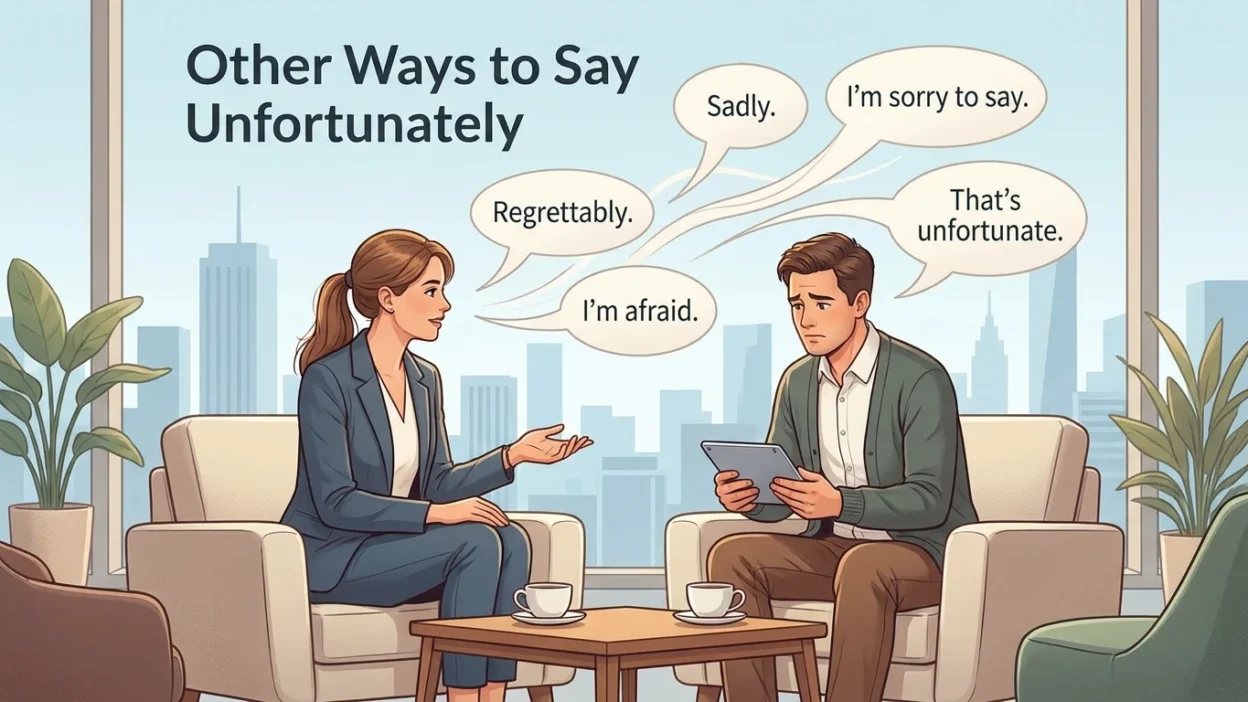
Using other ways to say unfortunately helps you express regret, disappointment, and difficult news with a clearer tone in speech, writing, and emails. Unfortunately is a common word that signals a negative situation when something has gone wrong or did not turn out as hoped. Although it is widely understood, repeatedly using the same expression can make language sound monotonous, so choosing an alternative can improve clarity, engagement, and communication. The best choice depends on the context, meaning, and level of regret you want to communicate. Using varied expressions also enhances professionalism in business communication and essays, while making everyday language more natural. For instance, Regrettably, cannot approve your request creates a formal, professional impression when explaining an approval decision or negative request response, whereas I’m afraid we can’t do that because it sounds friendlier and fits casual interactions better. From my experience, selecting an expression based on the situation makes difficult information easier to communicate because the right tone can express regret without sounding unnecessarily cold. This approach helps maintain professionalism while keeping the speech and writing varied, natural, and focused on clear meaning.
Quick Answer
Common alternatives to unfortunately include regrettably, sadly, I’m afraid, I regret to inform you, disappointingly, much to my disappointment, and it is unfortunate that. The best option depends on whether you need a formal, professional, polite, sympathetic, or casual tone.
Formal Alternatives to Unfortunately
1. Regrettably
Definition: “Regrettably” means unfortunately and shows clear regret about an unwanted situation.
Usage rule: Use it in formal emails, official notices, business communication, and professional writing.
Practical example: “Regrettably, we cannot approve your request at this time.”
Tips: This is one of the closest formal alternatives to unfortunately and works especially well when communicating negative decisions.
2. I Regret to Inform You
Definition: This phrase formally introduces disappointing or negative information.
Usage rule: Use it when you need to communicate an official decision or serious piece of bad news.
Practical example: “I regret to inform you that your application was unsuccessful.”
Tips: It is polite and professional but can sound serious, so use it when the situation genuinely requires a formal tone.
3. It Is Unfortunate That
Definition: This phrase states that an undesirable situation has occurred.
Usage rule: Use it in formal or carefully worded communication.
Practical example: “It is unfortunate that the meeting had to be canceled.”
Tips: It sounds neutral and professional without expressing overly strong emotion.
4. We Regret to Inform You
Definition: This is a formal organizational version of “I regret to inform you.”
Usage rule: Use it when a company, institution, or organization is communicating disappointing news.
Practical example: “We regret to inform you that the service will be discontinued.”
Tips: It is particularly appropriate for official announcements and customer communication.
5. With Regret
Definition: “With regret” communicates that something is being done or announced unwillingly.
Usage rule: Use it before or alongside a formal negative statement.
Practical example: “With regret, we must decline your proposal.”
Tips: Keep the rest of the sentence clear because this expression already establishes a formal tone.
6. To Our Regret
Definition: This phrase formally indicates disappointment about an outcome.
Usage rule: Use it mainly in formal written communication.
Practical example: “To our regret, the planned event cannot take place this year.”
Tips: It is less common in everyday conversation, so reserve it for formal contexts.
7. Regretfully
Definition: “Regretfully” means in a manner that expresses regret.
Usage rule: Use it when delivering an unwelcome decision or communicating disappointment.
Practical example: “Regretfully, we are unable to offer a refund.”
Tips: It sounds formal and should be used when the situation calls for professional language.
Professional and Workplace Alternatives
8. I’m Afraid
Definition: “I’m afraid” is a polite way to introduce disappointing information.
Usage rule: Use it before a negative statement when you want to soften the message.
Practical example: “I’m afraid we cannot complete the project by Friday.”
Tips: Despite containing the word “afraid,” it usually does not express fear in this context.
9. I’m Sorry to Say
Definition: This phrase politely introduces information that may disappoint the listener.
Usage rule: Use it in professional or personal conversations when you want to sound sympathetic.
Practical example: “I’m sorry to say that the position has already been filled.”
Tips: It sounds warmer and more personal than “regrettably.”
10. I’m Sorry to Inform You
Definition: This phrase expresses regret before communicating negative information.
Usage rule: Use it in polite professional correspondence or customer communication.
Practical example: “I’m sorry to inform you that your order has been delayed.”
Tips: It works well when empathy is important.
11. We’re Unable to
Definition: This phrase explains that a person or organization cannot fulfill a request.
Usage rule: Use it when communicating limitations, refusals, or unavailable services.
Practical example: “We’re unable to process your request today.”
Tips: It is professional and direct without unnecessarily emphasizing disappointment.
12. We Cannot
Definition: “We cannot” clearly states that something is not possible.
Usage rule: Use it when clarity is more important than emotional wording.
Practical example: “We cannot accept applications after the deadline.”
Tips: Add a polite explanation when appropriate to prevent the statement from sounding abrupt.
13. Unfortunately, We’re Unable To
Definition: This combines a negative announcement with a polite explanation of limitation.
Usage rule: Use it in customer service, workplace emails, and professional responses.
Practical example: “Unfortunately, we’re unable to change the booking after departure.”
Tips: Although it still contains the original word, this structure can make a professional refusal sound complete and courteous.
14. I’m Sorry, but
Definition: This phrase softens a refusal, correction, or disappointing response.
Usage rule: Use it when you need to say no while maintaining a friendly relationship.
Practical example: “I’m sorry, but we cannot extend the deadline.”
Tips: Follow it with a clear explanation or possible solution when one is available.
Polite and Gentle Alternatives
15. Sadly
Definition: “Sadly” expresses sadness or disappointment about an unwanted situation.
Usage rule: Use it when the emotional aspect of the situation matters.
Practical example: “Sadly, we will not be able to attend the event.”
Tips: It is warmer than “regrettably” and can work well in personal communication.
16. Much to My Disappointment
Definition: This phrase directly communicates that an outcome was disappointing.
Usage rule: Use it when you want to emphasize your personal reaction.
Practical example: “Much to my disappointment, the concert was canceled.”
Tips: It is more emotional and personal than a neutral alternative.
17. Much to Our Disappointment
Definition: This phrase expresses disappointment shared by a group.
Usage rule: Use it when an organization or group is unhappy about an outcome.
Practical example: “Much to our disappointment, the event was postponed.”
Tips: It is suitable for professional announcements when genuine disappointment needs to be communicated.
18. To My Disappointment
Definition: This phrase shows that something happened differently from what you expected or wanted.
Usage rule: Use it when discussing a personal experience or outcome.
Practical example: “To my disappointment, the application was rejected.”
Tips: It works best when you want to focus on your personal feelings.
19. To Our Disappointment
Definition: This phrase describes disappointment experienced by more than one person.
Usage rule: Use it when a team or group expects a different result.
Practical example: “To our disappointment, the proposal was not accepted.”
Tips: It is useful in professional reports and team communication.
20. Sadly Enough
Definition: This expression emphasizes that something unfortunate has happened.
Usage rule: Use it mainly in conversational or expressive writing.
Practical example: “Sadly enough, we missed the final train.”
Tips: It is less formal than “regrettably,” so avoid it in highly official communication.
21. It’s a Shame
Definition: “It’s a shame” expresses disappointment about something that did not happen as hoped.
Usage rule: Use it in informal or semi-formal conversations.
Practical example: “It’s a shame that you could not join us.”
Tips: This is friendly and natural but should generally be avoided in highly formal business writing.
Casual and Conversational Alternatives
22. I’m Afraid Not
Definition: This short phrase politely tells someone that the answer is no.
Usage rule: Use it when responding to a request or question in conversation.
Practical example: “Can we move the meeting to today? I’m afraid not.”
Tips: It is concise, natural, and softer than simply saying “No.”
23. Sorry About That
Definition: This phrase expresses a simple apology or regret about an inconvenience.
Usage rule: Use it for minor problems, mistakes, delays, or disappointments.
Practical example: “Sorry about that—the restaurant is already closed.”
Tips: It is friendly and casual rather than formal.
24. I Hate to Say It
Definition: This expression shows that you are uncomfortable sharing disappointing information.
Usage rule: Use it in informal conversations when you want to soften bad news.
Practical example: “I hate to say it, but I think we missed our chance.”
Tips: It is conversational and should not normally appear in formal business letters.
25. I Wish I Could Say Otherwise
Definition: This phrase shows that you would prefer to give a more positive answer.
Usage rule: Use it when you need to communicate an unavoidable negative response.
Practical example: “I wish I could say otherwise, but the position has been filled.”
Tips: It sounds sympathetic and can make a difficult response feel more human.
26. It’s Too Bad
Definition: “It’s too bad” expresses mild disappointment.
Usage rule: Use it in casual conversations about unwanted outcomes.
Practical example: “It’s too bad that the game was canceled.”
Tips: It is common in spoken English but not ideal for formal correspondence.
27. That’s Unfortunate
Definition: This phrase directly acknowledges that something disappointing has happened.
Usage rule: Use it when reacting to someone else’s bad news.
Practical example: “That’s unfortunate. I hope you can find another solution.”
Tips: It can sound sympathetic, but your voice and surrounding words should show genuine concern.
28. That’s a Shame
Definition: This expression shows sympathy or disappointment about an undesirable situation.
Usage rule: Use it in friendly and informal conversations.
Practical example: “That’s a shame; I was hoping you could come.”
Tips: It is natural and warm but should not replace formal expressions in official writing.
Alternatives for Specific Negative Situations
29. Unfortunately, This Means
Definition: This structure explains the consequence of an unwanted situation.
Usage rule: Use it when you need to connect bad news with its result.
Practical example: “Unfortunately, this means we will need to postpone the launch.”
Tips: It is useful when the reader needs to understand what happens next.
30. Due to Unforeseen Circumstances
Definition: This formal phrase explains that an unexpected situation caused a change or problem.
Usage rule: Use it for delays, cancellations, changes, and unexpected events.
Practical example: “Due to unforeseen circumstances, the meeting has been postponed.”
Tips: Use it when the specific reason cannot or does not need to be explained.
31. Due to Circumstances Beyond Our Control
Definition: This phrase explains that a problem occurred because of factors the speaker could not control.
Usage rule: Use it in formal notices and professional communication.
Practical example: “Due to circumstances beyond our control, delivery has been delayed.”
Tips: It can sound official, so use it when the situation genuinely involves external factors.
32. We Are Sorry to Report
Definition: This phrase formally introduces disappointing information or an unwanted development.
Usage rule: Use it in announcements, reports, and professional communication.
Practical example: “We are sorry to report that the event has been canceled.”
Tips: It combines professionalism with a sense of sympathy.
33. We Regret That
Definition: This phrase formally communicates dissatisfaction or regret about a situation.
Usage rule: Use it when an organization needs to explain a negative outcome.
Practical example: “We regret that we cannot provide the requested service.”
Tips: It is concise and appropriate for formal customer or business communication.
34. It Did Not Go as Planned
Definition: This phrase explains that an event or situation produced an unexpected result.
Usage rule: Use it when something fails to meet expectations without directly blaming someone.
Practical example: “The launch did not go as planned, so we need additional testing.”
Tips: It is useful when you want to focus on the outcome rather than simply labeling it unfortunate.
35. Things Did Not Work Out
Definition: This expression means that circumstances did not produce the desired result.
Usage rule: Use it in casual or semi-formal situations when discussing disappointment.
Practical example: “Things did not work out, so we decided to postpone the trip.”
Tips: It sounds natural and gentle, especially when the specific problem does not need to be emphasized.
Placement & Grammar Rules Table
| Synonym or phrase | Sentence position / placement | Tone / formality | Example sentence |
| Unfortunately | Beginning, middle | Neutral | “Unfortunately, the meeting was canceled.” |
| Regrettably | Beginning | Formal | “Regrettably, we cannot approve your request.” |
| I regret to inform you | Beginning | Very formal | “I regret to inform you that your application was unsuccessful.” |
| I’m afraid | Beginning | Polite / professional | “I’m afraid we cannot offer that service.” |
| Sadly | Beginning or middle | Emotional / neutral | “Sadly, the event has been canceled.” |
| That’s unfortunate | Beginning as a response | Neutral / sympathetic | “That’s unfortunate. I hope things improve.” |
| It’s a shame | Beginning or middle | Casual | “It’s a shame that you cannot attend.” |
| I’m sorry to say | Beginning | Polite / sympathetic | “I’m sorry to say that we cannot accept the request.” |
| I’d hate to say it, but | Beginning | Casual | “I’d hate to say it, but we may need to cancel.” |
| Due to unforeseen circumstances | Beginning | Formal | “Due to unforeseen circumstances, the event has been postponed.” |
| We regret that | Beginning | Formal / professional | “We regret that we cannot meet your request.” |
| It did not go as planned | Middle or beginning | Neutral | “The project did not go as planned.” |
| Things did not work out | Beginning or middle | Casual / neutral | “Things did not work out as expected.” |
| I wish I could say otherwise | Beginning | Polite / sympathetic | “I wish I could say otherwise, but the position is filled.” |
How to Choose the Right Alternative
The most important factor is formality. For a business email or official notice, regrettably, I regret to inform you, and we regret that they are reliable choices. They communicate negative information without sounding careless or overly emotional.
For everyday communication, softer phrases such as I’m afraid, sadly, that’s unfortunate, and it’s a shame may sound more natural. These expressions allow you to acknowledge disappointment while keeping the conversation friendly.
You should also consider the seriousness of the situation. “It’s too bad” is appropriate for a canceled casual plan, but it may sound too light when discussing a serious professional problem. In contrast, “I regret to inform you” can sound unnecessarily serious when talking to a friend.
Finally, consider whether you are expressing your own feelings or simply describing an outcome. Much to my disappointment focuses on personal emotion, while due to circumstances beyond our control focuses on the reason behind an unwanted result.
Common Mistakes When Using Alternatives to Unfortunately
One common mistake is choosing a phrase that is too formal for the situation. Saying I regret informing you to a close friend can sound overly serious. A simple “I’m sorry” or “That’s a shame” may be more natural.
Another mistake is using emotional language when the situation requires neutrality. Expressions such as much to my disappointment communicate personal feelings, so they may not be suitable when writing an objective business report.
Avoid using “I’m afraid” as if it always means fear. In phrases such as “I’m afraid we cannot help,” it is a polite way of softening negative information. The meaning comes from the context rather than the literal word “afraid.”
It is also important not to overuse alternatives. Replacing unfortunately with a different negative expression in every sentence can still make writing repetitive. Instead, use a mixture of direct statements, explanations, and suitable alternatives.
Finally, do not hide important information behind overly polite language. If a request is denied, clearly state the decision and provide a reason or next step when appropriate. Professional communication should be both courteous and easy to understand.
Practical Examples
In a professional email, you could write: “Regrettably, we cannot approve your request because the submission deadline has passed. We understand that unexpected circumstances can occur, and we appreciate your understanding. If you would like to discuss another option, please contact our team.” This approach delivers negative information clearly while maintaining a respectful professional tone.
In a casual conversation, you might say: “That’s a shame that you cannot come to dinner tonight. I was really looking forward to seeing you. Maybe we can plan something for next weekend instead.” Here, a formal expression such as “I regret to inform you” would feel unnatural because the relationship is informal.
In workplace communication, you could say: “I’m afraid the project did not go as planned, and we need additional testing before launch. We can review the remaining tasks tomorrow and create a new timeline.” This example avoids unnecessary negativity and immediately gives the listener useful information about what happens next.
FAQs
What are the best other ways to say unfortunately?
Some of the best alternatives are regrettably, sadly, I’m afraid, I’m sorry to say, that’s unfortunate, and it’s a shame. The right choice depends on your audience and tone.
What is a professional way to say unfortunately?
Regrettably, I regret to inform you, we regret that, and I’m afraid there are useful professional alternatives. “Regrettably” is especially close in meaning to “unfortunately.”
What is a polite way to say unfortunately?
You can say I’m sorry to say, I’m afraid, I’d like to let you know that, or I regret to inform you. These expressions can soften disappointing information.
What is a casual way to say unfortunately?
In casual English, you can use sad, that’s a shame, it’s too bad, sorry about that, or things did not work out.
Can I use “regrettably” instead of “unfortunately”?
Yes. Regrettably is a close synonym and is generally more formal. It is particularly useful in professional emails, official notices, and business communication.
Is “I’m afraid” a synonym for unfortunately?
It can function as a polite alternative when introducing bad news. For example, “I’m afraid we cannot accept the request” communicates a negative result in a softer way.
What is the best alternative to unfortunately in an email?
For a formal email, regrettably or I regret to inform you works well. For a friendly professional email, I’m afraid or I’m sorry to say may sound more natural.
How can I avoid repeating it unfortunately?
Use alternatives according to meaning rather than replacing the word randomly. You can use regrettably for formal regret, sadly for emotional disappointment, I’m afraid for polite refusals, and explanatory phrases for specific situations.
Is “sadly” more emotional than “unfortunately”?
Usually, yes. “Sadly” often highlights sadness or emotional disappointment, while “unfortunately” can simply describe an undesirable fact.
Is “it’s a shame” formal English?
No. It’s a shame it is mainly conversational and informal. It is natural with friends and familiar coworkers but is usually not the best choice for official business communication.
Final Thoughts
Knowing other ways to say unfortunately helps you communicate disappointing information with greater precision and confidence.
Formal options such as regrettably work well in business and official writing.
Friendlier expressions such as I’m afraid and that’s a shame fit everyday communication.
Always consider the audience, situation, seriousness, and emotional tone before choosing an alternative.
The goal is not to avoid “unfortunately,” but to select the expression that communicates your meaning most naturally.