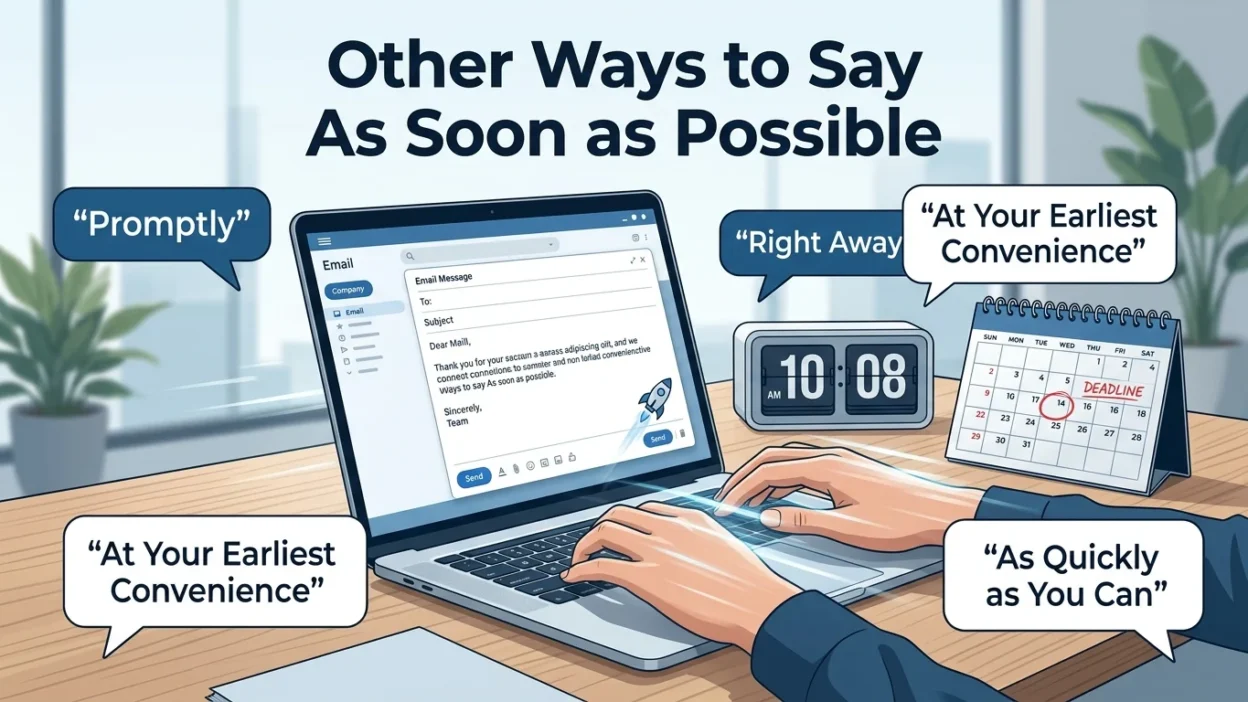
When choosing other ways to say as soon as possible, clear wording can make professional communication urgent without sounding rushed or demanding. In professional writing, the phrase is often used for urgent requests involving a task, reply, action, update, or decision that needs to happen quickly. However, repeating the same message can sound plain in certain situations, so careful word choice can improve tone, clarity, and politeness. Using suitable alternatives can communicate urgency, priority, and time sensitivity while showing professional respect. For example, “Please respond at your earliest convenience” may sound less harsh when you need a fast response without creating unnecessary pressure. The best choice depends on the situation, the relationship between the people involved, and the level of importance behind the request. If something must happen quickly, a clear deadline is often more useful than a vague demand, while a less urgent matter can use softer wording that gives the reader enough time to respond.
Quick Answer
Useful alternatives to “as soon as possible” include at your earliest convenience, at the earliest opportunity, as quickly as you can, when you get a chance, promptly, without delay, and at the earliest possible time. The right choice depends on the level of urgency and formality.
1. Professional Ways to Say As Soon as Possible
1. At Your Earliest Convenience
Definition: “At your earliest convenience” politely asks someone to complete something when they have an available opportunity.
Usage rule: Use it when the task matters but does not require immediate action.
Practical example: “Please review the attached document at your earliest convenience.”
Tips: This is a polished choice for professional emails because it sounds respectful rather than demanding.
2. At the Earliest Opportunity
Definition: This phrase asks someone to act when the earliest suitable opportunity becomes available.
Usage rule: Use it when you want prompt attention in formal or workplace communication.
Practical example: “Please contact the client at the earliest opportunity.”
Tips: It works especially well when immediate action is preferred but a specific deadline has not been stated.
3. As Quickly as Possible
Definition: “As quickly as possible” directly communicates that something should be completed quickly.
Usage rule: Use it when speed is important and the recipient understands the circumstances.
Practical example: “Please send the revised figures as quickly as possible.”
Tips: It is clearer and more direct than some softer alternatives.
4. At the Earliest Possible Time
Definition: This phrase requests completion at the first practical time available.
Usage rule: Use it in formal requests where timing is important.
Practical example: “We would appreciate receiving your response at the earliest possible time.”
Tips: It is useful in formal correspondence, but avoid using it repeatedly in the same message.
5. Promptly
Definition: “Promptly” means quickly or without unnecessary delay.
Usage rule: Place it near the verb describing the requested action.
Practical example: “Please respond promptly to confirm your attendance.”
Tips: It is concise and professional, making it useful when you want to avoid a longer phrase.
6. Without Delay
Definition: “Without delay” means that an action should happen immediately or with very little waiting.
Usage rule: Use it when the matter is genuinely urgent.
Practical example: “Please notify the support team without delay if the problem continues.”
Tips: Because it sounds firm, use it carefully in messages where a softer tone is preferable.
7. At the First Opportunity
Definition: This expression means at the first suitable chance to complete an action.
Usage rule: Use it when the recipient may not be able to act immediately.
Practical example: “Please call me at the first opportunity.”
Tips: It is courteous and works well when circumstances may affect timing.
2. Polite Alternatives to As Soon as Possible
8. When You Get a Chance
Definition: “When you get a chance” politely asks someone to do something when they have time.
Usage rule: Use it for low-pressure requests among colleagues, friends, or familiar contacts.
Practical example: “Could you check the attachment when you get a chance?”
Tips: This is less urgent than “as soon as possible,” so do not use it when immediate action is essential.
9. When You Have a Moment
Definition: This phrase asks someone to handle something when they have a small amount of free time.
Usage rule: Use it for brief, non-critical tasks.
Practical example: “Please give the document a quick look when you have a moment.”
Tips: It sounds friendly and considerate in everyday workplace communication.
10. When You Can
Definition: “When you can” gives the recipient flexibility while still requesting action.
Usage rule: Use it when there is no strict deadline.
Practical example: “Please send me the details when you can.”
Tips: This is a good option when maintaining a relaxed tone is more important than stressing urgency.
11. At Your Convenience
Definition: “At your convenience” means whenever it is suitable for the recipient.
Usage rule: Use it for flexible requests that do not require immediate attention.
Practical example: “Please call me at your convenience.”
Tips: Remember that this phrase can imply less urgency than “as soon as possible.”
12. When It’s Convenient for You
Definition: This phrase explicitly gives the recipient freedom to choose a suitable time.
Usage rule: Use it when you want to avoid putting pressure on someone.
Practical example: “Please let me know when it’s convenient for you.”
Tips: It is particularly useful when speaking with clients, senior colleagues, or people you do not know well.
13. Whenever You Get a Chance
Definition: This casual expression asks someone to act whenever they have an opportunity.
Usage rule: Use it in informal conversations and friendly messages.
Practical example: “Send me the photos whenever you get a chance.”
Tips: Avoid it when a specific deadline or urgent response is required.
14. When You Have Time
Definition: “When you have time” requests an action without imposing an immediate deadline.
Usage rule: Use it for routine or non-urgent tasks.
Practical example: “Could you review these notes when you have time?”
Tips: It sounds natural, but it should not replace a firm deadline when timing is important.
3. Urgent Ways to Say As Soon as Possible
15. Right Away
Definition: “Right away” means immediately or with virtually no delay.
Usage rule: Use it when an action needs to happen immediately.
Practical example: “Please call the technician right away.”
Tips: It is direct and conversational, so it is often better suited to speech or informal workplace communication.
16. Immediately
Definition: “Immediately” means at once, without waiting.
Usage rule: Use it only when immediate action is genuinely required.
Practical example: “Please report the issue immediately.”
Tips: Its strong tone can sound commanding, so reserve it for situations where urgency is justified.
17. As Quickly as You Can
Definition: This phrase asks someone to complete an action at the fastest practical speed.
Usage rule: Use it when speed matters but the exact deadline is uncertain.
Practical example: “Please get back to me as quickly as you can.”
Tips: It is direct but still relatively natural in everyday communication.
18. As Soon as You Can
Definition: “As soon as you can” is a friendly and flexible request for prompt action.
Usage rule: Use it in casual, workplace, and semi-formal communication.
Practical example: “Please send the updated file as soon as you can.”
Tips: It usually sounds more personal and conversational than “as soon as possible.”
19. At Once
Definition: “At once” means immediately.
Usage rule: Use it when something requires immediate attention.
Practical example: “Please address the issue at once.”
Tips: It can sound formal or forceful, so consider your audience before using it.
20. With All Due Speed
Definition: This formal expression asks for something to be done as quickly as circumstances allow.
Usage rule: Use it only in highly formal or specialised writing.
Practical example: “The request should be processed with all due speed.”
Tips: It is less common in everyday English, so simpler alternatives are often more natural.
21. With Urgency
Definition: “With urgency” signals that an action requires prompt attention.
Usage rule: Use it in professional contexts where the importance of speed needs to be highlighted.
Practical example: “Please treat this request with urgency.”
Tips: For ordinary emails, “promptly” or “as soon as you can” may sound more natural.
4. Casual Alternatives to As Soon as Possible
22. ASAP
Definition: “ASAP” is an abbreviation for “as soon as possible.”
Usage rule: Use it mainly in casual messages or familiar workplace communication.
Practical example: “Can you send me the file ASAP?”
Tips: Avoid it in highly formal correspondence unless the communication style of the organisation permits abbreviations.
23. As Soon as You Get a Chance
Definition: This phrase asks someone to act promptly once they have an opportunity.
Usage rule: Use it in friendly conversations and informal requests.
Practical example: “Call me as soon as you get a chance.”
Tips: It is warmer and less demanding than “do it immediately.”
24. Whenever Possible
Definition: “Whenever possible” means whenever circumstances allow an action to be completed.
Usage rule: Use it when flexibility is acceptable.
Practical example: “Please use the updated template whenever possible.”
Tips: This phrase does not necessarily communicate urgency, so use a stronger expression if timing matters.
25. As Fast as Possible
Definition: “As fast as possible” asks for the quickest practical completion.
Usage rule: Use it in informal or straightforward communication.
Practical example: “Please finish the update as fast as possible.”
Tips: “As quickly as possible” is generally more polished in professional writing.
26. As Soon as You Have Time
Definition: This phrase asks someone to act promptly once they have available time.
Usage rule: Use it for tasks that matter but are not emergencies.
Practical example: “Please look over the proposal as soon as you have time.”
Tips: It balances urgency with consideration for the other person’s schedule.
27. When You Get Around to It
Definition: This informal expression means when someone eventually has time to do something.
Usage rule: Use it only for low-priority tasks and familiar relationships.
Practical example: “Send me the old photographs when you get around to it.”
Tips: It can imply that the task is not urgent, so it is unsuitable for deadlines.
28. Whenever You Can
Definition: “Whenever you can” gives someone flexibility while still asking for action.
Usage rule: Use it in relaxed conversations or informal requests.
Practical example: “Please drop the documents off whenever you can.”
Tips: It sounds friendly but does not clearly communicate a specific level of urgency.
5. Email-Friendly Alternatives to As Soon as Possible
29. Please Respond at Your Earliest Convenience
Definition: This is a courteous email phrase requesting a response when the recipient can reasonably provide one.
Usage rule: Use it for professional correspondence without a strict emergency.
Practical example: “Please respond at your earliest convenience so we can proceed.”
Tips: It is particularly useful for clients, partners, and professional contacts.
30. We Would Appreciate a Prompt Response
Definition: This phrase politely communicates that a quick response would be helpful.
Usage rule: Use it when you want urgency without issuing a direct command.
Practical example: “We would appreciate a prompt response regarding the proposed schedule.”
Tips: It works well in formal business emails.
31. Please Get Back to Me Soon
Definition: “Please get back to me soon” asks someone to reply within a relatively short period.
Usage rule: Use it in friendly or semi-formal communication.
Practical example: “Please get back to me soon with your availability.”
Tips: If the timing is critical, replace “soon” with an actual deadline.
32. Please Prioritise This Request
Definition: This phrase asks the recipient to treat a particular request as important.
Usage rule: Use it when the task deserves attention ahead of routine work.
Practical example: “Please prioritise this request because the client is waiting for confirmation.”
Tips: Give a brief reason when possible so the urgency is clear.
33. Please Address This Promptly
Definition: This phrase asks someone to deal with an issue quickly and without unnecessary delay.
Usage rule: Use it for workplace problems, requests, and operational matters.
Practical example: “Please address this matter promptly to avoid further delays.”
Tips: It is professional and concise, but slightly firmer than “at your convenience.”
34. Your Prompt Attention Would Be Appreciated
Definition: This formal phrase politely requests quick attention to a matter.
Usage rule: Use it in formal letters, notices, and business correspondence.
Practical example: “Your prompt attention would be appreciated as we approach the deadline.”
Tips: It is useful when you need a respectful but clearly urgent tone.
35. Please Let Me Know at the Earliest Opportunity
Definition: This phrase requests information or confirmation as soon as the recipient has a suitable opportunity.
Usage rule: Use it when a timely response will help you move forward.
Practical example: “Please let me know at the earliest opportunity whether the meeting can proceed.”
Tips: It sounds professional without being unnecessarily forceful.
6. Ways to Say As Soon as Possible Without Sounding Rude
36. When You Have a Chance, Could You…
Definition: This structure combines a flexible timeframe with a polite request.
Usage rule: Use it when you want cooperation without creating pressure.
Practical example: “When you have a chance, could you review the final draft?”
Tips: Adding “could you” makes the request feel more collaborative.
37. If Possible, Could You…
Definition: This wording asks whether the recipient can complete something promptly while acknowledging practical limitations.
Usage rule: Use it when you want to be considerate of the person’s workload.
Practical example: “If possible, could you send the figures this afternoon?”
Tips: Add a specific timeframe if you need more clarity.
38. I’d Appreciate It If You Could…
Definition: This polite structure expresses appreciation while making a request.
Usage rule: Use it in professional emails and respectful conversations.
Practical example: “I’d appreciate it if you could send the signed form soon.”
Tips: It is softer than an imperative such as “Send the form immediately.”
39. Could You Please Prioritise…
Definition: This phrase politely asks someone to give a task additional attention.
Usage rule: Use it when a request genuinely needs to move ahead of less important tasks.
Practical example: “Could you please prioritise the customer response?”
Tips: Explain the reason when appropriate to prevent the request from sounding arbitrary.
40. If You Have a Moment, Could You…
Definition: This expression presents a task as a manageable request rather than an order.
Usage rule: Use it for relatively small tasks that need attention soon.
Practical example: “If you have a moment, could you check these figures?”
Tips: It is especially effective when speaking to colleagues or people you work with regularly.
41. I’d Be Grateful If You Could…
Definition: This formal and courteous expression communicates appreciation for completing a requested action.
Usage rule: Use it in polite business correspondence or formal requests.
Practical example: “I’d be grateful if you could provide the requested information soon.”
Tips: It softens urgency while maintaining a professional tone.
42. Could You Please Get Back to Me When You Can?
Definition: This phrase asks for a response while giving the recipient flexibility.
Usage rule: Use it when you need an answer but do not have an exact deadline.
Practical example: “Could you please get back to me when you can?”
Tips: For time-sensitive matters, specify the required date instead.
7. Clearer Alternatives When a Deadline Matters
43. By [Specific Time]
Definition: A specific time creates a clear and measurable deadline.
Usage rule: Use it when you genuinely need an action completed by a particular hour.
Practical example: “Please send the report by 3 p.m. today.”
Tips: Specific deadlines are usually clearer than vague phrases such as “ASAP.”
44. By the End of the Day
Definition: This phrase sets the end of the current working day as the deadline.
Usage rule: Use it when the recipient needs to complete something before the workday ends.
Practical example: “Please confirm the final figures by the end of the day.”
Tips: If people work across time zones, include the relevant time zone when necessary.
45. By Close of Business
Definition: “By close of business” establishes a professional business-day deadline.
Usage rule: Use it in workplace communication when a task must be completed before business closes.
Practical example: “Please send your feedback by close of business Friday.”
Tips: Because business hours vary, a specific time can sometimes be clearer.
46. Before the Deadline
Definition: This phrase tells someone that the requested action must happen before an established deadline.
Usage rule: Use it when the deadline has already been discussed or documented.
Practical example: “Please submit the completed form before the deadline.”
Tips: Refer to the exact deadline if there is any possibility of confusion.
47. By the Earliest Available Date
Definition: This phrase asks for completion on the first date when the necessary opportunity is available.
Usage rule: Use it for appointments, deliveries, scheduling, or administrative processes.
Practical example: “Please arrange the inspection for the earliest available date.”
Tips: It is more precise than simply saying “as soon as possible” when dates are involved.
48. Within the Next Few Hours
Definition: This phrase establishes a short timeframe for completing an action.
Usage rule: Use it when the task should happen soon but does not necessarily require immediate action.
Practical example: “Please send the confirmation within the next few hours.”
Tips: Use it only when that timeframe is realistic.
49. By [Specific Date]
Definition: A calendar date provides a precise deadline for completing a task.
Usage rule: Use it when the recipient needs an unambiguous target.
Practical example: “Please submit the revised proposal by 5 October.”
Tips: A specific date is usually the clearest alternative when timing affects other work.
Placement & Grammar Rules Table
| Synonym or phrase | Sentence position / placement | Tone / formality | Example sentence |
| As soon as possible | Usually after the main verb or at the end | Neutral | Please send the report as soon as possible. |
| At your earliest convenience | Usually at the end | Polite, formal | Please review the document at your earliest convenience. |
| Promptly | Usually after the verb or object | Professional | Please respond promptly. |
| Without delay | Usually at the end | Formal, urgent | Please report the problem without delay. |
| As quickly as you can | Usually at the end | Neutral, direct | Please reply as quickly as you can. |
| When you get a chance | Usually at the end | Casual, polite | Please check the file when you get a chance. |
| Immediately | Usually after the verb or at the end | Direct, urgent | Please contact us immediately. |
| Right away | Usually at the end | Casual, direct | I’ll handle it right away. |
| At the earliest opportunity | Usually at the end | Formal | Please contact me at the earliest opportunity. |
| By the end of the day | Usually at the end | Professional | Please complete the form by the end of the day. |
| By [specific date] | Usually at the end | Clear, professional | Please respond by 5 October. |
Common Mistakes When Saying As Soon as Possible
1. Using “ASAP” in Every Email
Although ASAP is widely understood, it can sound abrupt in some professional situations.
Choose a more courteous expression when communicating with clients, senior colleagues, or unfamiliar contacts.
2. Being Vague About a Real Deadline
If you genuinely need something by 2 p.m., saying “as soon as possible” does not provide enough information. A specific time is much clearer.
3. Using “Immediately” for Routine Tasks
“Immediately” signals strong urgency. Using it for ordinary requests can make your communication unnecessarily forceful.
4. Confusing “At Your Convenience” With Urgency
“At your convenience” gives the recipient flexibility. It is therefore not a good substitute when something truly needs to be completed quickly.
5. Repeating the Same Phrase
Using “as soon as possible” several times in one email can make the message sound repetitive. Vary the wording naturally based on the context.
6. Adding Unnecessary Pressure
Urgency should reflect the actual situation. If a request is not genuinely urgent, a phrase such as “when you have a chance” may be more appropriate.
7. Forgetting the Audience
The best alternative depends on who will receive the message. A phrase that sounds natural to a friend may be too casual for a formal business email.
Practical Example Paragraphs
Professional Email
Please review the attached proposal at your earliest convenience. We would appreciate your feedback before the next planning meeting so that the team can make the necessary adjustments.
Urgent Workplace Request
The server issue is affecting several users, so please address the problem promptly. If you are unable to resolve it, notify the technical team without delay.
Friendly Message
Could you send me the pictures when you get a chance? There is no immediate rush, but I’d love to have them before the weekend.
Clear Deadline
Please send the completed report by 3 p.m. on Friday. We need enough time to review the figures and prepare the final presentation.
Polite Client Communication
I’d be grateful if you could provide the missing information at the earliest opportunity. Once we receive the details, we can continue processing your request.
FAQs
What is a professional way to say “as soon as possible”?
“At your earliest convenience,” “at the earliest opportunity,” and “promptly” are professional alternatives. Choose based on how urgent the request actually is.
What is a polite way to say “as soon as possible” in an email?
You can say, “I’d appreciate it if you could…”, “Please respond at your earliest convenience,” or “Your prompt attention would be appreciated.”
Is “ASAP” professional?
ASAP is common and widely understood, but it can sound abrupt in some formal contexts. A complete phrase is often more polished.
What is a stronger word than “as soon as possible”?
“Immediately” is stronger because it indicates that something should happen at once. “Without delay” also communicates significant urgency.
What can I say instead of “as soon as possible” without sounding rude?
Try “when you get a chance,” “when you have a moment,” “as soon as you can,” or “I’d appreciate it if you could…” depending on the situation.
Is “at your earliest convenience” the same as “as soon as possible”?
Not exactly. “At your earliest convenience” is more flexible and polite, while “as soon as possible” generally places greater emphasis on speed.
How can I avoid vague urgency in professional emails?
Use a specific deadline whenever possible. For example, instead of “Please send it ASAP,” say, “Please send it by 3 p.m. today.”
Final Thoughts
Choosing the right alternative to as soon as possible helps you communicate urgency with greater precision and professionalism. The best expression depends on your audience, relationship, and actual deadline.
Use softer phrases when flexibility matters, stronger expressions when immediate action is necessary, and specific dates or times when accuracy is important. Good communication is not only about asking for speed—it is about making the expected timing clear.